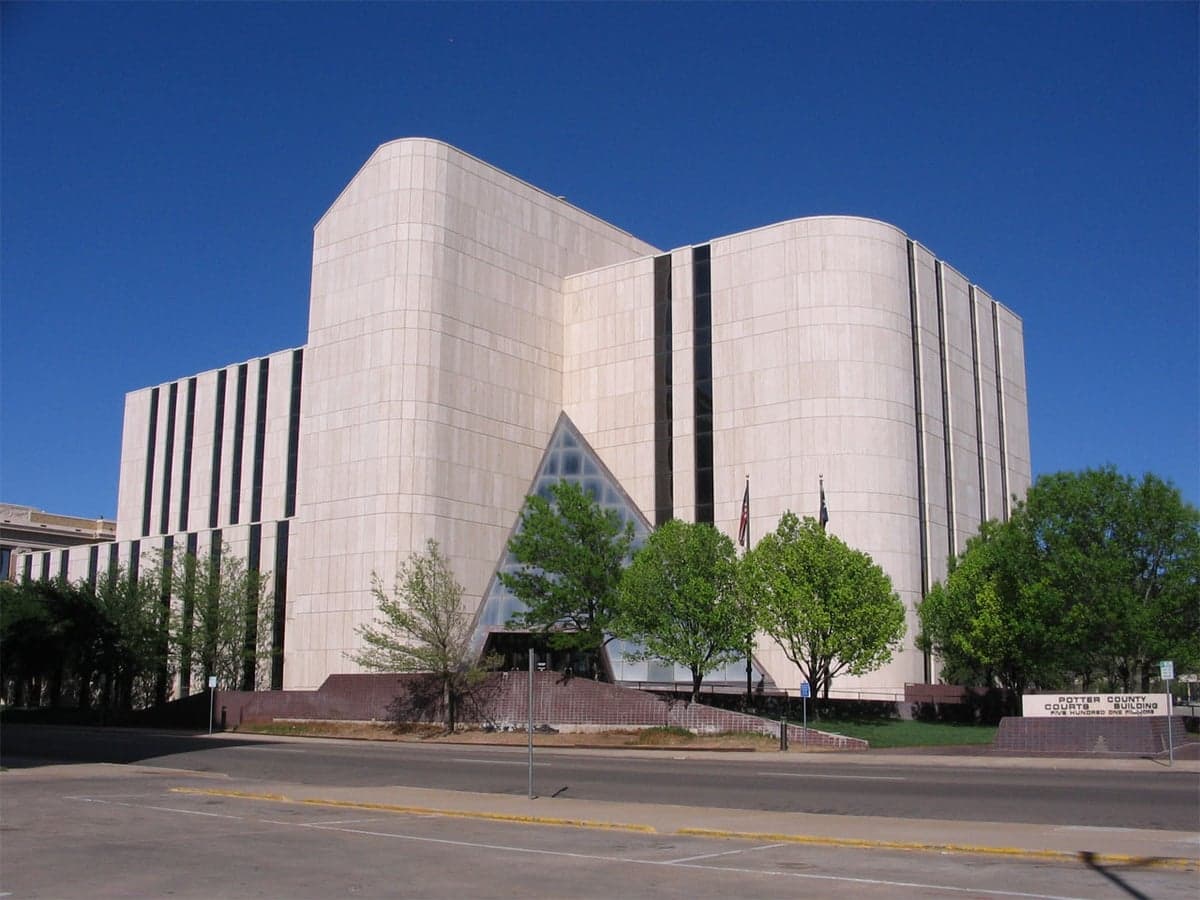
Photo: Wikipedia
Personal Sovereignty in Potter County
Viable for self-reliance. Generally workable, though some barriers may limit total independence.
What does Personal Sovereignty tell us?
Personal Sovereignty measures your capacity for self-reliance and independence with minimal government friction. Higher scores mean fewer barriers between you and the way you want to live... but it assumes you have the space you need and good neighbors.
What does this tell us?
Personal Sovereignty measures your capacity for self-reliance and independence with minimal government friction. Higher scores mean fewer barriers between you and the way you want to live... but it assumes you have the space you need and good neighbors.
State Policy
Energy independence: Net exporter (220% of energy produced in-state)
Personal Liberty
Homesteading

Personal Liberty Analysis
Potter County, anchored by Amarillo in the Texas Panhandle, offers a personal sovereignty environment that stands in stark contrast to the regulatory-heavy corridors of Austin or Dallas. Here, the ethos of self-reliance isn't just a talking point—it's baked into the local culture and legal framework, making it a serious consideration for those prioritizing autonomy over convenience. While no place is a libertarian utopia, the combination of low taxes, permissive gun laws, and a general hands-off government posture creates a foundation where individuals and families can operate with significantly less state interference than in most urban or coastal areas.
Tax burden and regulatory posture in Potter County
Texas has no state income tax, which immediately puts more money back into your pocket for self-directed priorities like land, supplies, or savings. Potter County's property tax rate hovers around 2.3% of assessed value, which is on the higher end for Texas but still manageable compared to states like New York or California. The real advantage is the regulatory climate: there are no county-level building codes outside of Amarillo's city limits, and zoning is minimal in unincorporated areas. For example, in Bishop Hills or Lake Tanglewood, you'll find fewer restrictions on what you can do with your property—no HOA overlords dictating lawn length or paint colors. The county's approach to business licensing is similarly light; a simple registration is often all that's needed for a home-based operation. This contrasts sharply with Amarillo proper, where city ordinances on noise, signage, and land use are more stringent, but even there, the regulatory burden is a fraction of what you'd face in Harris County or Travis County.
Self-defense and gun law specifics in the Panhandle
Texas is a constitutional carry state, meaning no permit is required to carry a handgun openly or concealed for anyone legally allowed to possess a firearm. Potter County's sheriff's office is known for a pro-2A stance, and local law enforcement generally respects the right to self-defense without unnecessary harassment. The county has no additional firearm restrictions beyond state law, so magazine capacity limits, "assault weapon" bans, and waiting periods are nonexistent. In Amarillo, you'll find multiple gun ranges and retailers, and the culture is such that open carry in a holster is a common sight at grocery stores or gas stations. For those concerned with government overreach, this is a critical buffer: the local legal climate treats the firearm as a tool of personal sovereignty, not a privilege to be managed by bureaucrats. Stand-your-ground laws apply fully, and there is no duty to retreat in your home, vehicle, or any place you have a legal right to be. This is a stark difference from states like Colorado or Washington, where magazine bans and red-flag laws have eroded that autonomy.
Self-reliance and homesteading viability in Potter County
If your goal is to reduce dependency on fragile supply chains or government systems, Potter County offers genuine opportunities. Outside of Amarillo's city limits, lot sizes in unincorporated areas can be as small as 1 acre for rural residential zoning, but larger parcels of 5 to 40 acres are common and affordable. In Bushland and Timbercreek Canyon, you'll find properties where off-grid living is feasible: rainwater catchment, solar panels, and septic systems are standard, and the county does not require permits for these installations on private land. Zoning is virtually nonexistent in these areas, so raising chickens, goats, or even a few head of cattle is unrestricted. The climate is semi-arid, so water conservation is a real consideration—but that also means fewer mold issues and lower humidity for food storage. For the prepper mindset, Fritch and Sanford offer proximity to Lake Meredith for water access, though the lake levels fluctuate. The key takeaway: you can buy a few acres, build a modest home, and live largely off-grid without a parade of inspectors or zoning board meetings. This is not possible in most of the country, and it's a major draw for those seeking to insulate themselves from systemic disruptions.
Personal liberties in Potter County: parental rights, medical autonomy, speech, and property
Parental rights are strongly protected in Texas law, and Potter County's school districts—including Amarillo ISD and Highland Park ISD—generally defer to parents on medical decisions, curriculum objections, and disciplinary matters. The state's parental bill of rights gives you legal standing to opt your child out of any instruction you find objectionable, and the county's conservative school boards are unlikely to push back. Medical autonomy is more nuanced: Texas has banned vaccine passports and prohibits mask mandates in schools, but the state's medical board does impose restrictions on alternative treatments. That said, the county's rural nature means fewer enforcement resources, so home-based remedies and supplement use are largely unmonitored. Speech is protected under the First Amendment, and Potter County has no local hate speech ordinances or social media censorship laws—you can express your views without fear of government retaliation. Property rights are robust: eminent domain is rarely used outside of major infrastructure projects, and the county's appraisal district is transparent about valuations. In Claude (technically Armstrong County but adjacent), you'll see the same ethos: neighbors respect boundaries and government stays out of private disputes unless absolutely necessary.
Overall, Potter County ranks among the more sovereignty-friendly areas in Texas, particularly for those willing to live outside Amarillo's city limits. The combination of no income tax, constitutional carry, minimal zoning, and a culture of self-reliance creates an environment where government overreach is the exception, not the rule. Compared to the regulatory thickets of the Pacific Northwest or the Northeast, this is a breath of fresh air—but it's not perfect. Property taxes are a real burden, and the county's reliance on state funding means you're still contributing to a system you may distrust. For the strategic relocator with a prepper or survivalist mindset, the calculus is clear: Potter County offers a high degree of personal sovereignty at a reasonable cost, with enough land and legal latitude to build the autonomous life you're after. Just be prepared for the wind and the cold—nature's sovereignty is the one thing you can't negotiate with.

* Values derived from national, state, county, city and local statistics and may differ in a specific area. Last updated: 2026-05-21T02:27:14.000Z
Narrative content on this page is AI-generated and may contain mistakes. Verify any details that matter before acting on them.
ReloMaps may earn a commission from affiliate links at no extra cost to you.

