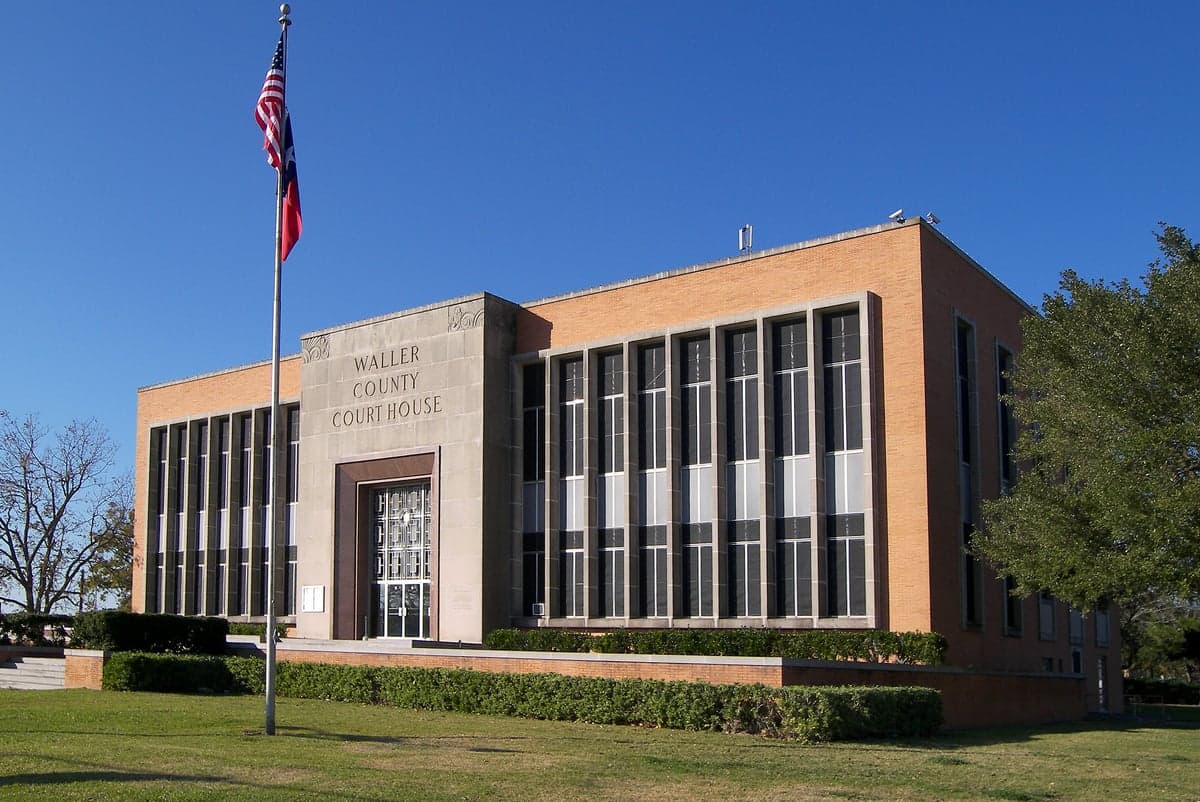
Photo: Wikipedia
Demographics of Waller County
Affluence Level in Waller County
A middle-class area roughly in line with national averages across income, home values, education, and employment.
People of Waller County
Waller County, Texas, is home to 59,455 residents who form a tri-ethnic community where non-Hispanic whites (38.8%), Hispanic or Latino residents (33.0%), and Black or African American residents (23.4%) each represent substantial shares of the population. This demographic balance is unusual for a Texas county and reflects a layered history of plantation-era slavery, post-Civil War freedom colonies, 20th-century agricultural labor migration, and recent suburban expansion from the Houston metro area. The county’s identity is rooted in its rural character, its historically Black communities like Hempstead and Prairie View, and the growing Hispanic presence that now shapes much of its cultural and economic life.
Settlement & growth (pre-1960)
Before Anglo-American settlement, the area that became Waller County was inhabited by the Karankawa and Atakapa peoples, coastal tribes who moved seasonally between the Gulf and inland prairies. Spanish and Mexican authorities claimed the region but established no permanent settlements here; the land was part of the vast Stephen F. Austin colony granted under Mexican rule. The first Anglo settlers arrived in the 1820s and 1830s, primarily from the southern United States, drawn by cheap land grants for cotton cultivation. These settlers brought enslaved African Americans with them, and by 1860, enslaved people made up a majority of the county’s population—a pattern that would shape the county’s demographics for generations.
Waller County was formally created in 1873 from parts of Austin and Grimes counties, named for a Texas Revolution veteran. The county seat, Hempstead, grew as a railroad and cotton-ginning center, while Prairie View emerged as the site of Prairie View A&M University, founded in 1876 as one of Texas’s first public historically Black colleges. After emancipation, freedmen established numerous “freedom colonies” across the county—small, self-sufficient Black farming communities such as Fields Store, Monaville, and Shiloh. These communities persisted through Jim Crow, sustained by land ownership and the anchor of Prairie View A&M. Meanwhile, German and Czech immigrants arrived in smaller numbers in the late 19th century, settling near Brookshire and Pattison, where they farmed cotton and corn.
The early 20th century brought little new immigration to Waller County. The Great Migration saw many Black residents leave for Houston and northern cities, but Prairie View A&M continued to draw Black students and faculty from across the South. The county remained overwhelmingly rural and agricultural through the 1950s, with cotton, cattle, and later rice farming as economic mainstays. The population in 1960 was roughly 12,000, with Black residents forming a plurality and white residents a close second; the Hispanic population was negligible at that time.
Modern era (post-1965)
The post-1965 period transformed Waller County’s demographics primarily through domestic migration and natural increase rather than international immigration. The foreign-born share today is just 7.7%, below the Texas average of about 17%. The most significant change has been the rapid growth of the Hispanic population, which rose from under 5% in 1970 to 33.0% today. This growth came from two sources: Mexican-American families moving outward from Houston’s East End and Harris County in search of affordable rural land, and direct immigration from Mexico and Central America, particularly in the 1990s and 2000s, drawn by agricultural and construction work. Hispanic residents are concentrated in Hempstead and Brookshire, where they now form a majority or near-majority in many neighborhoods, and in unincorporated areas along the U.S. 290 corridor.
The Black population share has declined from its historic highs—from roughly 50% in 1960 to 23.4% today—as younger Black residents have moved to Houston and other urban centers for employment. However, Prairie View remains a vital Black community anchor, and the university continues to draw Black students from across Texas. The white population share has also fallen, from over 50% in 1960 to 38.8% today, as suburban development has brought a more diverse mix of residents. The Asian population is very small at 1.4% (East/Southeast Asian) and 0.3% (Indian subcontinent), concentrated in newer subdivisions near Fulshear and the far eastern edge of the county bordering Fort Bend County.
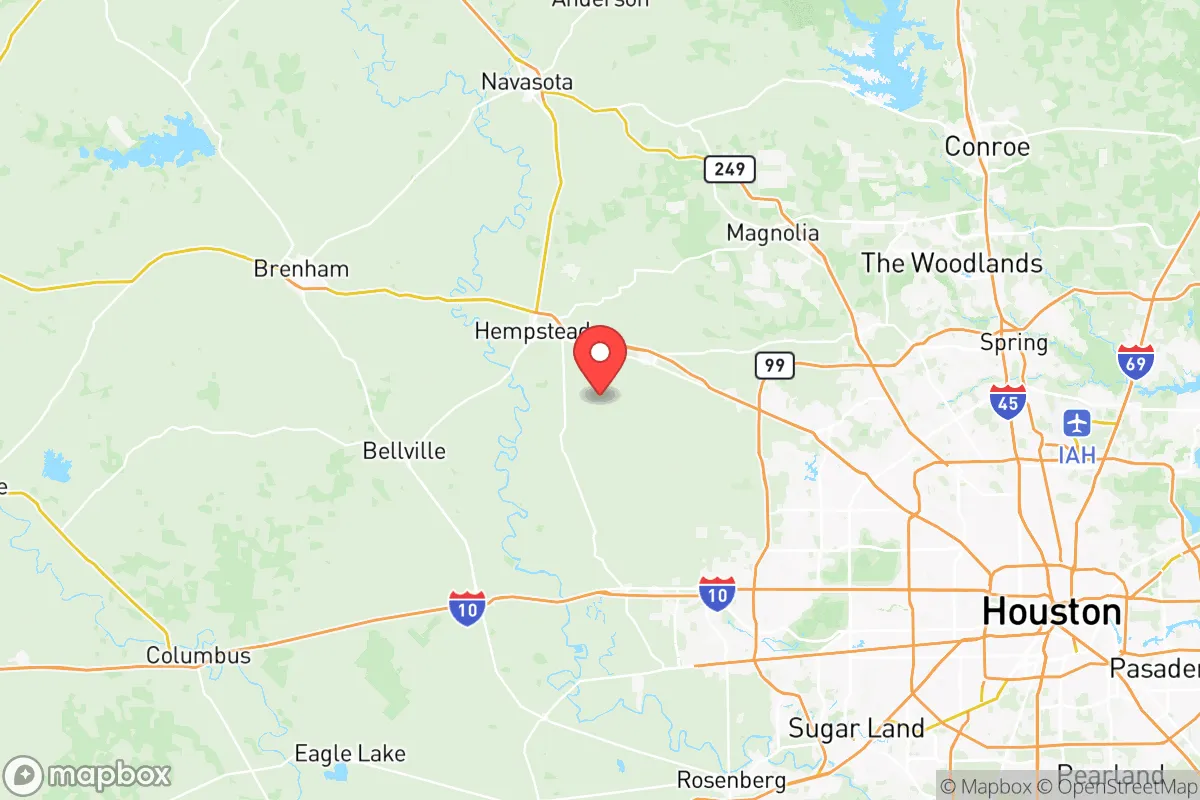
Suburbanization has been the dominant force since 2000. Waller County sits at the western fringe of the Houston metropolitan area, and the completion of the Grand Parkway (State Highway 99) has accelerated commuter development. Fulshear, technically in Fort Bend County but adjacent to Waller County, has seen explosive growth that spills over into Waller County’s eastern precincts. New master-planned communities are attracting families from Houston and other parts of Texas, drawn by lower home prices and larger lots. This influx is gradually raising the county’s college-educated share to 26.6%, though this remains below the national average.
The future
Waller County is becoming more diverse in absolute terms but less so in the sense of a single dominant group. The Hispanic population is projected to continue growing, potentially reaching 40-45% by 2040, driven by both natural increase and continued migration from the Houston area. The Black population share is likely to stabilize or decline slightly, as Prairie View A&M remains a draw but outmigration to urban centers continues. The white population share will probably continue to fall as new residents are disproportionately Hispanic and, to a lesser extent, Asian. The Asian population, while small, is likely to grow as Houston’s Asian communities expand westward along the U.S. 290 corridor, with Brookshire and Hempstead seeing new Asian-owned businesses and residential enclaves.
The county’s cultural identity is evolving from a historically Black-white rural dynamic to a tri-ethnic suburban-rural hybrid. The growing Hispanic presence is reshaping local politics, with Hispanic candidates winning seats on city councils and school boards in Hempstead and Brookshire. The county remains politically conservative—Waller County voted +23 for Donald Trump in 2024—but the Hispanic vote is more competitive than in many rural Texas counties. New subdivisions near Fulshear and along the Grand Parkway are attracting younger, more educated families who may shift the county’s politics toward the center over time.
For someone moving in now, Waller County offers a mix of rural affordability and suburban convenience, with a population that is genuinely multi-ethnic rather than predominantly one group. The county’s schools, particularly in the Royal and Hempstead districts, are becoming more diverse and are adapting to serve a student body that is roughly one-third Hispanic, one-third Black, and one-third white. The next decade will likely see continued population growth, more retail and commercial development along U.S. 290, and a gradual blurring of the line between Waller County’s small towns and Houston’s suburban sprawl.

* Values derived from national, state, county, city and local statistics and may differ in a specific area. Last updated: 2026-08-08T14:26:24.000Z
Narrative content on this page is AI-generated and may contain mistakes. Verify any details that matter before acting on them.
ReloMaps may earn a commission from affiliate links at no extra cost to you.

