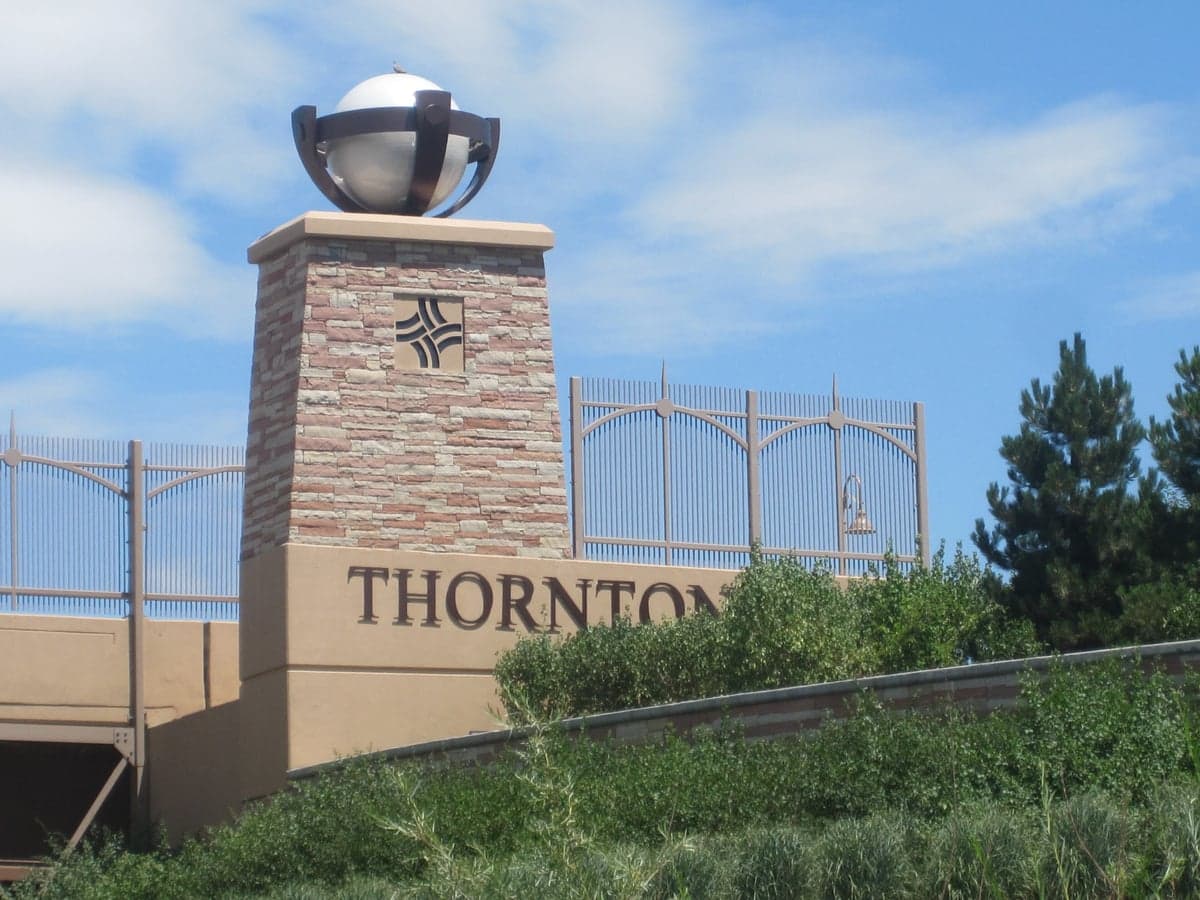
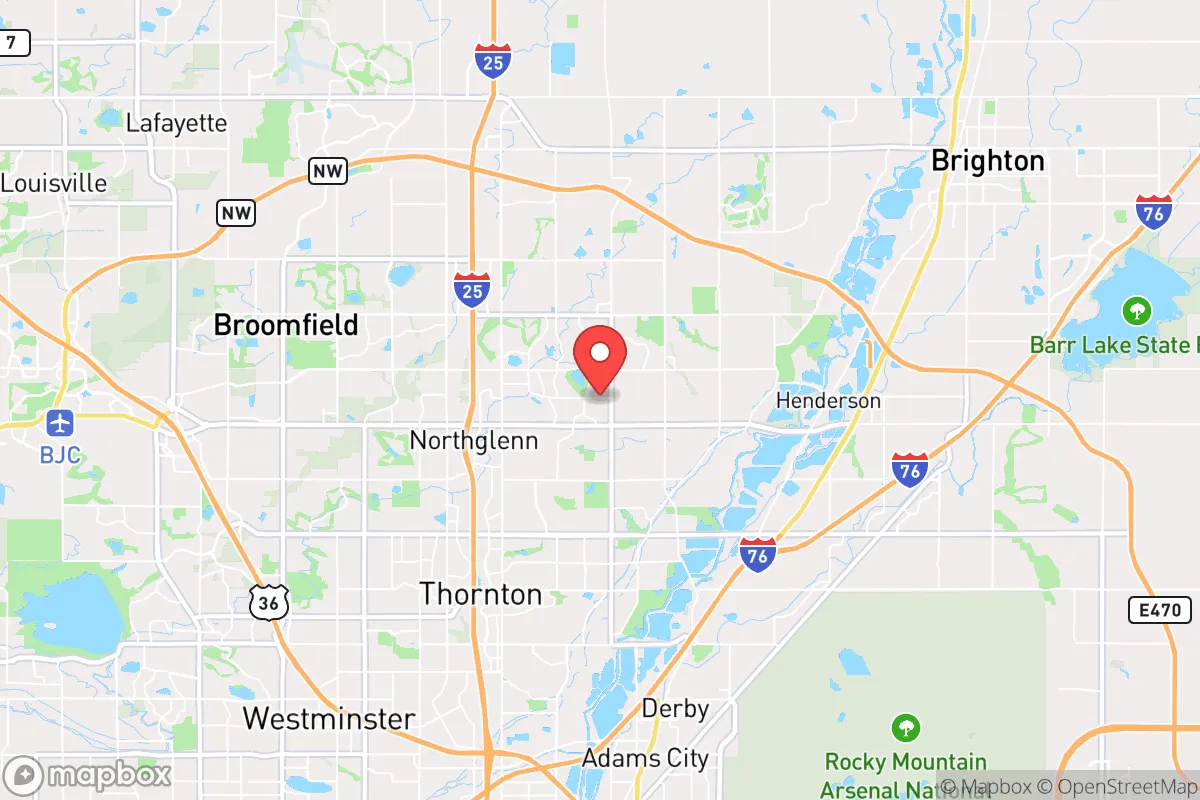
Photo: Wikipedia
Demographics of Thornton, CO
Affluence Level in Thornton, CO
An upper-middle-class area. Household wealth, education levels, and homeownership run ahead of national benchmarks.
People of Thornton, CO
Thornton, Colorado, is a rapidly maturing suburb of Denver where a white-plurality population (50.4%) coexists with a large Hispanic community (37.4%) and smaller but growing East/Southeast Asian (4.7%) and Indian-subcontinent (1.0%) enclaves. With 142,878 residents, it is one of Colorado’s largest cities by population, yet it retains a middle-class, family-oriented character distinct from the denser urban core. The city’s identity is shaped by its post-1960s boom as a bedroom community for Denver and the northern Front Range, with a foreign-born share of 9.2% that is lower than the national average, indicating a population that is largely native-born and rooted in multi-generational Colorado families.
How the city was settled and grew
Thornton was incorporated in 1956, making it a purely post-war suburb with no pioneer-era founding. The land was originally part of the South Platte River valley, used for dryland farming and ranching by families of European descent, primarily German and Scandinavian homesteaders. The city’s namesake, former Colorado Lieutenant Governor Dan Thornton, championed the development of affordable housing for returning World War II veterans and their families. The first major wave of residents were white, middle-class families moving from Denver’s aging neighborhoods, drawn by cheap land and new construction. The original core of the city, now known as Original Thornton (bounded roughly by 88th and 104th Avenues, between Washington and York Streets), was built out in the 1960s and 1970s with modest ranch-style homes and small-lot subdivisions. These neighborhoods remain predominantly white and older, with a high share of long-term residents who have seen the city transform around them.
Modern era (post-1965)
The 1965 Hart-Cellar Act opened immigration from Latin America and Asia, but Thornton’s Hispanic growth accelerated later, in the 1980s and 1990s, as Denver’s expanding Latino population sought affordable housing north of the city. The Lakeshore and Riverdale neighborhoods, near the South Platte River and the Adams County line, became early anchors for Hispanic families, many of whom worked in construction, landscaping, and service industries. By 2000, Thornton’s Hispanic share had risen to roughly 20%, and it has since climbed to 37.4%, driven by both domestic migration from other Colorado cities and some foreign-born arrivals from Mexico and Central America. The East/Southeast Asian community (4.7%) is a more recent phenomenon, concentrated in the newer subdivisions of Hunters Glen and Thorncreek, built in the 1990s and 2000s. These neighborhoods, with larger homes and better schools, attracted Vietnamese, Korean, and Chinese families who were already established in the Denver metro area and sought suburban space. The Indian-subcontinent population (1.0%) is smaller but visible in the same areas, often working in Denver’s tech and healthcare sectors. The Black population (1.9%) remains very small, reflecting Thornton’s historical lack of a significant African American community, though it has grown slightly from near-zero in the 1990s.
The future
Thornton’s population is projected to continue growing, potentially reaching 170,000 by 2035, driven by annexation of remaining agricultural land to the north and east. The city is not homogenizing; rather, it is tribalizing into distinct enclaves along income and ethnicity lines. The older, white-majority neighborhoods like Original Thornton are aging in place, with younger white families increasingly choosing newer suburbs farther north (e.g., Firestone, Frederick). The Hispanic population is spreading from Lakeshore and Riverdale into the Eastlake area, where new townhome developments are attracting first-time homebuyers. The East/Southeast Asian and Indian communities are likely to plateau or grow slowly, as Thornton competes with Aurora and Broomfield for these higher-income groups. The foreign-born share (9.2%) is below the Colorado average (10.5%) and is not expected to rise sharply, as most growth will come from domestic migration within Colorado. The city’s college-educated rate (32.2%) is below the state average (42%), reflecting its blue-collar and service-sector base, but new mixed-use developments near the Thornton Town Center (at 88th and Colorado Boulevard) are attracting some college-educated professionals priced out of Denver.
For a conservative-leaning individual or family moving to Thornton now, the city offers a stable, middle-class environment with a strong sense of local identity, but it is not a place of rapid demographic change. The white-plurality majority and large Hispanic population create a culturally conservative, family-focused atmosphere, with low crime rates relative to Denver and a strong network of parks and recreation. The key decision is neighborhood: Original Thornton for established, older homes and a quiet, settled feel; Hunters Glen or Thorncreek for newer construction and better schools; or Lakeshore for more affordable entry points with a growing Hispanic community. Thornton is becoming a mature, self-contained suburb where the population is settling into stable, distinct enclaves rather than blending into a single melting pot.

* Values derived from national, state, county, city and local statistics and may differ in a specific area. Last updated: 2026-05-02T12:31:51.000Z
Narrative content on this page is AI-generated and may contain mistakes. Verify any details that matter before acting on them.
ReloMaps may earn a commission from affiliate links at no extra cost to you.

