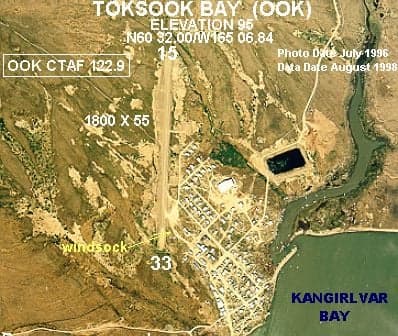
Photo: Wikipedia
Personal Sovereignty in Toksook Bay, AK
Strong independent fundamentals that actively favor personal liberty and low regulation.
What does Personal Sovereignty tell us?
Personal Sovereignty measures your capacity for self-reliance and independence with minimal government friction. Higher scores mean fewer barriers between you and the way you want to live... but it assumes you have the space you need and good neighbors.
What does this tell us?
Personal Sovereignty measures your capacity for self-reliance and independence with minimal government friction. Higher scores mean fewer barriers between you and the way you want to live... but it assumes you have the space you need and good neighbors.
State Policy
Energy independence: Net exporter (350% of energy produced in-state)
Personal Liberty
Homesteading

Personal Liberty Analysis
Toksook Bay, Alaska, offers a level of personal sovereignty that is increasingly rare in the Lower 48, but it comes with a unique set of trade-offs that demand serious consideration. For the survivalist or prepper, this remote Yup'ik village on Nelson Island represents a near-total departure from the regulatory density and surveillance culture of urban America. However, the autonomy you gain from the federal and state apparatus is balanced by a dependence on subsistence living, a harsh climate, and the realities of life within a tribal community where local governance and social norms can be just as binding as any statute. The question isn't whether you can be free here—it's whether you can handle the kind of freedom that requires you to be your own infrastructure, your own law enforcement, and your own supply chain.
Tax burden and regulatory posture in a remote Alaskan village
Alaska's state-level posture is a major draw for those seeking to minimize government overreach. There is no state income tax and no state sales tax, a fact that immediately puts Toksook Bay ahead of nearly every jurisdiction in the Lower 48. The state's Permanent Fund Dividend, while not a tax break per se, effectively returns a portion of resource wealth to residents, a model that respects individual property rights. However, the regulatory picture is more complex. Toksook Bay is a federally recognized tribe, the Nunakauyarmiut Tribe, and the land is largely held in trust by the federal government through the Bureau of Indian Affairs (BIA) and the Alaska Native Claims Settlement Act (ANCSA) village corporation, Qanirtuuq Incorporated. This means you cannot simply buy land and build; property is typically leased from the corporation or the tribe, and zoning is controlled by local tribal councils and the BIA. For a prepper wanting to own a freehold outright, this is a significant limitation. Building codes are minimal compared to the Lower 48, but you will still need permits from the tribal government and likely the Alaska Department of Environmental Conservation for any septic or water systems. The regulatory burden is low by national standards, but the lack of private property ownership is a sovereignty trade-off that cannot be ignored.
Self-defense and gun law specifics in a remote Alaskan village
Alaska is one of the most gun-friendly states in the union, and that ethos extends to Toksook Bay. There is no permit required to purchase a rifle, shotgun, or handgun, and no state-level registration. Constitutional carry is fully in effect—you can carry a concealed firearm without a permit. This is a bedrock of personal sovereignty for anyone concerned with self-defense in a remote area where police response times can be measured in hours, if not days. The Alaska State Troopers are the primary law enforcement, but their nearest post is in Bethel, a 100-mile flight or a multi-day boat ride away. In practice, you are your own first responder. However, there are practical constraints. Ammunition is expensive and must be flown in or brought by barge. The village has a local tribal council that may impose restrictions on firearms within the community, though these are rarely enforced against residents. More importantly, the environment is brutal on gear—saltwater, extreme cold, and moisture will destroy a firearm quickly if not meticulously maintained. For the prepper, this is a place where your right to bear arms is nearly absolute, but your ability to exercise that right depends entirely on your logistical preparedness.
Self-reliance and homesteading viability in Toksook Bay
Toksook Bay is a subsistence-based economy, and that is the core of its appeal for the self-reliant. The Yup'ik people have lived here for millennia without modern infrastructure, and the skills required—hunting seal, fishing for salmon and whitefish, gathering berries, and processing game—are still practiced daily. For a newcomer, the learning curve is steep, but the opportunity to live off the land is genuine. Lot sizes are not a typical concern because there is no conventional real estate market. Housing is allocated through the tribal corporation or the Alaska Housing Finance Corporation, and most homes are small, government-subsidized units. Off-grid feasibility is high by necessity: there is no road connection to the rest of Alaska. Electricity comes from diesel generators run by the local utility, and fuel prices are among the highest in the nation. Solar is marginal due to long winter nights, but wind power has potential. Water is often collected from rain or melted ice, and sewage is typically handled by honey buckets—a reality that tests even the most committed prepper. For those willing to adapt, the ability to live largely outside the cash economy and the federal regulatory framework is real. But this is not homesteading in the Lower 48 sense; it is a communal subsistence lifestyle that requires integration into the local culture and acceptance of its norms.
Personal liberties: parental rights, medical autonomy, speech, and property
Parental rights in Toksook Bay are strong by default, simply because the state has limited reach. The local school is run by the Lower Kuskokwim School District, but homeschooling is a practical option given the remote setting, and the state has minimal oversight for independent homeschoolers. Medical autonomy is a double-edged sword. There is a small clinic staffed by community health aides, but for any serious medical issue, you must be medevaced to Bethel or Anchorage. This means you have near-total freedom from government medical mandates in daily life—no one is checking vaccination records or enforcing mask mandates in a village of 600 people. However, that freedom comes with the risk that if you or your child gets seriously ill, you are entirely dependent on a system that may take hours to respond. Free speech is protected by the Alaska Constitution, and in practice, there is little government censorship. However, the social fabric of a small, tight-knit Yup'ik village means that what you say can have immediate social consequences. Property rights, as noted, are the weakest link. You cannot own the land under your feet in fee simple; it is held in trust or by the corporation. This is a fundamental limitation for anyone who believes that true sovereignty begins with owning the dirt you stand on.
In the final analysis, Toksook Bay offers a form of personal sovereignty that is rare in modern America: low taxes, minimal government presence, and a culture of self-reliance that is not a lifestyle choice but a survival necessity. For the prepper or conservative seeking to escape the regulatory state, it is a compelling option. But the trade-offs are severe—no private land ownership, extreme isolation, a communal governance structure that may feel restrictive, and a climate that will test every piece of gear and every ounce of resolve. Compared to a rural county in Idaho or Montana, where you can buy 40 acres outright and build a bunker, Toksook Bay is a different kind of freedom: one that requires you to surrender the concept of private property in exchange for near-total absence of government oversight. It is not for everyone, but for those who can adapt, it is one of the last places in the United States where the state truly leaves you alone.

* Values derived from national, state, county, city and local statistics and may differ in a specific area. Last updated: 2026-04-19T19:39:04.000Z
Narrative content on this page is AI-generated and may contain mistakes. Verify any details that matter before acting on them.
ReloMaps may earn a commission from affiliate links at no extra cost to you.

