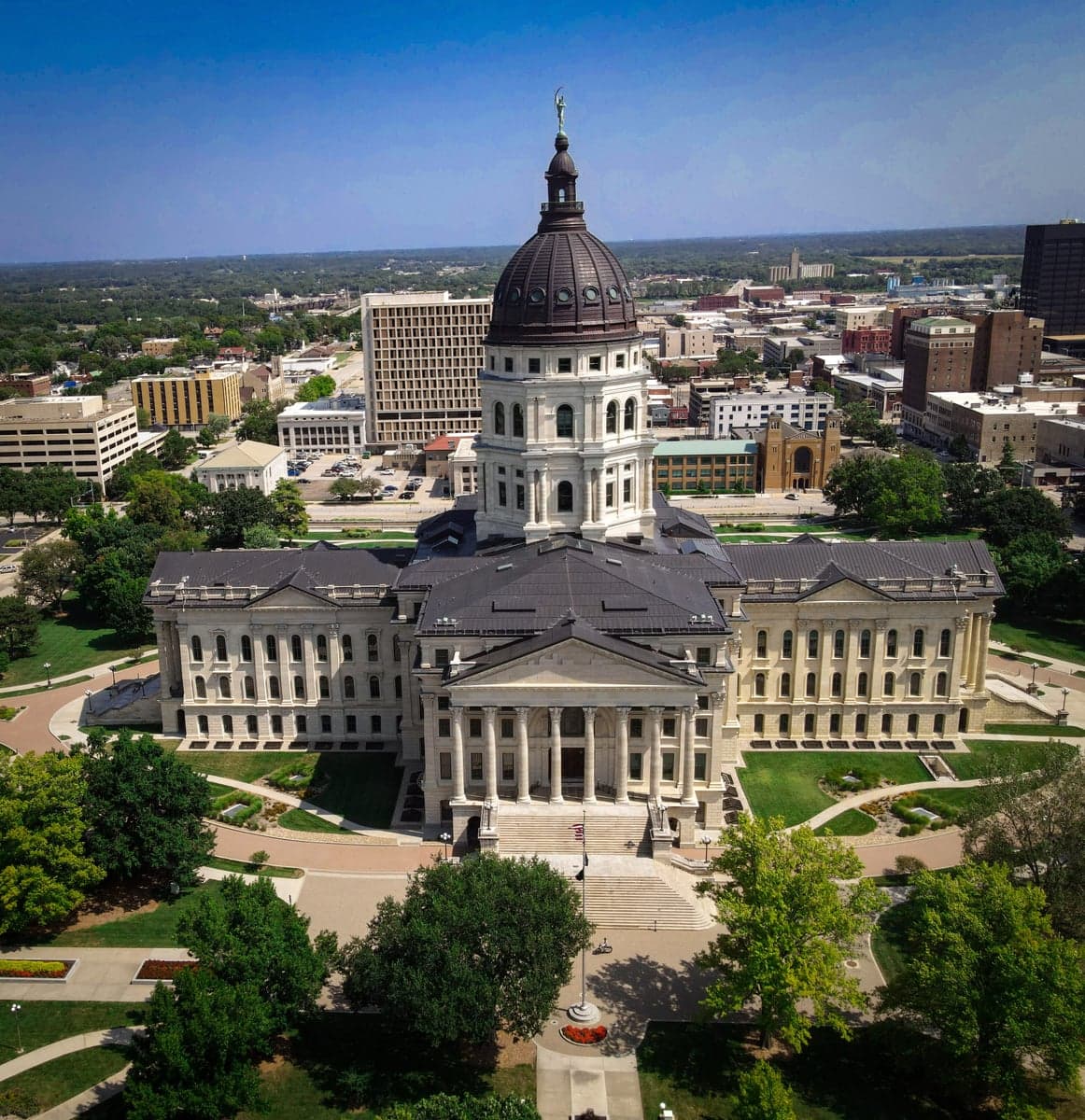
Photo: Wikipedia
Demographics of Topeka, KS
Affluence Level in Topeka, KS
A below-average socioeconomic profile. Incomes, home values, and educational attainment trail the U.S., with higher poverty and unemployment.
People of Topeka, KS
Topeka, Kansas, is home to 126,103 residents, a population that is 65.6% White, 16.9% Hispanic, 9.3% Black, and 1.0% East/Southeast Asian, with a small Indian subcontinent community at 0.7% and a foreign-born rate of just 3.4%. The city’s character is shaped by its role as the state capital and a government employment hub, giving it a stable, middle-class, and politically moderate-to-conservative identity compared to Kansas City. Distinctive markers include a strong sense of place rooted in the Civil Rights movement and the Brown v. Board of Education legacy, alongside a population that is older and less transient than the national average. Only 29.1% of adults hold a bachelor’s degree, reflecting a workforce oriented toward state government, healthcare, and education rather than high-tech or finance.
How the city was settled and grew
Topeka was founded in 1854 by the New England Emigrant Aid Company, which sent anti-slavery settlers from Massachusetts, Connecticut, and Vermont to ensure Kansas would enter the Union as a free state. These original settlers—largely Yankee Protestants—established the city’s early character in neighborhoods like Potwin Place, a historic district of Victorian homes built by merchants and railroad officials, and Central Park, where the city’s first churches and schools clustered. The arrival of the Atchison, Topeka and Santa Fe Railway in the 1870s drew a second wave: German and Irish immigrants who settled in North Topeka, working in the railroad yards and meatpacking plants. A third wave came during the Great Migration (1910–1940), when Black families from Missouri, Arkansas, and Oklahoma moved to Tennessee Town and East Topeka, drawn by railroad jobs and the promise of less segregation than in the Deep South. These neighborhoods remain the historic heart of Topeka’s Black community, anchored by churches like St. John African Methodist Episcopal and the Brown v. Board of Education National Historic Site at Monroe Elementary.
Modern era (post-1965)
After the 1965 Immigration and Nationality Act, Topeka saw only modest foreign-born growth, unlike larger Kansas cities. The Hispanic population began rising in the 1970s, primarily Mexican immigrants and Tejano families moving from Texas for agricultural and meatpacking work. They concentrated in Oakland, a working-class neighborhood south of downtown, and along the Kansas Avenue corridor, where tiendas and taquerias now anchor a small but visible Latino commercial district. The East/Southeast Asian community (1.0%) arrived later, mostly Vietnamese and Filipino refugees and professionals in the 1980s and 1990s, settling in southwest Topeka near the Washburn University campus and the VA hospital. The Indian subcontinent community (0.7%) is even smaller, composed largely of doctors and engineers at Stormont Vail Health and the University of Kansas Medical Center, living in newer subdivisions like Shawnee Heights. Suburbanization after 1970 pulled White families to west Topeka and the Huntoon Road corridor, leaving East Topeka and Tennessee Town with higher poverty rates and aging housing stock. The Black population share has declined from 12% in 1990 to 9.3% today, as younger Black residents move to Kansas City or Atlanta for better job markets.
The future
Topeka’s population is slowly homogenizing by race but tribalizing by income and geography. The Hispanic share is the only growing minority group, projected to reach 20–22% by 2040, driven by natural increase and continued migration from Texas and Mexico. The White population is aging and declining slightly, while the Black share is plateauing. The East/Southeast Asian and Indian communities are too small to shift the overall demographic profile and are likely to remain stable, with second-generation professionals assimilating into west-side suburbs. The city is not becoming a major immigrant destination—the foreign-born rate of 3.4% is less than half the national average—so the future is one of slow, incremental change rather than rapid diversification. The biggest demographic story is the hollowing out of East Topeka and Tennessee Town, where population loss and disinvestment continue, while west Topeka and Shawnee County suburbs absorb most new housing construction. For a conservative-leaning mover, Topeka offers a stable, low-cost, and politically moderate environment where government employment anchors the economy and the population is unlikely to see dramatic cultural shifts in the next decade.
Bottom-line: Topeka is becoming a more Hispanic, more suburban, and slightly older city, with the White majority shrinking gradually and Black residents leaving for larger metros. The city’s future is one of modest demographic churn rather than transformation—a place where the population is stable enough to preserve its character, but where newcomers should expect the most growth and change in the Hispanic and west-side communities. For someone moving in now, the key choice is between the historic, walkable neighborhoods of central Topeka and the newer, car-dependent subdivisions of the west side, each with a distinct social and demographic profile.

* Values derived from national, state, county, city and local statistics and may differ in a specific area. Last updated: 2026-04-29T21:10:22.000Z
Narrative content on this page is AI-generated and may contain mistakes. Verify any details that matter before acting on them.
ReloMaps may earn a commission from affiliate links at no extra cost to you.

