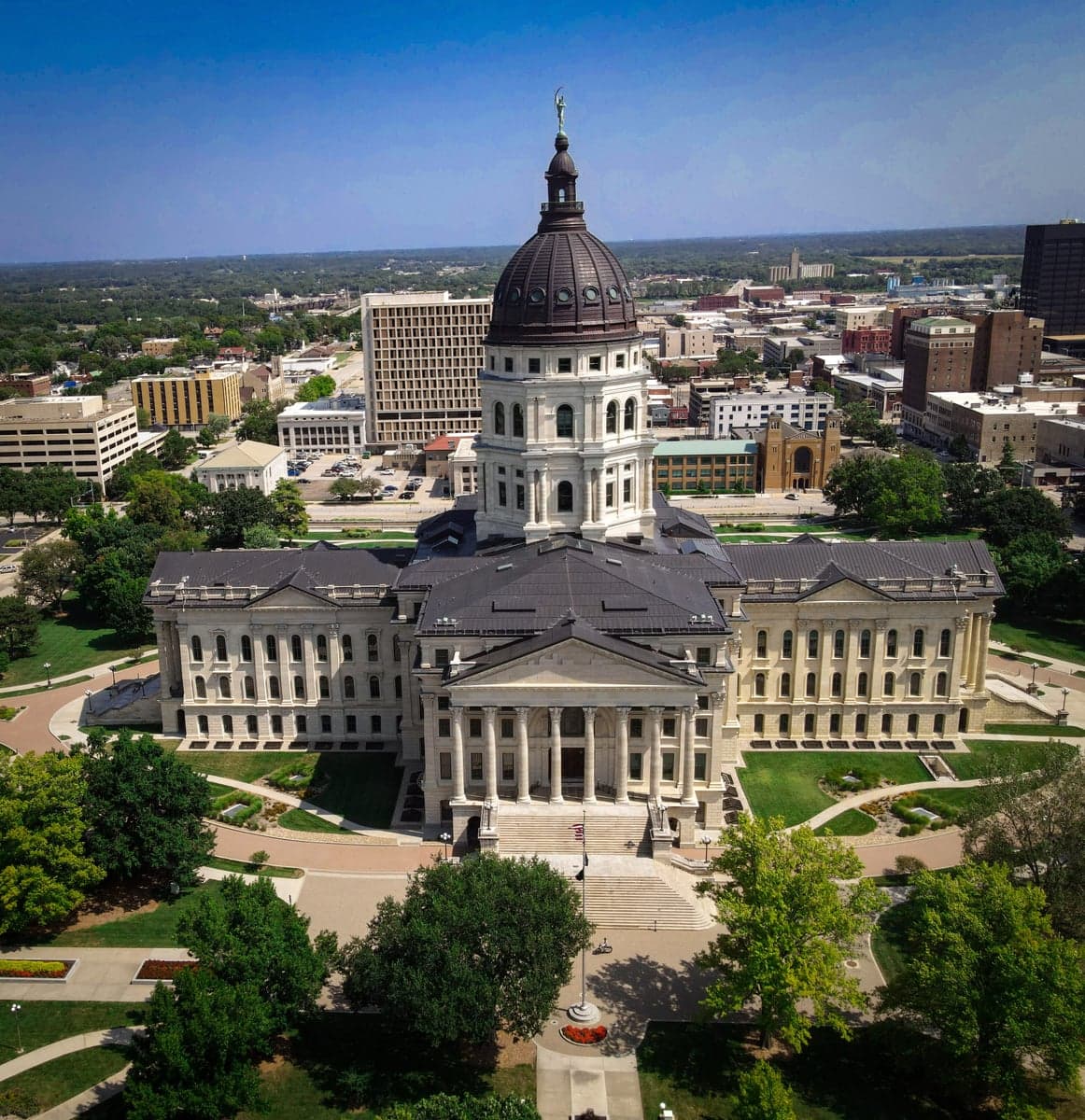
Photo: Wikipedia
Personal Sovereignty in Topeka, KS
Viable for self-reliance. Generally workable, though some barriers may limit total independence.
What does Personal Sovereignty tell us?
Personal Sovereignty measures your capacity for self-reliance and independence with minimal government friction. Higher scores mean fewer barriers between you and the way you want to live... but it assumes you have the space you need and good neighbors.
What does this tell us?
Personal Sovereignty measures your capacity for self-reliance and independence with minimal government friction. Higher scores mean fewer barriers between you and the way you want to live... but it assumes you have the space you need and good neighbors.
State Policy
Energy independence: Self-sufficient (80% of energy produced in-state)
Personal Liberty
Homesteading

Personal Liberty Analysis
For the individual or family who values personal sovereignty above all else—who sees government overreach as the primary threat to liberty—Topeka, Kansas, offers a surprisingly resilient environment within a state that has largely resisted the most aggressive trends in federal and coastal-state overreach. While no location is a fortress against national-level erosion of rights, the capital of Kansas sits in a state with a constitutional carry law, a relatively low tax burden, and a political culture that still pays lip service to local control. The question for the strategic relocator is whether this translates into real, defensible autonomy on the ground, or merely a veneer of freedom that can be stripped away with a single legislative session. The answer, as of 2026, leans toward the former, but with critical caveats regarding the city's own municipal impulses and the long-term trajectory of state-level governance.
Tax burden and regulatory posture for the self-reliant individual
Kansas maintains a state income tax with a top marginal rate of 5.7%, which is moderate by national standards but notably higher than neighboring states like Texas or Oklahoma. However, the state's property tax burden is a more significant factor for the landowner. The average effective property tax rate in Shawnee County (which contains Topeka) hovers around 1.3% of assessed value—higher than the national average but not crippling for a homesteader who owns their land outright. The real advantage lies in the regulatory posture. Kansas is a right-to-work state, meaning no forced union membership, and it has no statewide building code for single-family homes in unincorporated areas, though Topeka itself enforces the International Residential Code. For the prepper seeking to build a self-sufficient compound, the key is to look outside city limits, where zoning restrictions are far looser and the county's regulatory appetite is minimal. The state's sales tax on groceries was fully repealed in 2025, a small but meaningful nod to reducing the tax burden on daily subsistence. For the individual who values keeping more of what they earn, Kansas is not a tax haven, but it is a state where a determined person can legally minimize their footprint through proper land use and business structuring.
Self-defense and gun law specifics for the armed citizen
Kansas is a constitutional carry state, meaning no permit is required to carry a concealed firearm for any law-abiding adult 21 or older. This is the bedrock of personal sovereignty for the survivalist mindset. There is no state-level waiting period, no universal background check system beyond the federal NICS check, and no ban on standard-capacity magazines or commonly owned semi-automatic rifles. Topeka itself has not enacted any local gun control ordinances that exceed state law, a critical point given that many cities in blue states have used home rule to effectively nullify state preemption. The state preemption statute is strong, explicitly prohibiting cities from regulating the carrying, possession, or transfer of firearms. For the armed citizen, this means that moving to Topeka does not require navigating a patchwork of local restrictions. However, the practical reality of self-defense in an urban environment must be considered: Topeka's violent crime rate is above the national average, particularly in certain neighborhoods. This is not a reason to avoid the area, but it underscores the necessity of being prepared. The legal framework supports the individual's right to defend themselves, but the social environment demands that one actually exercise that right with situational awareness and training.
Self-reliance and homesteading viability: lot sizes, zoning, and off-grid feasibility
For the individual or family seeking to reduce dependence on centralized systems, the viability of homesteading within Topeka proper is limited but not impossible. Standard residential lots within the city are typically one-quarter acre or smaller, and city zoning codes require connection to municipal water and sewer in most areas. True off-grid living—with solar panels, rainwater catchment, and composting toilets—is effectively prohibited within city limits due to building codes and health regulations. The strategic move is to look at the unincorporated areas of Shawnee County, or neighboring counties like Osage or Wabaunsee, where lot sizes of five to forty acres are common and affordable. In these areas, there are no county-level restrictions on alternative energy systems, and well water and septic systems are the norm. The cost of land is a major advantage: raw acreage in the Topeka periphery can be found for $3,000 to $8,000 per acre, a fraction of the cost in the Front Range or the Pacific Northwest. For the prepper who wants to build a defensible, self-sufficient property, the land is available, the regulatory barriers are low, and the local culture is generally accepting of independent living. The trade-off is proximity to resources: a forty-acre homestead thirty minutes from Topeka means a drive for groceries, medical care, and hardware supplies, but for those serious about autonomy, that distance is a feature, not a bug.
Personal liberties: parental rights, medical autonomy, speech, and property
Kansas has been a battleground for parental rights in education, with recent legislation affirming parents' ability to review curriculum and opt their children out of objectionable material. The state does not have a broad medical freedom law akin to Montana or Idaho, but it has not imposed vaccine mandates for adults or children beyond federal requirements for school attendance. The COVID-era emergency orders were relatively short-lived compared to blue states, and the political climate in Topeka is such that any future public health overreach would face immediate legislative pushback. On free speech, Kansas has no state-level hate speech laws that criminalize protected expression, and the state's courts have generally upheld First Amendment protections. Property rights are strong: Kansas is a "Dillon's Rule" state, meaning local governments only have powers expressly granted by the state, which limits the ability of Topeka's city council to impose onerous land-use restrictions without state authorization. The most significant threat to personal sovereignty in Kansas is the potential for federal preemption on issues like firearms or environmental regulation, but that is a national problem, not a local one. For the individual who values the right to make medical decisions for themselves and their children, to speak freely without fear of government sanction, and to use their property as they see fit, Topeka's legal environment is far more permissive than the majority of the country.
In the final analysis, Topeka offers a solid foundation for personal sovereignty relative to the rest of the United States, but it is not a libertarian paradise. The state's income tax is a persistent drain, the city's crime rate demands vigilance, and the long-term political trajectory of Kansas is uncertain as demographic shifts and federal pressures mount. However, for the survivalist or prepper who is willing to locate outside city limits, invest in land, and engage in the local political process to defend existing liberties, Topeka represents a viable base of operations. It is a place where the legal framework still largely respects the individual's right to be left alone, and where the cost of entry—both in land and in regulatory compliance—is low enough that a determined person can build a life of genuine self-reliance. The key is to act now, while the window of relative freedom remains open, and to understand that sovereignty is not a gift from the state but a condition that must be actively maintained.

* Values derived from national, state, county, city and local statistics and may differ in a specific area. Last updated: 2026-04-29T21:10:22.000Z
Narrative content on this page is AI-generated and may contain mistakes. Verify any details that matter before acting on them.
ReloMaps may earn a commission from affiliate links at no extra cost to you.

