Photo: Wikipedia
Demographics of Trinidad, CO
Affluence Level in Trinidad, CO
A below-average socioeconomic profile. Incomes, home values, and educational attainment trail the U.S., with higher poverty and unemployment.
People of Trinidad, CO
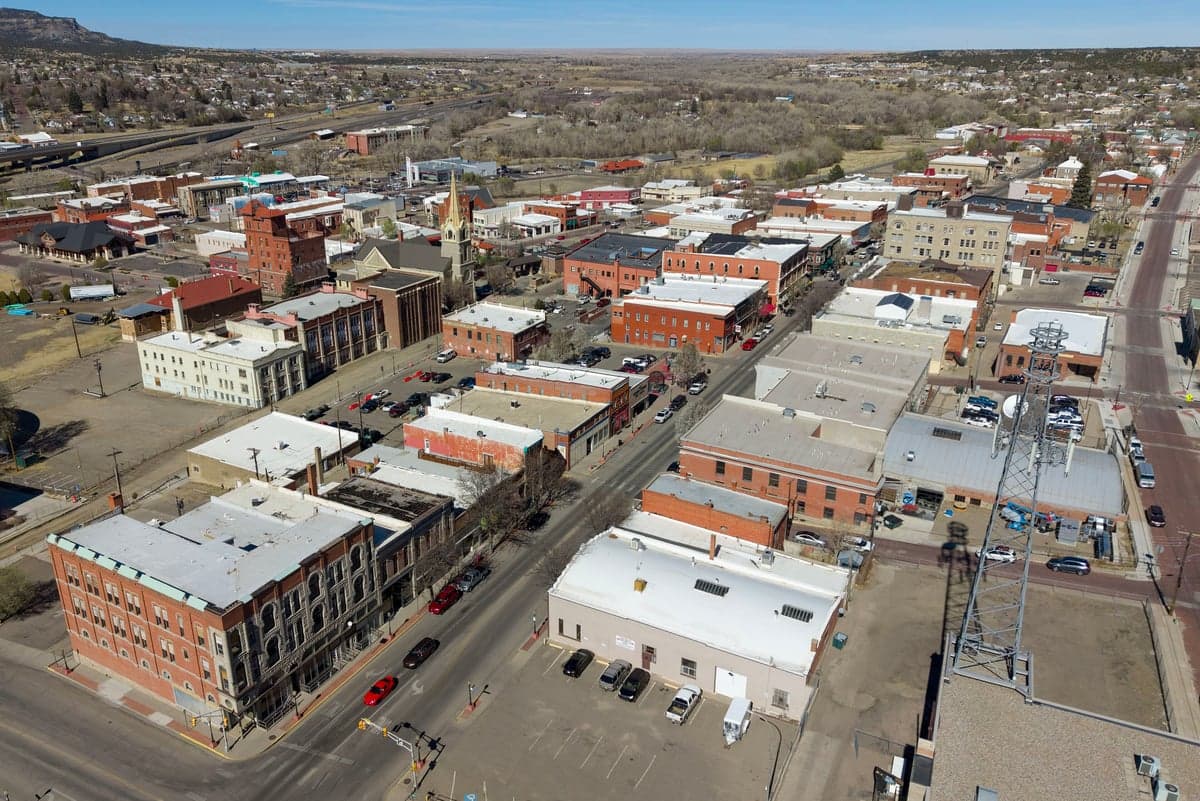
The people of Trinidad, Colorado today form a compact, binational community of roughly 8,300 residents, split almost evenly between white (49.7%) and Hispanic (44.7%) populations, with very small Asian (1.4%), Indian subcontinent (0.6%), and Black (0.8%) minorities. The city’s character is shaped by its history as a coal-mining and railroad hub, a legacy that created a working-class, Catholic-influenced culture with deep roots in both Anglo-American and Hispano-Mexican traditions. Only 15.9% of adults hold a college degree, reflecting a blue-collar economic base, while the foreign-born share sits at just 2.2% — well below the national average — indicating a population that is overwhelmingly native-born and long-settled. Distinctive identity markers include a strong sense of local pride in the city’s Victorian architecture, its role as the “City of Champions” (for its high school sports legacy), and a quiet, self-reliant ethos common to small Colorado towns.
How the city was settled and grew
Trinidad was founded in 1862 as a trading post on the Santa Fe Trail, but its first major population wave came with the arrival of the Atchison, Topeka and Santa Fe Railway in the late 1870s. The railroad brought Anglo-American merchants, engineers, and laborers, who built the Commercial Street corridor and the brick Victorian homes that still line Main Street. Simultaneously, the discovery of coal in the surrounding Raton Basin drew thousands of immigrants — first Irish and Italian miners, then, after 1900, large numbers of Mexican and Hispano workers from southern Colorado and northern New Mexico. These families settled in the North Side neighborhood, near the mines and rail yards, creating a tight-knit, Spanish-speaking enclave that remains the heart of Trinidad’s Hispanic community today. By 1910, the city’s population had surged past 10,000, making it one of Colorado’s largest cities, with a polyglot workforce that included small numbers of Eastern European Jews and Chinese railroad laborers (the latter a precursor to today’s tiny Asian population). The 1913-1914 Colorado Coalfield War, which included the Ludlow Massacre just 12 miles west, cemented a union-friendly, working-class identity that persisted through the mid-20th century.
Modern era (post-1965)
After the coal mines closed in the 1950s and 1960s, Trinidad’s population declined sharply, losing nearly half its residents by 1980. The post-1965 immigration reforms had little effect here — unlike Denver or Pueblo, Trinidad attracted almost no new foreign-born arrivals, and the foreign-born share has remained below 3% for decades. Instead, the modern demographic story is one of domestic out-migration and gradual ethnic stabilization. The white population, which was over 80% in 1970, has fallen to 49.7% as many Anglo families left for larger cities, while the Hispanic share has risen from roughly 30% to 44.7% through higher birth rates and the return of some former residents. The South Side neighborhood, once predominantly Anglo and middle-class, has become more mixed, while the North Side remains overwhelmingly Hispanic and working-class. The small Asian population (1.4%) is concentrated in the University District near Trinidad State College, largely composed of Vietnamese and Filipino families who arrived in the 1980s and 1990s. The Indian subcontinent population (0.6%) is a recent addition, mostly professionals working at the local hospital or the college, and lives scattered across the West Side near the new housing developments. The Black population (0.8%) is historically rooted in a small community that arrived during the railroad era, centered around Elm Street near the old depot.
The future
Trinidad’s population is projected to remain stable or grow slowly, with the Hispanic share likely to continue rising gradually as the white population ages and younger white families continue to leave for larger job markets. The city is not homogenizing into a single culture; instead, it is tribalizing into distinct enclaves, with the North Side becoming more uniformly Hispanic and the South Side and West Side remaining mixed but increasingly Anglo. The immigrant communities — Asian, Indian, and Black — are too small to drive significant change and are likely to plateau or slowly assimilate into the broader white or Hispanic populations. The biggest wildcard is the potential for in-migration from out-of-state retirees and remote workers drawn by Trinidad’s low housing costs and historic charm, which could increase the white, college-educated share and shift the city’s political and cultural character. For now, the foreign-born share (2.2%) is so low that immigration policy changes would have negligible local impact.
What Trinidad is becoming is a smaller, more Hispanic version of its former self — a quiet, affordable, blue-collar town where the old coal-mining families and the Hispano ranching families have blended into a single, stable community. For a conservative-leaning individual or parent moving in now, the city offers a low-crime, family-oriented environment with strong local institutions and minimal demographic churn, but also limited economic opportunity and a population that is aging and slowly shrinking. The neighborhoods to watch are the North Side for its deep community roots and the West Side for newer, more diverse housing stock — each offering a different slice of Trinidad’s enduring, working-class character.

* Values derived from national, state, county, city and local statistics and may differ in a specific area. Last updated: 2026-05-02T04:13:00.000Z
Narrative content on this page is AI-generated and may contain mistakes. Verify any details that matter before acting on them.
ReloMaps may earn a commission from affiliate links at no extra cost to you.

