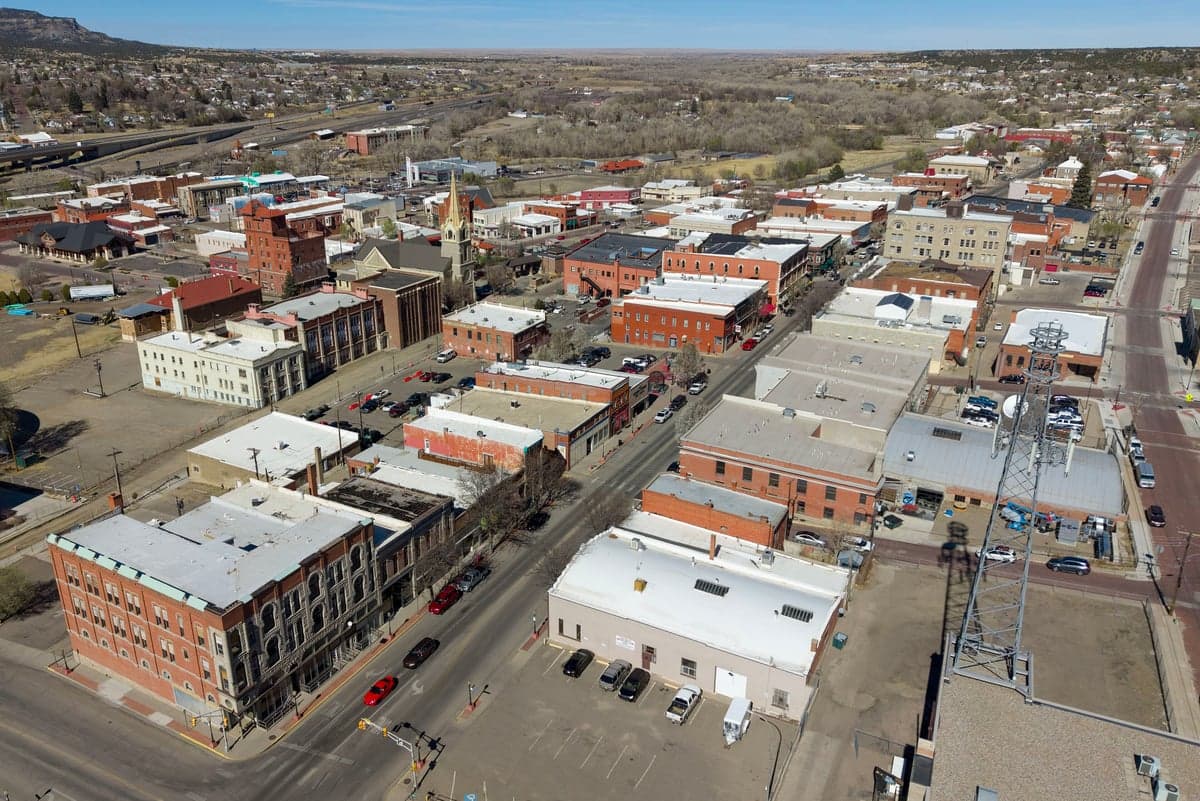
Photo: Wikipedia
Personal Sovereignty in Trinidad, CO
Viable for self-reliance. Generally workable, though some barriers may limit total independence.
What does Personal Sovereignty tell us?
Personal Sovereignty measures your capacity for self-reliance and independence with minimal government friction. Higher scores mean fewer barriers between you and the way you want to live... but it assumes you have the space you need and good neighbors.
What does this tell us?
Personal Sovereignty measures your capacity for self-reliance and independence with minimal government friction. Higher scores mean fewer barriers between you and the way you want to live... but it assumes you have the space you need and good neighbors.
State Policy
Energy independence: Net exporter (110% of energy produced in-state)
Personal Liberty
Homesteading

Personal Liberty Analysis
Trinidad, Colorado offers a notably high degree of personal sovereignty relative to many Front Range communities, largely due to its rural location, limited local government footprint, and the state's constitutional protections that still hold weight despite recent progressive shifts in Denver. For the prepper or survivalist-minded individual, the town represents a strategic balance: you are far enough from the regulatory and cultural gravity of the state capital to enjoy significant practical autonomy, yet still subject to Colorado's broader legal framework. The key question is whether the state-level headwinds—particularly on gun laws and energy policy—outweigh the local advantages of low-density living, minimal zoning enforcement, and a community that largely minds its own business.
Tax burden and regulatory posture: How Colorado's state policies affect Trinidad
Colorado's overall tax burden is moderate, with a flat state income tax rate of 4.4% and a state sales tax of 2.9%, but Trinidad's local sales tax adds roughly 4%, bringing the combined rate to around 7.9%—higher than some rural Colorado towns but still below Denver's 8.81%. The property tax picture is more favorable: Las Animas County levies a mill levy that keeps effective rates low, typically around 0.5% of assessed value, which is well below the national average. For a prepper, the real concern is regulatory creep. Colorado's state-level building codes, energy mandates, and environmental regulations are increasingly burdensome, but enforcement in Trinidad is lax. The city has no dedicated code enforcement officer for rural properties, meaning that many off-grid setups—solar panels, rainwater collection, even small livestock—operate without interference. The state's push for electric vehicle mandates and renewable energy standards is largely irrelevant here, as the local grid is already unreliable and most residents rely on propane, wood, or generator backup. The regulatory posture is best described as "benign neglect" from the city, with state-level overreach mostly theoretical unless you plan to build a new structure or start a commercial operation.
Self-defense and gun law specifics: Navigating Colorado's restrictions in a rural setting
Colorado's gun laws have tightened significantly since 2013, with red flag orders, universal background checks, and a 2023 ban on magazines over 15 rounds for new purchases. However, Trinidad's rural character means that enforcement is minimal, and the local sheriff's office is known for a pro-Second Amendment stance. Open carry is legal without a permit for anyone 18 or older who can legally possess a firearm, and concealed carry requires a permit that Las Animas County issues with minimal delay—typically under 30 days. The practical reality is that most residents carry openly or concealed without issue, and the local gun culture is strong, with multiple gun shops and a shooting range just outside town. The magazine ban is the most significant restriction for preppers, as it limits defensive capacity, but existing pre-ban magazines are grandfathered and widely available on the private market. Stand-your-ground laws apply in Colorado, and there is no duty to retreat in one's home or vehicle. For the survivalist, Trinidad offers a workable legal environment for self-defense, provided you are aware of state-level restrictions and avoid the more restrictive jurisdictions like Denver or Boulder.
Self-reliance and homesteading viability: Lot sizes, zoning, and off-grid feasibility
Trinidad's zoning is remarkably permissive for a Colorado town. Most residential lots in the city limits are a quarter-acre or larger, and the county allows parcels as small as one acre for rural residential use. The city has no zoning ordinance that explicitly prohibits chickens, goats, or even small-scale livestock within city limits, though noise and nuisance ordinances apply. Off-grid living is entirely feasible: solar panels are common, rainwater collection is legal (Colorado's strict water rights laws technically require a permit for large-scale collection, but small household systems are ignored), and composting toilets are allowed with a simple permit. The biggest practical challenge is water—Trinidad sits in a semi-arid region with limited groundwater, so most homes rely on municipal water or hauled water from local suppliers. Propane delivery is reliable, and firewood is abundant from nearby national forests. The county's building department is understaffed and rarely inspects existing structures, meaning that many properties have unpermitted additions, sheds, or tiny homes that operate without issue. For the homesteader, Trinidad offers a low-barrier entry point for self-reliance, with the caveat that you will need to invest in water storage and backup power.
Personal liberties: Parental rights, medical autonomy, speech, and property
Parental rights in Colorado are under pressure from state-level mandates on school curriculum and vaccination requirements, but Trinidad's local school district is conservative-leaning and has resisted some progressive initiatives. The district does not enforce mask mandates or critical race theory curricula, and parents have significant influence through the local school board. Medical autonomy is a mixed bag: Colorado has legalized recreational marijuana and psilocybin therapy, which some preppers view as a positive for personal choice, but the state also mandates vaccine schedules for school attendance and has a strong public health apparatus. For the survivalist, the key is that Trinidad is far enough from Denver that state health officials rarely intervene in local medical decisions. Free speech is protected under the First Amendment, and the local culture is openly conservative, with no reported instances of viewpoint discrimination. Property rights are strong: Colorado's property tax system is transparent, and Las Animas County has no overlay zoning or historic district restrictions that would limit what you can do on your land. The biggest threat to property rights is the state's growing use of conservation easements and environmental regulations, but these have not yet reached Trinidad in any meaningful way.
Overall, Trinidad offers a level of personal sovereignty that is increasingly rare in Colorado. The state's progressive tilt on guns, energy, and education is a real concern, but the town's isolation, lax enforcement, and conservative local culture create a buffer that allows for a high degree of practical autonomy. Compared to the Front Range or even other rural Colorado towns like Durango or Salida, Trinidad is more permissive, less regulated, and more aligned with a survivalist or prepper mindset. The trade-off is economic stagnation and limited services, but for those prioritizing freedom over convenience, Trinidad remains a strong contender for relocation.

* Values derived from national, state, county, city and local statistics and may differ in a specific area. Last updated: 2026-05-02T04:13:00.000Z
Narrative content on this page is AI-generated and may contain mistakes. Verify any details that matter before acting on them.
ReloMaps may earn a commission from affiliate links at no extra cost to you.

