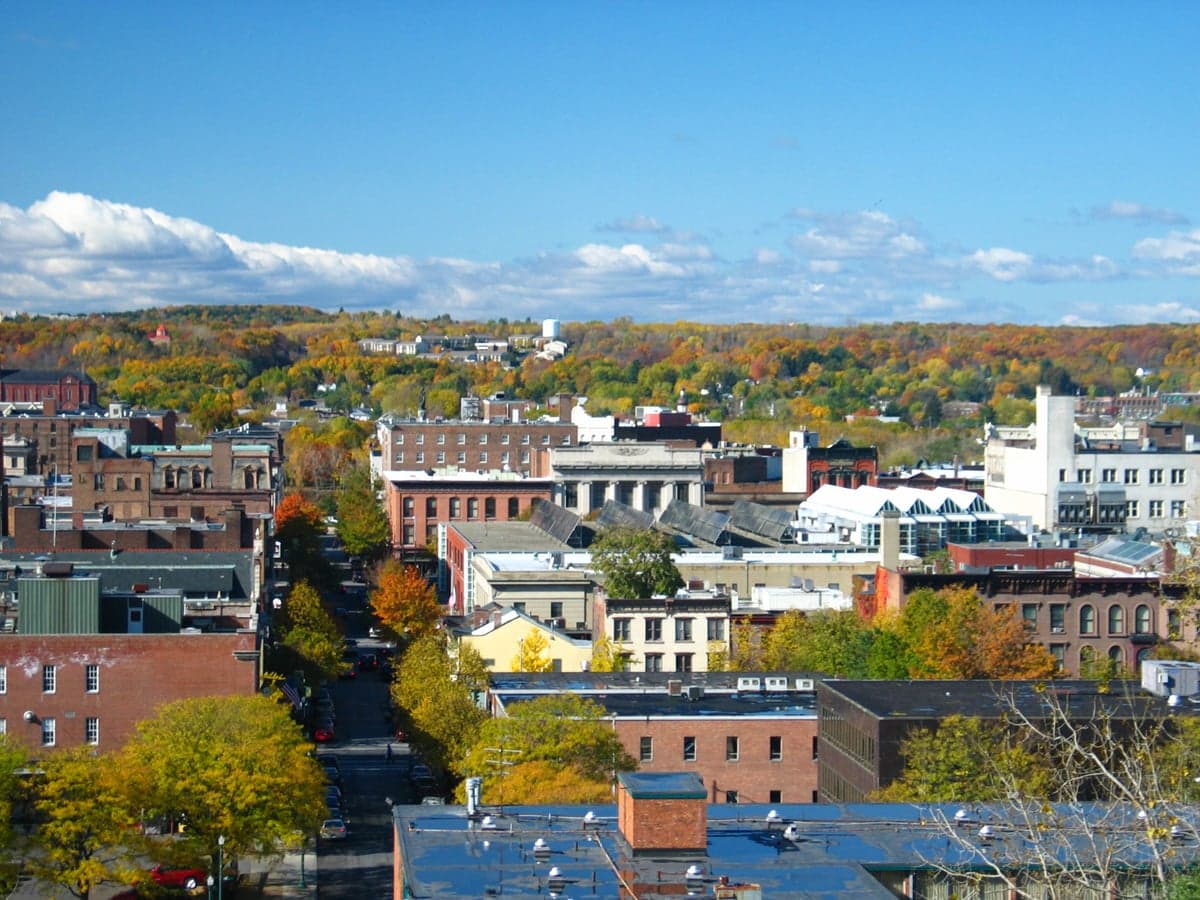
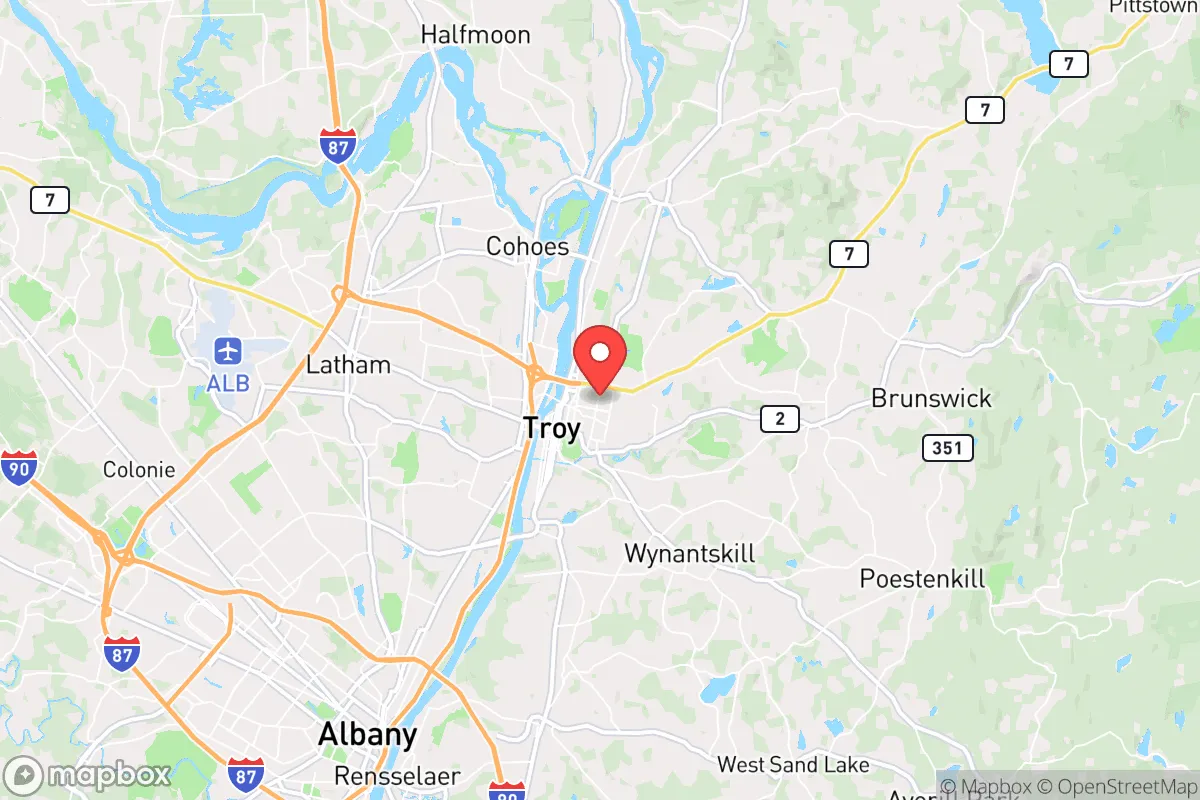
Photo: Wikipedia
Demographics of Troy, NY
Affluence Level in Troy, NY
A below-average socioeconomic profile. Incomes, home values, and educational attainment trail the U.S., with higher poverty and unemployment.
People of Troy, NY
The people of Troy, New York today form a dense, diverse, and historically layered urban population of 51,054. The city is notably more racially and ethnically mixed than its surrounding Rensselaer County suburbs, with a white population of 63.2%, a Black population of 15.6%, a Hispanic population of 9.8%, and growing East/Southeast Asian (2.6%) and Indian-subcontinent (1.6%) communities. Troy’s identity is shaped by its legacy as a 19th-century industrial powerhouse, its post-industrial decline, and a recent revival driven by young professionals and immigrants, creating a city that is simultaneously gritty, historic, and in transition.
How the city was settled and grew
Troy was first settled by Dutch farmers in the late 1600s, but its explosive growth began after the American Revolution when it was chartered as a city in 1816. The key draw was the Hudson River and the Erie Canal, which made Troy a major manufacturing and transportation hub. Irish immigrants fleeing the Great Famine arrived in the 1840s and 1850s, settling in the South Troy neighborhood, where they worked in the iron foundries and steel mills that lined the river. German immigrants followed in the 1850s and 1860s, establishing themselves in North Central Troy and building breweries and churches. By the late 19th century, Eastern European Jews and Italians arrived, forming tight-knit enclaves in Little Italy (around 4th and 5th Avenues) and the Beman Park area. The city’s population peaked at over 72,000 in the 1930s, fueled by the collar, shirt, and iron industries that made Troy a national manufacturing center.
Modern era (post-1965)
The post-1965 era brought profound demographic change. The Immigration and Nationality Act of 1965 opened the door to new waves of immigrants, while the collapse of Troy’s industrial base in the 1970s and 1980s triggered a white flight to suburbs like Brunswick and East Greenbush. The city’s population dropped from 62,000 in 1970 to 49,000 by 2000. During this period, Black families moved into the Lansingburgh neighborhood in the north, historically a working-class area, and into parts of South Troy as older Irish and Italian families departed. Hispanic immigration, primarily from Puerto Rico and later from Central America, began in the 1980s and concentrated in North Central Troy and the Hill District (the area around Hoosick Street). The East/Southeast Asian population, mostly Vietnamese and Chinese, grew slowly after 1990, settling in South Troy and near the Rensselaer Polytechnic Institute (RPI) campus. The Indian-subcontinent community, smaller but visible, is largely tied to RPI and the tech sector, with families living in the East Side near the university. The foreign-born share today is 5.5%, below the national average but significant for a small upstate city.
The future
Troy’s population is slowly stabilizing after decades of decline, with a slight uptick since 2010 driven by young professionals and immigrants. The city is not homogenizing; rather, it is tribalizing into distinct enclaves. The white population is aging and shrinking in older neighborhoods like Lansingburgh and South Troy, while the Hispanic and Black populations are growing in North Central Troy and the Hill District. The East/Southeast Asian and Indian communities are small but growing, concentrated near RPI and in the East Side. The next 10-20 years will likely see continued diversification, with Hispanic and Asian populations increasing as white residents continue to age out or move to suburbs. The city’s downtown revival, anchored by the Troy Waterfront Farmers Market and tech startups, is attracting a younger, more educated cohort (36.8% college educated), but this group is largely white and concentrated in the Downtown and Washington Park areas, creating a growing economic and cultural divide between the revitalized core and the older, poorer neighborhoods.
For someone moving in now, Troy is a city of stark contrasts: a revitalized, walkable downtown with historic architecture and a growing arts scene, alongside struggling, high-poverty neighborhoods with aging infrastructure. The population is becoming more diverse and slightly more educated, but the city remains economically stratified and racially divided by neighborhood. It is a place for those who value urban grit, history, and diversity, but who are also prepared for the challenges of a city still recovering from its industrial collapse.

* Values derived from national, state, county, city and local statistics and may differ in a specific area. Last updated: 2026-04-24T15:14:18.000Z
Narrative content on this page is AI-generated and may contain mistakes. Verify any details that matter before acting on them.
ReloMaps may earn a commission from affiliate links at no extra cost to you.

