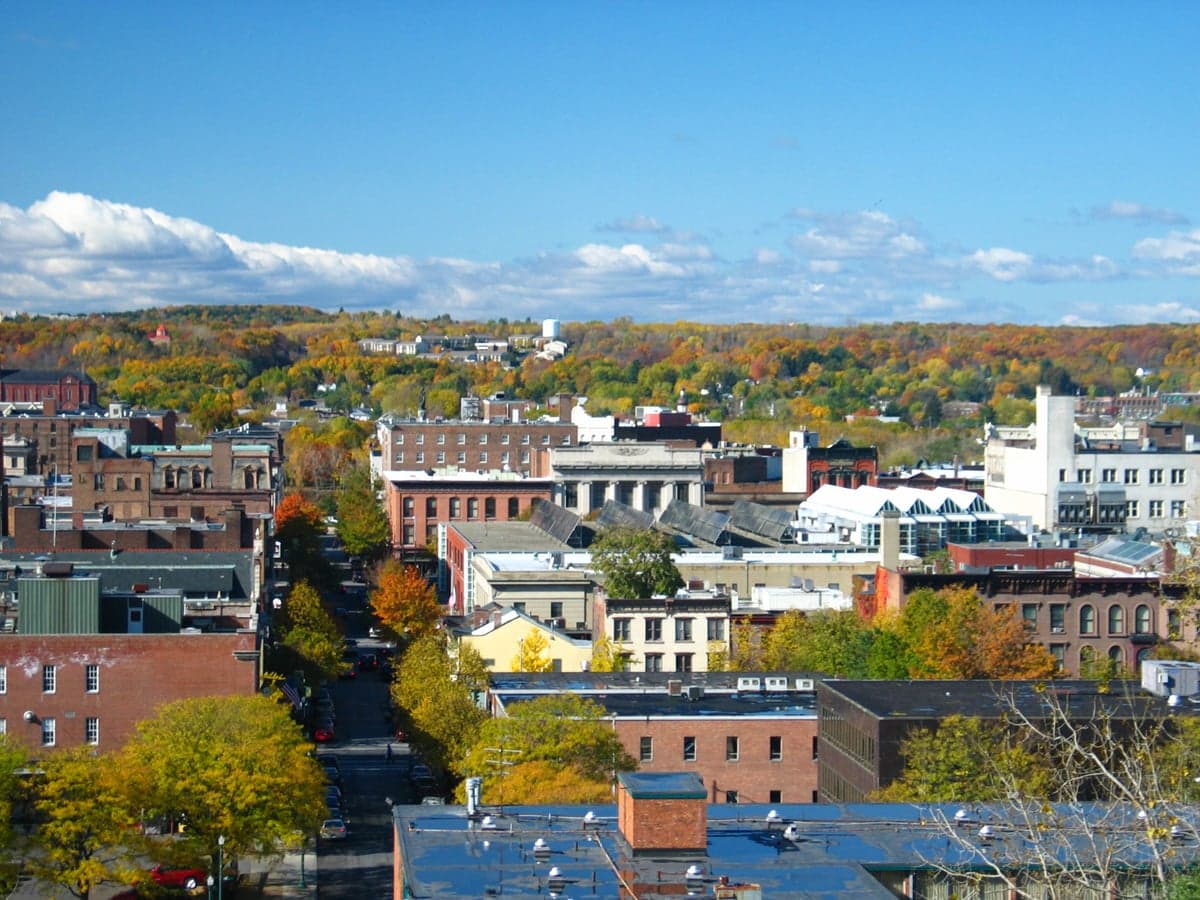
Photo: Wikipedia
Personal Sovereignty in Troy, NY
Moderate friction. Expect trade-offs in some aspect of personal liberty and independence.
What does Personal Sovereignty tell us?
Personal Sovereignty measures your capacity for self-reliance and independence with minimal government friction. Higher scores mean fewer barriers between you and the way you want to live... but it assumes you have the space you need and good neighbors.
What does this tell us?
Personal Sovereignty measures your capacity for self-reliance and independence with minimal government friction. Higher scores mean fewer barriers between you and the way you want to live... but it assumes you have the space you need and good neighbors.
State Policy
Energy independence: Importer (12% of energy produced in-state)
Personal Liberty
Homesteading

Personal Liberty Analysis
Troy, New York, presents a challenging environment for personal sovereignty, where the promise of historic affordability and a walkable urban core is heavily offset by New York State’s aggressive regulatory apparatus and high tax burden. For the strategic relocator operating from a survivalist or prepper mindset, Troy offers a mixed bag: a dense, defensible urban footprint with a strong DIY culture, but under the thumb of one of the most interventionist state governments in the nation. The city’s autonomy environment is best described as a constrained liberty—you can carve out a resilient life within your four walls, but the state’s long arm reaches deep into your finances, your healthcare choices, and your right to self-defense.
Tax burden and regulatory posture: how New York state law impacts Troy residents
The single greatest threat to personal sovereignty in Troy is the state-level tax and regulatory regime. New York has the highest combined state and local tax burden in the nation, and Troy residents feel this acutely. Property taxes in Rensselaer County are among the highest in the state, often exceeding 3% of assessed home value annually, which directly erodes wealth and the ability to self-fund preparedness. The state’s regulatory posture is equally stifling: New York’s strict building codes, environmental conservation laws, and energy mandates (like the Climate Leadership and Community Protection Act) impose costly compliance burdens on any attempt to modify property for self-sufficiency. For example, installing a backup generator or solar array requires permits and inspections that can take months and cost thousands. The state’s overreach into local land use via the State Environmental Quality Review Act (SEQRA) means even minor projects can trigger bureaucratic delays. For the prepper, this means Troy is not a place for rapid, unpermitted infrastructure development; every step toward resilience must be navigated through a hostile regulatory maze.
Self-defense and gun law specifics: what Troy residents can and cannot do
New York’s gun laws are among the most restrictive in the country, and Troy residents operate under a regime that fundamentally undermines the right to self-defense. The state’s Concealed Carry Improvement Act (CCIA), passed in 2022, requires a “proper cause” showing for a concealed carry permit—effectively a may-issue standard that gives local sheriffs and judges broad discretion to deny. In practice, Rensselaer County is more permissive than downstate counties, but the process remains expensive and time-consuming, often taking 6-12 months and costing over $500 in fees and training. The state also bans “assault weapons” (defined by a feature-based test), limits magazine capacity to 10 rounds, and requires background checks for all ammunition purchases. For the survivalist, this means building a meaningful firearms inventory for defense or hunting is legally constrained and heavily monitored. Open carry is effectively prohibited, and transporting firearms across state lines is a legal minefield. The NY SAFE Act also mandates registration of certain firearms, creating a de facto gun registry that many preppers view as a precursor to confiscation. In short, Troy offers no sanctuary for the armed citizen; self-defense is a privilege granted by the state, not a right.
Self-reliance and homesteading viability: lot sizes, zoning, and off-grid feasibility in Troy
Troy’s dense urban layout severely limits traditional homesteading. The typical residential lot in the city is 2,500 to 5,000 square feet, with many row houses and multi-family buildings. Zoning is primarily R-1 (single-family) and R-2 (two-family), with strict prohibitions on livestock, large gardens, and accessory structures without permits. Keeping chickens is allowed in some districts but requires a permit and neighbor notification; goats, pigs, or larger livestock are outright banned. Off-grid living is essentially impossible within city limits: the city requires connection to municipal water and sewer, and any attempt to install a septic system or well is prohibited. Solar panels are allowed but must be grid-tied, and battery storage is subject to fire code restrictions. For the prepper seeking true self-reliance, Troy’s urban core is a dead end. However, the surrounding towns of Brunswick, Schaghticoke, and Poestenkill—within a 15-minute drive—offer 1-5 acre parcels with agricultural zoning, where chickens, goats, and even small-scale farming are feasible. The trade-off is a longer commute and exposure to the same state-level regulatory burdens, but the land is significantly cheaper than in the Hudson Valley to the south. For the serious homesteader, Troy itself is a base camp, not a final destination.
Personal liberties: parental rights, medical autonomy, speech, and property rights
New York’s progressive governance directly encroaches on several key personal liberties. Parental rights are under constant assault: the state’s education law mandates LGBTQ-inclusive curriculum and prohibits schools from notifying parents of a child’s gender identity changes without the child’s consent, effectively overriding parental authority in the classroom. Medical autonomy is similarly constrained: New York has a vaccine mandate for healthcare workers and school attendance, and the state’s emergency powers during COVID allowed the governor to unilaterally impose restrictions on businesses and gatherings. The state’s red flag law allows for the seizure of firearms based on a complaint without a criminal conviction, a clear violation of due process. Free speech is nominally protected, but New York’s hate speech laws and social media regulations create a chilling effect for conservative viewpoints. Property rights are the most compromised: the state’s rent stabilization laws in Troy (which covers buildings built before 1974 with six or more units) allow the government to control rent increases and eviction procedures, effectively transferring control of private property to tenants and bureaucrats. For the prepper, this means your home is never truly your castle—the state can dictate who lives in it, what you can do on it, and what medical choices you can make for your family.
Overall, Troy’s personal sovereignty profile is a study in contradictions. The city’s walkable, dense layout and strong community networks offer a form of resilience that suburban sprawl cannot—mutual aid, local barter, and a tight-knit social fabric. But the state-level apparatus of high taxes, restrictive gun laws, and intrusive regulations makes it a poor choice for anyone seeking true independence. Compared to areas like rural Texas or the Mountain West, where property rights and self-defense are constitutionally protected, Troy is a cage with a nice view. For the strategic relocator, Troy is best viewed as a temporary staging ground—a place to build capital and skills before moving to a jurisdiction that respects the sovereignty of the individual. If you must stay in New York, the best you can do is buy a small piece of land in a neighboring town, keep your head down, and prepare for the day when the state’s overreach becomes untenable.

* Values derived from national, state, county, city and local statistics and may differ in a specific area. Last updated: 2026-04-24T15:14:18.000Z
Narrative content on this page is AI-generated and may contain mistakes. Verify any details that matter before acting on them.
ReloMaps may earn a commission from affiliate links at no extra cost to you.

