
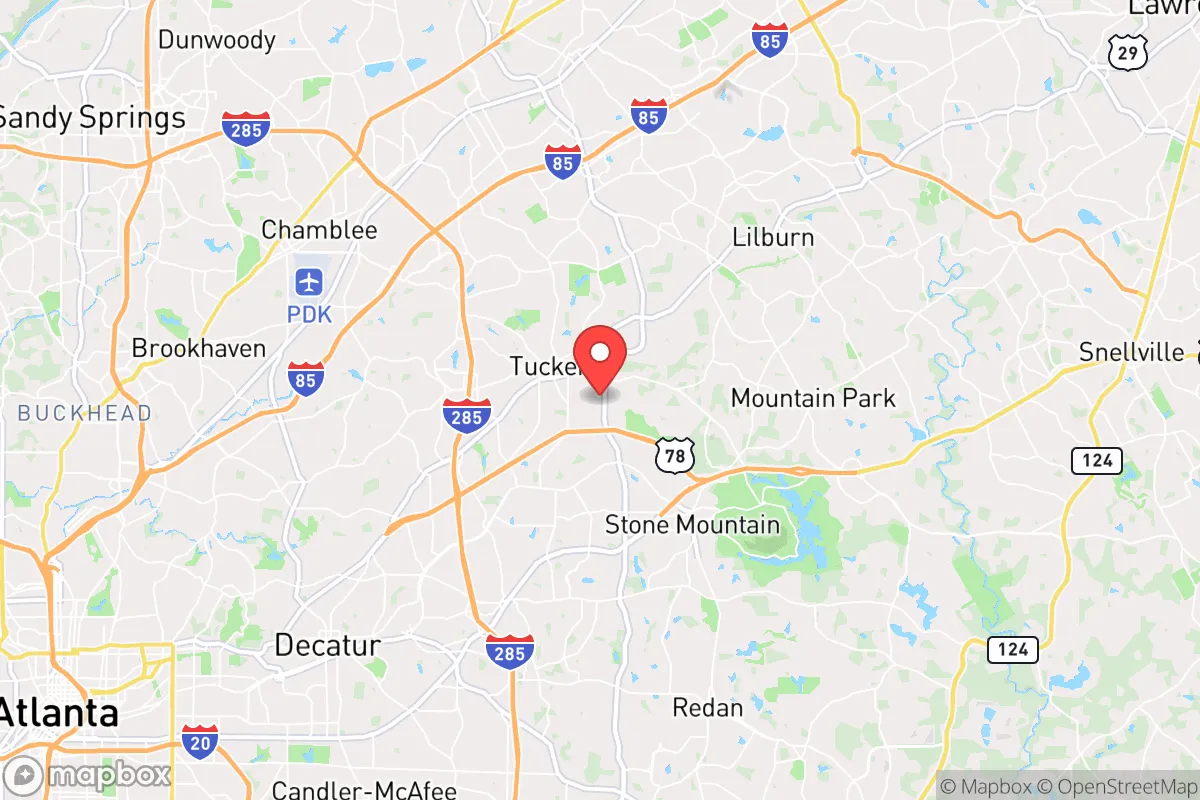
Photo: Wikipedia
Political ClimatePolitical Climate in Tucker, GA
District shown is the primary district for this city’s centroid. Cities may span multiple districts.
Local Political AnalysisPolitical Analysis of Tucker, GA
Tucker, Georgia, leans heavily Democratic, with a Cook PVI of D+27, meaning it votes about 27 points more Democratic than the national average. This wasn't always the case—I remember when this area was a lot more purple, with a real mix of folks who just wanted to be left alone. But over the last decade, especially since incorporation in 2016, the political energy has shifted hard to the left. You see it in local elections, where progressive candidates often run unopposed, and in the general vibe at city council meetings. It's a far cry from the more balanced, live-and-let-live atmosphere we had even ten years ago.
How it compares
Drive ten minutes north to Duluth or Norcross, and you'll feel a different political breeze. Those areas still have a stronger conservative undercurrent, with more competitive races and a louder voice for fiscal restraint and individual liberties. Tucker, by contrast, is increasingly mirroring the politics of Decatur or Avondale Estates—places where progressive social policies and higher taxes are seen as virtues. The contrast is stark: in Tucker, a proposal to increase property taxes for a new bike lane might pass with little debate, while in a place like Lilburn, that same idea would face serious pushback from residents worried about government overreach and their bottom line. It's like two different worlds separated by just a few miles of highway.
What this means for residents
For those of us who value personal freedoms and limited government, the trend here is genuinely concerning. The local government has become more proactive in areas that used to be left to individuals and families. You're seeing more zoning restrictions that tell you what you can do with your own property, more talk of "equity" initiatives that pick winners and losers, and a general attitude that the city knows better than you do. Property taxes have crept up as the city hires more staff and funds more programs, and there's a growing sense that your voice at town hall doesn't carry the weight it used to. If you're a small business owner or someone who just wants to be left alone to raise your family, you might start feeling like the odd one out.
On a cultural level, Tucker has lost some of its old, easygoing character. The annual Tucker Day festival used to be a simple, fun community gathering; now it's often a platform for political activism and social messaging. The local schools, once a point of pride for their focus on academics, are increasingly caught up in ideological battles over curriculum and student rights. Looking ahead, if this trajectory continues, I worry Tucker will become a place where conformity to progressive orthodoxy is expected, not chosen. For anyone who values genuine freedom—the freedom to speak your mind, run your business, and raise your kids without the government breathing down your neck—it's worth paying very close attention to what's happening here. The old Tucker is fading, and what's replacing it isn't for everyone.

State Political ClimatePolitical Climate in Georgia
State Political AnalysisPolitical Environment in the State
Georgia has shifted from a reliably conservative stronghold to a genuine battleground state over the past two decades, with its 16 electoral votes now regularly contested. The state’s partisan lean is essentially dead-even at the presidential level—Joe Biden won it by just 0.2% in 2020, and Donald Trump lost it by a similarly narrow margin in 2024—but downballot races still tilt Republican, with the GOP controlling the governorship, both legislative chambers, and the Public Service Commission. The long arc shows a slow but steady Democratic trend driven by explosive growth in the Atlanta metro, offset by deep-red rural and exurban counties that remain fiercely conservative.
Urban vs. rural divide
The political map of Georgia is a tale of two Georgias. The Atlanta metro—specifically Fulton, DeKalb, Cobb, Gwinnett, and Clayton counties—now delivers roughly 60% of the state’s Democratic votes. Fulton County alone gave Biden 73% of its vote in 2020, while DeKalb hit 85%. These are the engine rooms of the state’s progressive shift, fueled by in-migration from blue states, a growing professional class, and a heavily mobilized African American electorate. Meanwhile, the rest of the state is overwhelmingly Republican. Rural counties like Murray, Gilmer, and Union in the north routinely vote 80%+ GOP, as do the agricultural counties of south Georgia like Colquitt and Tift. The exurban ring—counties like Forsyth, Cherokee, and Paulding—has become a Republican firewall, with Forsyth County voting 68% for Trump in 2024. The key swing counties are the suburban Atlanta counties that flipped blue in the 2018-2020 cycle: Cobb (Biden +14), Gwinnett (Biden +18), and Henry (Biden +12). These are now the most politically contested turf in the state, with both parties pouring resources into them every cycle.
Policy environment
Georgia’s policy environment is broadly conservative, but with notable exceptions that frustrate many on the right. The state has a flat income tax rate of 5.49% (down from 6% in 2022) and a sales tax cap of 4% at the state level, though local options can push it higher. Property taxes are relatively low, with a median effective rate of 0.87%, and there is no state estate tax. The regulatory posture is business-friendly, with a right-to-work law and a tort reform package passed in 2005 that capped noneconomic damages. On education, Georgia has a robust school choice landscape: the state offers a $6,500 tax credit scholarship program for private school tuition, and the 2024 Georgia Promise Scholarship Act created a $6,500 education savings account for students in low-performing schools. However, the state’s public schools remain a mixed bag—metro Atlanta districts like Gwinnett and Cobb are well-funded but increasingly politicized, while rural districts struggle with funding and teacher shortages. On healthcare, Georgia did not expand Medicaid under the Affordable Care Act, but the state’s 2023 “Georgia Pathways” program added limited coverage for low-income adults who meet work requirements. Election laws have been a flashpoint: the 2021 SB 202 (the “Election Integrity Act”) added voter ID requirements for absentee ballots, limited drop boxes, and restricted third-party ballot collection, which conservatives see as necessary safeguards but progressives decry as suppression. The law has survived multiple court challenges.
Trajectory & freedom
Georgia’s trajectory on personal freedom is a mixed bag that should give conservatives pause. On the positive side, the state has expanded gun rights significantly: Georgia is a constitutional carry state since 2022 (HB 218), meaning no permit is needed to carry a concealed firearm. The state also has a strong Stand Your Ground law and preempts local gun ordinances. Parental rights were bolstered by the 2022 “Parents’ Bill of Rights” (SB 449), which requires schools to notify parents of any medical or mental health services provided to their child and prohibits instruction on sexual orientation or gender identity in K-3 classrooms. However, the state has also seen concerning expansions of government power. The 2020 “Georgia Hate Crimes Act” (HB 426) created enhanced penalties for bias-motivated crimes, which some conservatives view as a slippery slope toward viewpoint-based prosecution. More troubling is the state’s aggressive use of eminent domain for private development, particularly in the Atlanta suburbs, where local governments have seized property for transit-oriented projects and luxury apartments. On medical freedom, Georgia did not impose a COVID-19 vaccine mandate for state employees, but it did allow private businesses to require them—a stance that many conservatives felt was too permissive. The state’s abortion law (HB 481, the “Heartbeat Bill”) bans abortions after six weeks, which is among the strictest in the nation, but enforcement has been uneven due to court challenges.
Civil unrest & political movements
Georgia has been a focal point for political activism on both sides. The 2020 election cycle saw massive protests in Atlanta following the killing of George Floyd, with the city experiencing several nights of property damage and arson that left a lasting impression on residents. The “Stop Cop City” movement—a campaign to block construction of a public safety training facility in DeKalb County—has been one of the most sustained activist efforts in the state, involving months of protests, legal battles, and even a domestic terrorism designation by the FBI. On the right, the Georgia Republican Party has been riven by internal factionalism between establishment conservatives and Trump-aligned populists, with the 2022 primary for governor seeing a bitter challenge to Brian Kemp from David Perdue. Immigration politics are less visible than in border states, but the 2024 “Georgia Criminal Alien Program” (SB 110) requires local law enforcement to cooperate with ICE detainer requests, which has been controversial in metro Atlanta’s immigrant-heavy communities. Election integrity remains a live issue: the 2021 audit of Fulton County’s ballot counting found no widespread fraud, but many conservatives remain skeptical of the state’s Dominion voting machines and the 2020 results. The most visible flashpoint for a new resident would be the constant political advertising—Georgia is now a permanent swing state, so every cycle brings a flood of TV spots and door-knockers.
Projection
Over the next 5-10 years, Georgia is likely to continue its slow drift toward competitive two-party politics, but the outcome is far from settled. The Atlanta metro’s growth shows no signs of slowing—the region added 1.2 million people between 2010 and 2020, and the 2024 census estimates show continued gains in Cobb, Gwinnett, and Forsyth counties. This demographic shift favors Democrats, as the new arrivals tend to be younger, more diverse, and more liberal. However, the exurban and rural counties are also growing, and they are voting even more Republican than before. The wild card is the state’s growing Hispanic population, which is concentrated in the Atlanta metro and south Georgia agricultural counties—this group has historically leaned Democratic but has shown signs of shifting right in recent cycles. If Georgia’s Hispanic voters move toward the GOP, it could offset the Democratic gains from white suburbanites. The legislative landscape will likely remain Republican-controlled for the near term, thanks to gerrymandered maps that survived the 2023 redistricting cycle, but the state’s congressional delegation is already evenly split (9R-5D after the 2024 election). A new resident moving in now should expect to live in a state where every election is a nail-biter, where the political culture is increasingly polarized, and where the policy environment could swing dramatically depending on which party controls the governor’s mansion after 2026.
For a conservative considering a move to Georgia, the bottom line is this: you get a low-tax, gun-friendly, school-choice state with a strong economy and a growing population. But you also get a state that is politically contested at every level, where your vote matters more than in deep-red states, and where the cultural and policy battles of the next decade will be fought in your backyard. If you want a place where your values are the default, look to Tennessee or Alabama. If you want a place where you can fight for them and win, Georgia is your arena.
* Values derived from national, state, county, city and local statistics and may differ in a specific area. Last updated: 2026-04-30T14:34:02.000Z
Narrative content on this page is AI-generated and may contain mistakes. Verify any details that matter before acting on them.
ReloMaps may earn a commission from affiliate links at no extra cost to you.

