
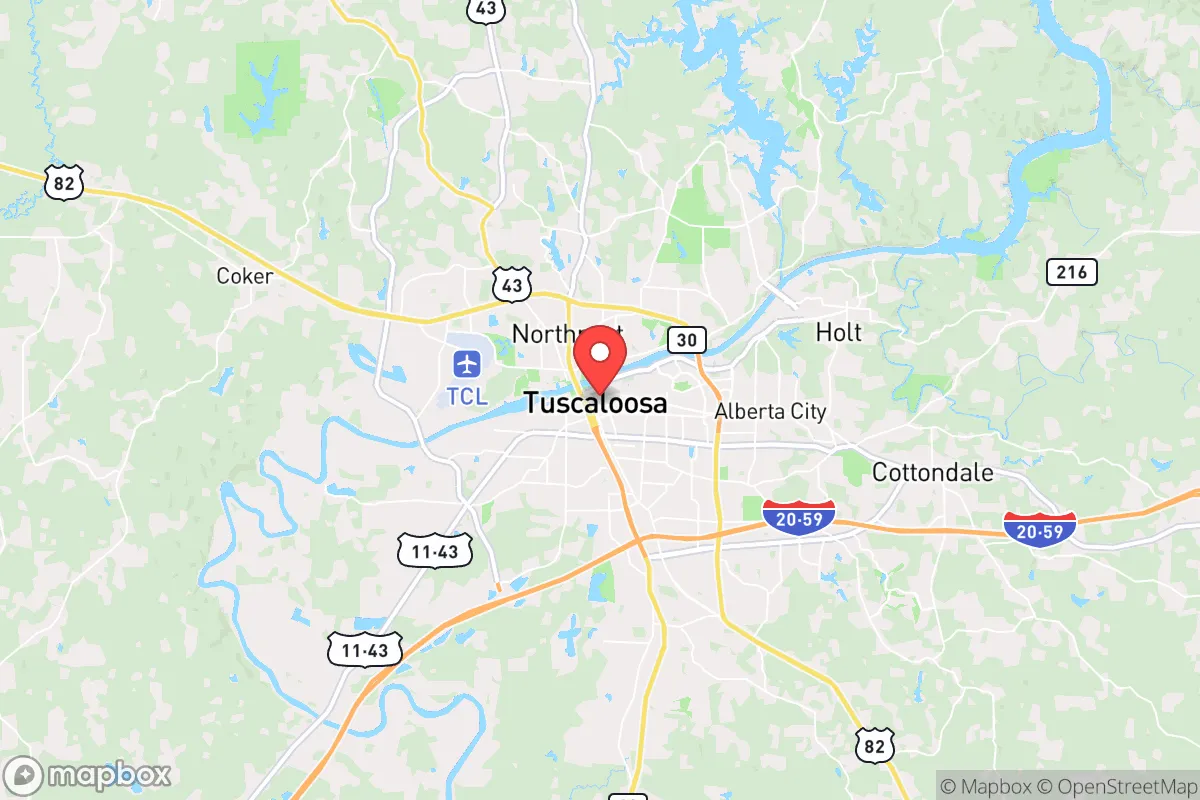
Photo: Wikipedia
Personal Sovereignty in Tuscaloosa, AL
Viable for self-reliance. Generally workable, though some barriers may limit total independence.
What does Personal Sovereignty tell us?
Personal Sovereignty measures your capacity for self-reliance and independence with minimal government friction. Higher scores mean fewer barriers between you and the way you want to live... but it assumes you have the space you need and good neighbors.
What does this tell us?
Personal Sovereignty measures your capacity for self-reliance and independence with minimal government friction. Higher scores mean fewer barriers between you and the way you want to live... but it assumes you have the space you need and good neighbors.
State Policy
Energy independence: Importer (45% of energy produced in-state)
Personal Liberty
Homesteading

Personal Liberty Analysis
Tuscaloosa, Alabama, offers a notably high degree of personal sovereignty compared to much of the urbanized Southeast, largely due to Alabama’s constitutional and statutory framework that limits local government overreach. For the individual or family operating from a survivalist or prepper mindset, the city provides a legal environment where the presumption favors personal action over state permission, though it is not without its municipal-level friction points. The key question is whether the city’s local ordinances and cultural drift erode the state-level protections enough to make relocation here a net positive for autonomy. The short answer: for most conservative-leaning individuals prioritizing self-defense, economic independence, and parental authority, Tuscaloosa ranks as a strong contender, but the devil is in the zoning code and the school board.
Tax burden and regulatory posture in Tuscaloosa vs. the state
Alabama’s tax structure is among the most favorable in the nation for those seeking to keep more of their labor and resources. There is no state-level tax on groceries, and the combined state and local sales tax in Tuscaloosa County typically runs around 9-10%, which is moderate for the region. The critical advantage is the absence of a state property tax levy on personal property like vehicles and boats—only real property is taxed, and at a rate that is among the lowest in the country (roughly 0.4% of assessed value for residential). This means a prepper’s investment in land, tools, and stored goods is not annually penalized. Regulatory posture at the state level is explicitly pro-business and anti-red tape, with Alabama being a right-to-work state and having no statewide building codes in unincorporated areas. However, Tuscaloosa city itself enforces the International Building Code and has a zoning ordinance that can be restrictive for certain homesteading activities. The city’s business license fees are reasonable, but the permitting process for structural modifications (like adding a root cellar or a detached workshop) requires patience and compliance. For the survivalist, the state-level tax and regulatory climate is a clear win; the city adds a layer of bureaucracy that is manageable but not negligible.
Self-defense and gun law specifics in Tuscaloosa County
Alabama is a constitutional carry state, meaning no permit is required to carry a concealed handgun for anyone legally allowed to possess a firearm. This is a foundational sovereignty protection. Tuscaloosa County does not impose any additional local restrictions beyond state law, so the right to keep and bear arms is effectively unfettered within city limits. Stand-your-ground and castle doctrine laws are fully codified, with no duty to retreat in any place where the individual has a legal right to be. This is critical for the prepper mindset: if a situation escalates on your property or in a public space, the law backs your right to use deadly force if you reasonably believe it is necessary to prevent death or great bodily harm. The only notable local nuance is that the Tuscaloosa Police Department has a reputation for proactive enforcement of firearm-related nuisance laws (e.g., discharging a firearm within city limits is illegal except at ranges), so zeroing a rifle on your own acreage inside the city is not permitted. For those who want to train on their own land, living in the unincorporated county or a nearby rural area is advisable. Overall, the legal framework for self-defense is among the strongest in the South, and the local culture is overwhelmingly pro-Second Amendment.
Self-reliance and homesteading viability in Tuscaloosa
The viability of a self-reliant lifestyle in Tuscaloosa depends heavily on whether you are inside the city limits or in the surrounding county. Within the city, standard residential lots are typically 0.25 to 0.5 acres, and the zoning code restricts livestock (chickens are allowed with a permit, but roosters are prohibited, and larger animals like goats or pigs are generally not permitted on lots under two acres). Off-grid living is effectively impossible inside city limits because the city requires connection to municipal water and sewer for any habitable structure. Rainwater collection is not prohibited, but it cannot be the primary water source for a dwelling. In unincorporated Tuscaloosa County, the picture changes dramatically. Lot sizes of 1-5 acres are common and affordable, with no building codes beyond basic septic and well regulations. You can keep chickens, goats, and even cattle without special permits. Solar panels are unrestricted, and composting toilets are legal as long as they meet state health department standards for alternative sanitation. The county’s soil is generally good for gardening, with a long growing season (March to November). For the prepper seeking a balance of proximity to city resources (medical, supply runs) and genuine self-reliance, the county’s rural fringe—areas near Coker, Northport, or along Highway 82 West—offers the best of both worlds. The city itself is a poor fit for serious homesteading; the county is excellent.
Personal liberties in Tuscaloosa: parental rights, medical autonomy, speech, and property
Parental rights in Alabama are strongly protected by state law, including a 2022 law that prohibits public schools from withholding information about a child’s mental or physical health from parents. Tuscaloosa City Schools, while generally compliant, have seen local school board debates over library materials and curriculum transparency that mirror national trends. For parents who want maximum control, the city has a robust homeschooling community and several private Christian schools (e.g., Tuscaloosa Academy, Holy Spirit Catholic School). Medical autonomy is a mixed bag: Alabama has some of the strictest vaccine mandates for school entry in the South (though philosophical exemptions exist for K-12), and the state’s abortion law is among the most restrictive in the nation, which aligns with many conservative values. However, the state also has a certificate-of-need law that limits the number of healthcare facilities, which can reduce choice in medical providers. Free speech is robustly protected by the Alabama Constitution, and the city has no local hate speech ordinances or permit requirements for public assembly that go beyond standard public safety. Property rights are strong, with no statewide rent control and a straightforward eminent domain process that requires just compensation. The city’s zoning board has been known to deny variances for non-standard uses (e.g., a home-based firearms training business), so property use is not entirely unfettered. For the survivalist, the legal environment respects your right to raise your children as you see fit, speak your mind, and control your property—but you must navigate local administrative hurdles for non-conventional uses.
In the broader context of the Southeast, Tuscaloosa offers a sovereignty profile that is above average for a mid-sized city but below what you would find in rural Alabama or states like Idaho or Montana. The state-level protections—constitutional carry, low taxes, strong parental rights, and minimal business regulation—create a solid foundation. The city’s local ordinances on zoning, building codes, and utility hookups introduce friction that a serious prepper must account for. If you are willing to live just outside the city limits, you gain nearly all the advantages of the area with none of the municipal overreach. For the individual or family who values personal autonomy as a primary relocation criterion, Tuscaloosa County is a strategic choice; the city itself is a compromise that still beats most of the coastal urban centers hands down. The bottom line: move to the county, not the city, and you will find a legal and cultural environment that respects your right to prepare, defend, and live on your own terms.

* Values derived from national, state, county, city and local statistics and may differ in a specific area. Last updated: 2026-04-19T19:11:40.000Z
Narrative content on this page is AI-generated and may contain mistakes. Verify any details that matter before acting on them.
ReloMaps may earn a commission from affiliate links at no extra cost to you.

