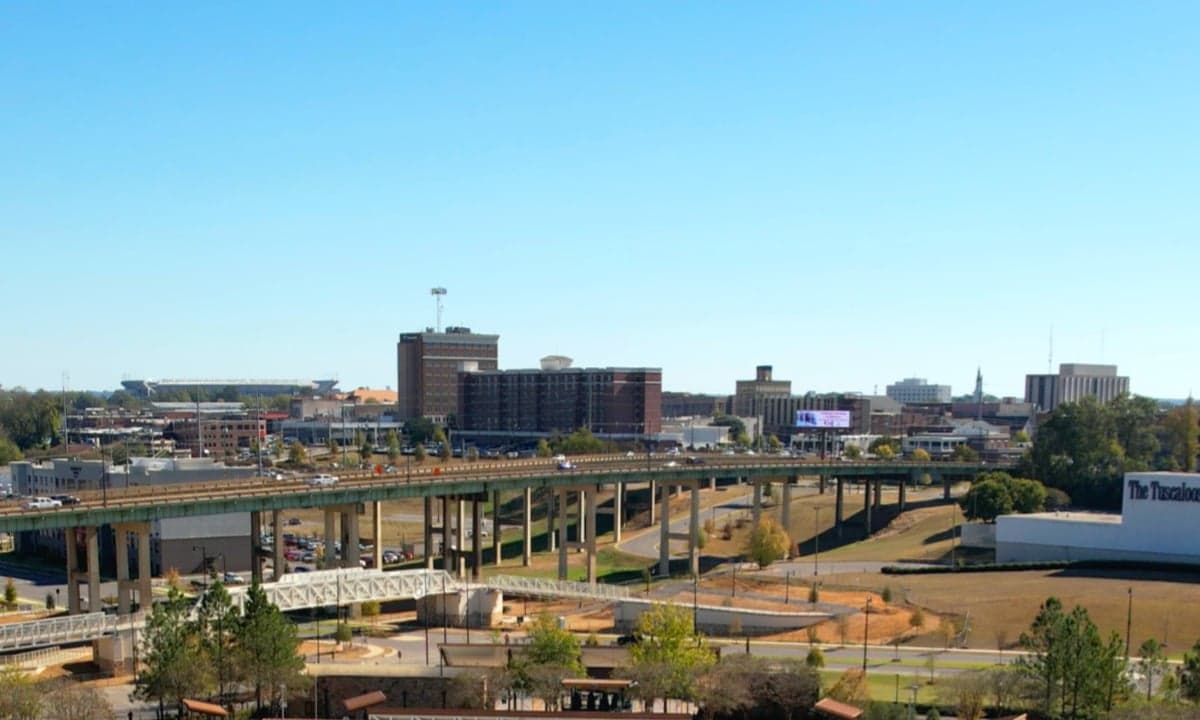
Photo: Wikipedia
Demographics of Tuscaloosa, AL
Affluence Level in Tuscaloosa, AL
A below-average socioeconomic profile. Incomes, home values, and educational attainment trail the U.S., with higher poverty and unemployment.
People of Tuscaloosa, AL
The people of Tuscaloosa, Alabama, in 2026 form a nearly evenly split Black and White population of 107,699, with a small but growing Hispanic presence and a modest college-educated cohort of 38.1%. The city’s identity is shaped by its role as a university town (home to the University of Alabama), a historic manufacturing hub, and a deeply rooted Southern community where racial lines remain visible in neighborhood patterns. Only 3.0% of residents are foreign-born, making Tuscaloosa less diverse by immigration than many peer cities, but internal migration from rural Alabama and other Southern states continues to reshape its character.
How the city was settled and grew
Tuscaloosa was founded in 1819 on the Black Warrior River as Alabama’s second state capital, a position it held until 1846. The original white settlers were planters and merchants from Georgia, South Carolina, and Virginia, drawn by fertile river bottomlands for cotton cultivation. Enslaved Black laborers, who made up a majority of the county’s population by 1840, built the city’s early infrastructure and worked the surrounding plantations. After the Civil War, freedmen established the West Tuscaloosa neighborhoods—particularly Rosedale and West End—which remain predominantly Black communities today. The arrival of the railroad in the 1850s and the establishment of the University of Alabama (which had relocated to Tuscaloosa in 1831) attracted a professional class that settled in the Highlands, a historic district of Victorian homes near campus. The early 20th century brought a wave of white rural migrants from Appalachia and the Deep South, drawn by jobs at the Gulf States Paper mill and the Bryce Hospital mental health facility, settling in working-class areas like Alberta City.
Modern era (post-1965)
The post-1965 period saw Tuscaloosa’s Black population grow through continued rural-to-urban migration from Alabama’s Black Belt counties, while white flight to suburbs accelerated after school desegregation orders in the 1970s. Northport, across the river in Tuscaloosa County, absorbed much of this white suburbanization, growing from a small town into a bedroom community of 26,000 by 2020. Within the city limits, the Forest Lake neighborhood became a middle-class Black enclave, while Downtown Tuscaloosa experienced white reinvestment starting in the 1990s, driven by university expansion and student housing development. The Hispanic population, though small at 5.2%, began to grow in the 2000s, primarily Mexican and Central American immigrants working in construction, poultry processing, and landscaping, settling in West Tuscaloosa and parts of Alberta City. The East/Southeast Asian community (1.5%) is largely tied to the university—faculty, graduate students, and medical professionals—and clusters near campus in the Highlands and newer apartment complexes along McFarland Boulevard. The Indian-subcontinent population (1.0%) follows a similar pattern, with many working in healthcare at DCH Regional Medical Center or in tech roles at the university.
The future
Tuscaloosa’s population is projected to grow modestly, driven by university enrollment (which has held steady around 38,000) and industrial expansion, including the Mercedes-Benz plant in nearby Vance. The city is not homogenizing; instead, it is tribalizing into distinct enclaves. West Tuscaloosa remains overwhelmingly Black and economically disadvantaged, while Northport and newer subdivisions along Highway 69 are predominantly white and affluent. The Hispanic population is growing slowly but steadily, likely reaching 7-8% by 2035, and is beginning to assimilate into majority-white neighborhoods as second-generation families move out of initial enclaves. The foreign-born share (3.0%) is unlikely to rise dramatically, as Tuscaloosa lacks the refugee resettlement programs or large immigrant employer base seen in Birmingham or Huntsville. The Black and White shares are expected to remain roughly equal, with the Black population slightly declining as younger, college-educated Black residents move to larger metros for career opportunities.
For someone moving to Tuscaloosa now, the city offers a stable, family-oriented environment with strong public schools in the suburbs and a vibrant university core, but clear racial and economic boundaries between neighborhoods. The low foreign-born share means less cultural diversity than in larger Alabama cities, but the university provides a steady influx of young, educated residents that keeps the city from stagnating. The next decade will likely see continued suburban expansion, modest Hispanic growth, and a slow drift toward greater integration in newer developments, while older neighborhoods retain their historic character.

* Values derived from national, state, county, city and local statistics and may differ in a specific area. Last updated: 2026-04-19T19:11:40.000Z
Narrative content on this page is AI-generated and may contain mistakes. Verify any details that matter before acting on them.
ReloMaps may earn a commission from affiliate links at no extra cost to you.

