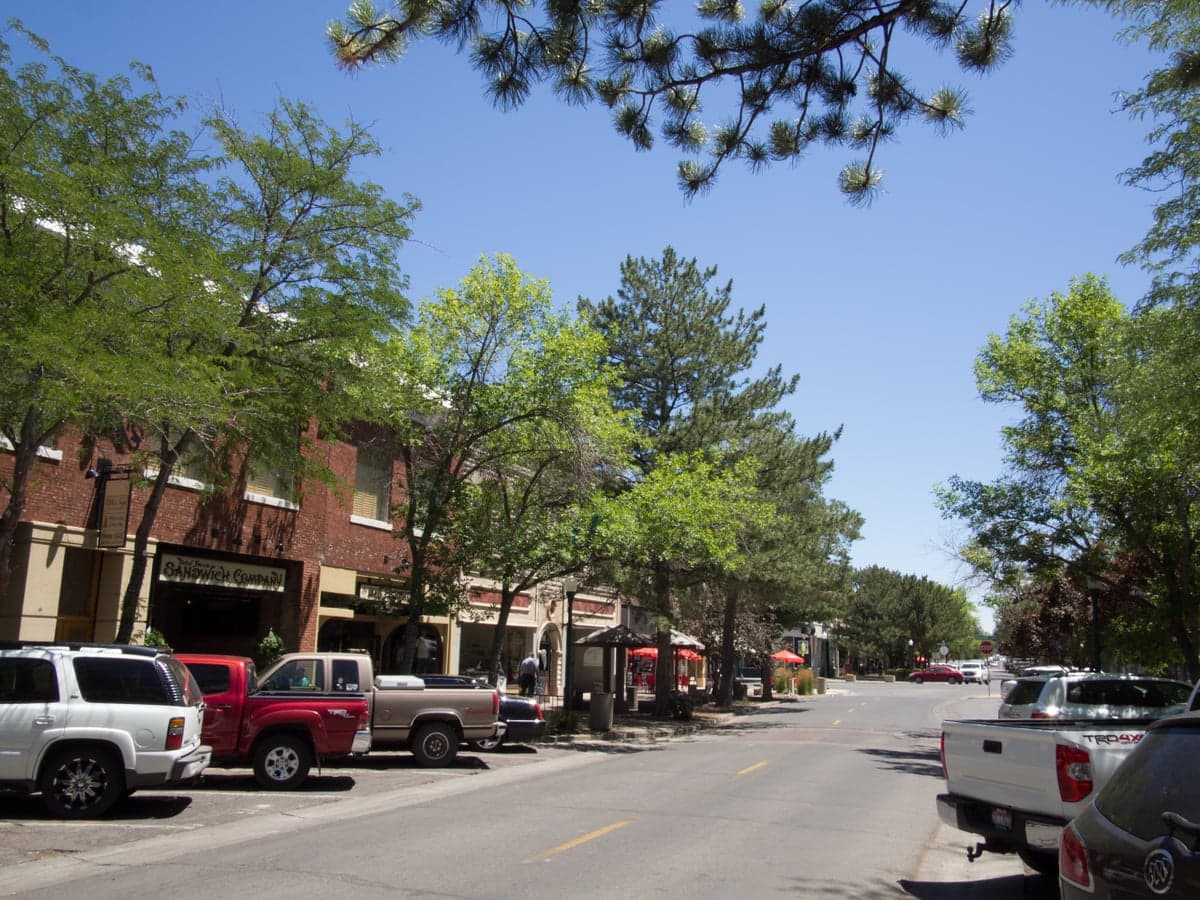
Photo: Wikipedia
Demographics of Twin Falls, ID
Affluence Level in Twin Falls, ID
A middle-class area roughly in line with national averages across income, home values, education, and employment.
People of Twin Falls, ID
The people of Twin Falls, Idaho, today number 53,219 and form a predominantly white (75.5%) and increasingly Hispanic (15.9%) community with a distinct small-city character. The population is notably less diverse than the national average in foreign-born residents (3.8%) and college graduates (22.7%), reflecting a working-class and agricultural heritage. Twin Falls feels more like a regional hub than a transient stopover, with a stable, family-oriented identity rooted in its history as a planned irrigation colony.
How the city was settled and grew
Twin Falls was not a pioneer-era settlement but a deliberate creation of the early 20th century, born from the Bureau of Reclamation's Minidoka Project. The city was founded in 1904 as a planned community to serve the newly irrigated farmland of the Magic Valley. The original population was overwhelmingly white and native-born, drawn by land grants and the promise of dry-land farming transformed by the Snake River's water. The first wave of settlers—primarily from the Midwest and Great Plains—built the Historic Downtown and the adjacent Blue Lakes Boulevard corridor, establishing the city's commercial and civic core. A second wave arrived during the 1910s and 1920s, including a small number of Basque sheepherders and Japanese laborers who worked the sugar beet fields and railroad lines. These groups settled in modest neighborhoods near the railroad tracks, such as the area around Filer Avenue and the East End, though their numbers remained tiny. By 1950, Twin Falls was a nearly all-white town of about 15,000, its growth driven by agriculture and the expansion of the Union Pacific Railroad.
Modern era (post-1965)
The post-1965 era brought modest demographic shifts, primarily through domestic in-migration and the growth of the Hispanic population. The Immigration and Nationality Act of 1965 had little immediate effect on Twin Falls, but by the 1980s and 1990s, agricultural labor demands drew a steady stream of Mexican and Central American workers. These families settled in the North Side and West End neighborhoods, near the dairy farms and food processing plants that anchor the local economy. Today, Hispanic residents make up 15.9% of the population, concentrated in these areas and forming the city's largest minority group. The Asian population remains small at 1.0% (East/Southeast Asian) and the Indian-subcontinent population at 1.2%, both largely professional and tied to the regional healthcare and education sectors. The Black population is negligible at 0.9%. Suburbanization after 1970 pushed white families into newer developments like Rock Creek and Morningside, while the older core neighborhoods near the Snake River Canyon saw gradual turnover. The city's college-educated share (22.7%) is below the national average, reflecting a workforce still heavily oriented toward agriculture, manufacturing, and trades rather than knowledge industries.
The future
Twin Falls is slowly diversifying, but the pace is gradual and the trajectory is toward a more Hispanic-influenced community rather than a broad multi-ethnic mix. The Hispanic population is growing through both immigration and natural increase, and is likely to reach 20-25% of the city's total within the next decade. This growth is concentrated in the North Side and West End, which are becoming distinct Hispanic-majority enclaves, while the newer subdivisions like Rock Creek remain overwhelmingly white. The East/Southeast Asian and Indian-subcontinent communities are small and stable, with no signs of rapid growth. The white population is aging and declining slightly in share, but remains the dominant group. The city is not tribalizing into sharply divided enclaves, but it is developing a clear geographic pattern: newer, whiter suburbs on the south and east sides, and older, more Hispanic neighborhoods near the industrial and agricultural zones. The foreign-born share (3.8%) is low and unlikely to spike, as Twin Falls lacks the refugee resettlement programs or high-tech job magnets that drive rapid diversification elsewhere.
For someone moving to Twin Falls now, the city offers a stable, family-oriented community with a strong agricultural identity and a slowly diversifying population. The white majority remains culturally dominant, but the Hispanic presence is growing and reshaping the North Side and West End. The city is not becoming a melting pot, but it is becoming a more layered place—one where a new resident can choose between the established, largely white suburbs and the emerging, more diverse older neighborhoods. The bottom line: Twin Falls is a conservative, working-class city that is changing at a deliberate pace, and that change is most visible in its Hispanic neighborhoods rather than across the entire population.

* Values derived from national, state, county, city and local statistics and may differ in a specific area. Last updated: 2026-04-29T23:27:09.000Z
Narrative content on this page is AI-generated and may contain mistakes. Verify any details that matter before acting on them.
ReloMaps may earn a commission from affiliate links at no extra cost to you.

