 Popular
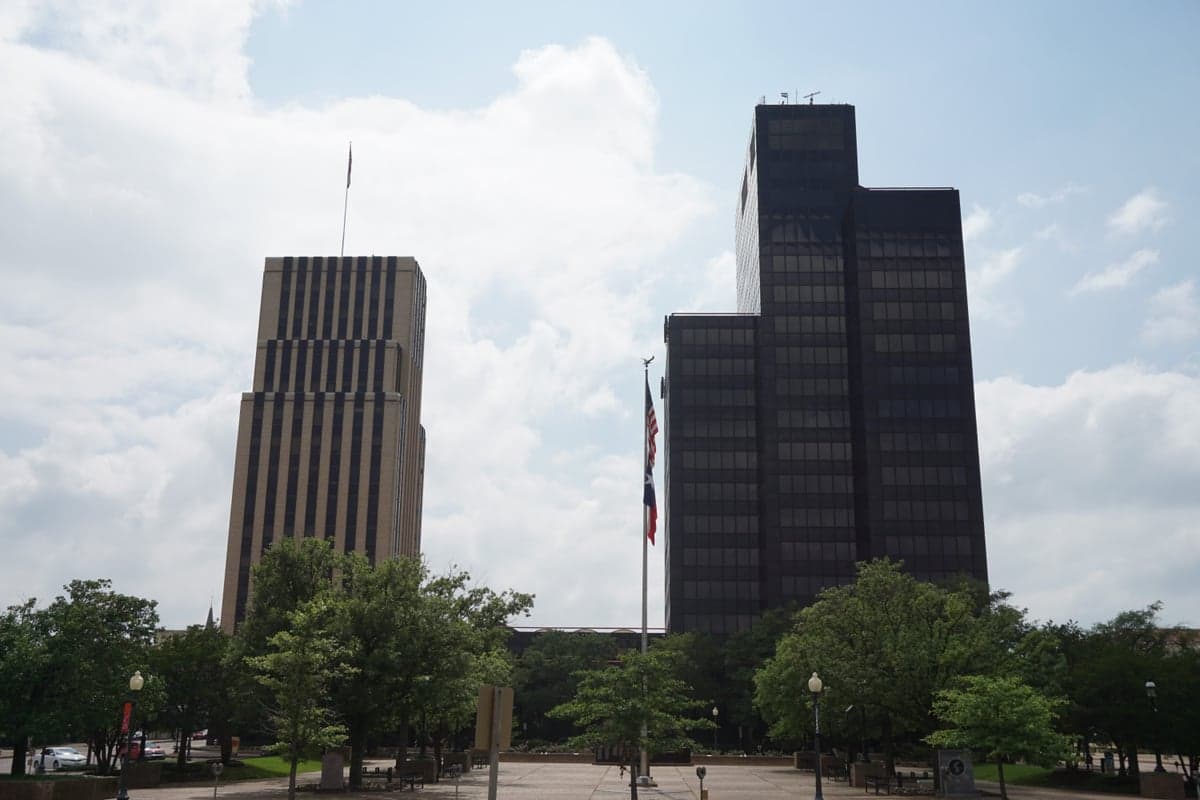
Photo: Wikipedia
Demographics of Tyler, TX
Affluence Level in Tyler, TX
A middle-class area roughly in line with national averages across income, home values, education, and employment.
People of Tyler, TX
The people of Tyler, Texas today form a population of 107,718 that is notably tripartite in its racial and ethnic composition, with roughly equal shares of White (47.0%), Hispanic (23.6%), and Black (23.3%) residents, alongside a smaller but growing East/Southeast Asian community (2.0%) and a distinct Indian-subcontinent population (0.5%). The city’s character is shaped by its deep roots in the East Texas oil and agriculture economy, a strong evangelical Christian culture, and a relatively low foreign-born share of 7.1% that indicates most growth comes from domestic migration. Tyler is often described as the "Rose Capital of America," a nickname that reflects both its historic rose-growing industry and a certain conservative, family-oriented civic pride. For a relocating family or individual, Tyler offers a community where traditional values remain visible in local politics, school choice debates, and church attendance rates.
How the city was settled and grew
Tyler was founded in 1846 as the seat of Smith County, named after President John Tyler, and its early population consisted primarily of Anglo-American settlers from the Upper South—Tennessee, Kentucky, and the Carolinas—who were drawn by the fertile blackland prairie for cotton farming. The arrival of the Texas and Pacific Railway in the 1870s transformed Tyler into a regional agricultural hub, and the discovery of the East Texas Oil Field in 1930 triggered a boom that doubled the population within a decade. The historic Azalea District, with its early 20th-century homes, was built by the oil-boom professionals and merchants who formed Tyler’s white middle class. Meanwhile, the North Tyler area, historically known as the "North Side," became the primary settlement for Black families who migrated from rural East Texas during the Great Migration, working in the oil fields, railroads, and domestic service. The Mexican-American population began arriving in the 1910s and 1920s, initially as railroad laborers and agricultural workers, settling in the South Tyler corridor near the rail yards and later spreading into the Green Acres neighborhood.
Modern era (post-1965)
The post-1965 period saw Tyler’s population diversify further through both domestic and international migration. The Immigration and Nationality Act of 1965 opened doors for new Asian and Indian immigration, though Tyler’s geographic isolation in East Texas meant these groups arrived later and in smaller numbers than in Houston or Dallas. The East/Southeast Asian community, now 2.0% of the population, began forming in the 1980s and 1990s, with Vietnamese and Filipino families drawn by healthcare jobs at the University of Texas Health Science Center at Tyler and by the region’s lower cost of living. These families concentrated in the Old Jacksonville Highway corridor and the South Tyler suburban developments near the medical district. The Indian-subcontinent population (0.5%) is even smaller and more recent, largely composed of professionals in medicine and engineering who arrived after 2000, settling in the same South Tyler neighborhoods. The Hispanic population grew from roughly 5% in 1980 to 23.6% today, driven by both immigration from Mexico and Central America and by higher birth rates; this community is most visible in the West Tyler neighborhoods near the Loop 323 corridor and in the Garden Valley area. The Black population, which was historically concentrated in North Tyler, has suburbanized somewhat since the 1990s, with middle-class families moving into South Tyler subdivisions and the Whitehouse area just south of the city limits, though North Tyler remains the cultural and institutional heart of the Black community.
The future
Tyler’s population is trending toward greater diversity but not toward a single melting-pot identity. The White share has declined from over 60% in 2000 to 47.0% today, while the Hispanic share continues to rise steadily, projected to reach 30-32% by 2040 based on current birth rates and migration patterns. The Black share has remained stable at roughly 23-24% for two decades, suggesting a plateau rather than growth. The East/Southeast Asian and Indian communities are growing slowly from a small base, likely reaching 3-4% combined by 2040, but Tyler lacks the large employer base or ethnic infrastructure—such as ethnic grocery stores or religious institutions—that would drive rapid Asian or Indian growth. The city is not homogenizing; instead, distinct enclaves are solidifying: North Tyler remains predominantly Black, West Tyler is increasingly Hispanic, and South Tyler is the most diverse and fastest-growing area, attracting White, Black, Hispanic, and Asian families alike. The foreign-born share of 7.1% is below the national average of 13.7%, indicating that Tyler remains primarily a destination for domestic migrants from other parts of Texas and the South, not for international immigrants.
For someone moving to Tyler now, the city offers a stable, family-oriented community where racial and ethnic groups coexist in separate but overlapping spheres, with South Tyler emerging as the most integrated area. The population is growing at a moderate pace of roughly 1-2% annually, driven by domestic migration from California and other high-cost states, and the city’s conservative political culture is likely to persist even as its demographic base diversifies. Tyler is becoming more diverse, but it is doing so slowly and within the framework of its existing evangelical, oil-and-agriculture identity—not through rapid transformation.

* Values derived from national, state, county, city and local statistics and may differ in a specific area. Last updated: 2026-04-15T15:44:48.000Z
Narrative content on this page is AI-generated and may contain mistakes. Verify any details that matter before acting on them.
ReloMaps may earn a commission from affiliate links at no extra cost to you.

