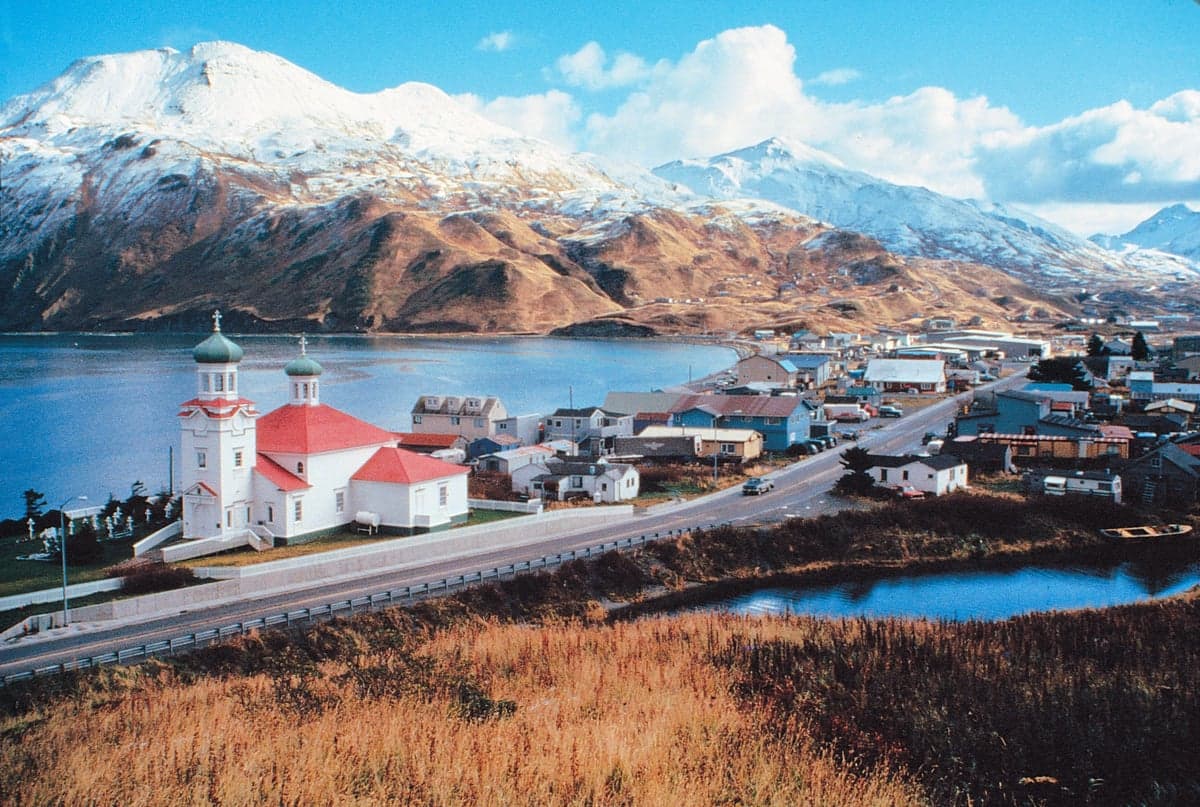
Photo: Wikipedia
Demographics of Unalaska, AK
Affluence Level in Unalaska, AK
An upper-middle-class area. Household wealth, education levels, and homeownership run ahead of national benchmarks.
People of Unalaska, AK
Today, Unalaska’s 4,430 residents form one of the most ethnically distinctive populations in Alaska: nearly half (47.0%) are East and Southeast Asian, primarily Filipino, while the White population has shrunk to just 21.9%. The city is a tight-knit, working-class port community where the Bering Sea fishing industry dictates daily life, and the foreign-born share (28.5%) is more than triple the national average. This is not a typical Alaska frontier town — it is a modern, multicultural company town built around a single industry, with a population density and diversity that feel more like an urban fishing district than a remote Aleutian island outpost.
How the city was settled and grew
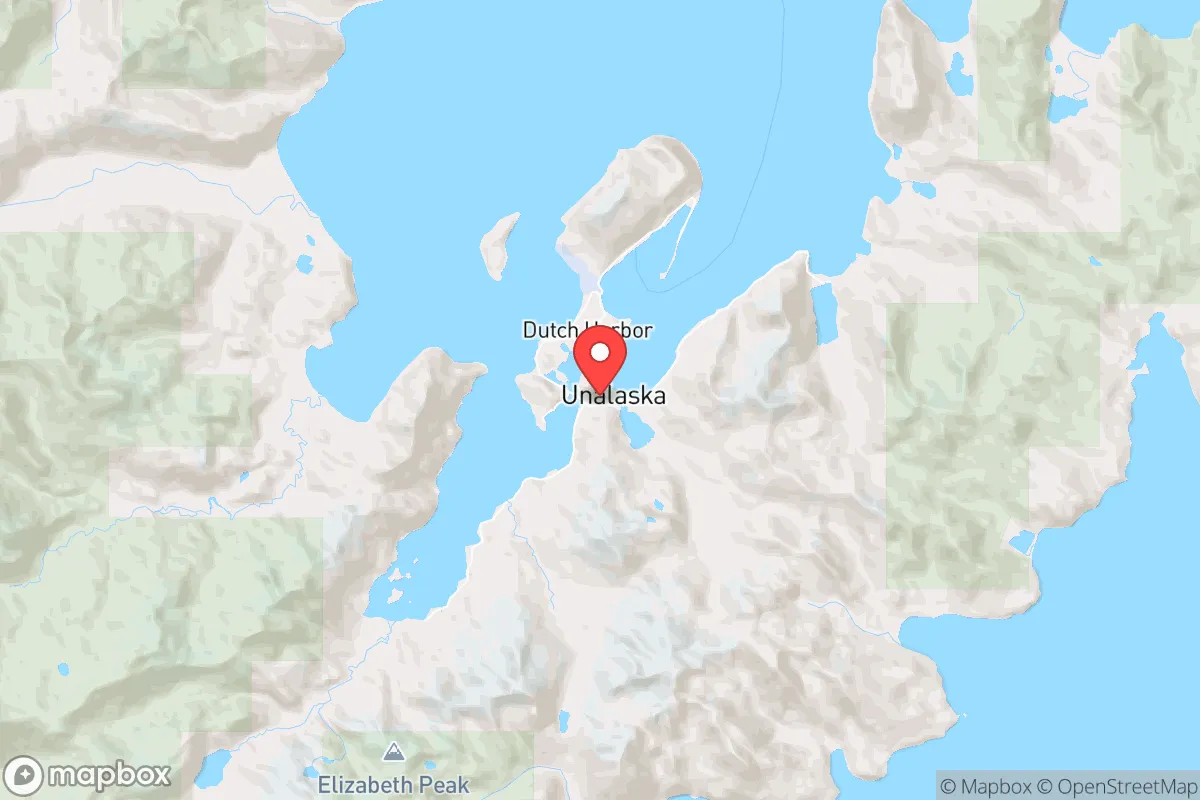
Unalaska’s human history begins with the Unangax̂ (Aleut) people, who occupied the island for thousands of years before Russian fur traders arrived in the mid-18th century. The Russian-American Company established a permanent settlement at Illiuliuk Village (the historic core of today’s Unalaska) in the 1770s, using forced Unangax̂ labor to harvest sea otters. After the U.S. purchased Alaska in 1867, the population dwindled to a few hundred, mostly Unangax̂ and a handful of American missionaries and traders. The modern city was effectively born during World War II, when the U.S. military built Fort Schwatka and Dutch Harbor Naval Operating Base on Amaknak Island, connected by a bridge to Unalaska. Thousands of servicemen and construction workers poured in, and the Unangax̂ population was forcibly evacuated to internment camps in Southeast Alaska. After the war, the military left, but the infrastructure — docks, runways, housing — remained, setting the stage for the fishing boom. The original Unangax̂ settlement at Illiuliuk and the military-built neighborhoods on Amaknak Island, such as Dutch Harbor proper, became the foundation of the modern town.
Modern era (post-1965)
The 1965 Hart-Cellar Act opened immigration from Asia, and the 1970s collapse of West Coast fisheries sent fishing fleets north to the Bering Sea. Unalaska’s population exploded from roughly 200 in 1970 to over 4,000 by 1990. The dominant group in this wave was Filipino men recruited to work in the crab and pollock processing plants. They settled in Dutch Harbor and the newer residential areas on Amaknak Island, particularly around the processing plants and the Spit — a narrow strip of land where worker housing and docks are concentrated. By the 2000s, Filipino families had established a permanent community, with churches, grocery stores, and social clubs in the Broad Bay and Captain’s Bay neighborhoods. The White population, once the majority, declined as the fishing industry professionalized and younger Alaskans moved to Anchorage for education and white-collar work. Today, East and Southeast Asians (47.0%) are the largest group, followed by Whites (21.9%), Hispanics (14.7%), and Blacks (5.4%). The Indian subcontinent population is negligible at 0.1%. The Unangax̂ population, now a small minority, lives primarily in the Illiuliuk historic district and the Summer Bay area on Unalaska Island.
The future
Unalaska’s population is plateauing — the 2020 census showed a slight decline from 4,376 to 4,254, with a modest rebound to 4,430 in 2024 estimates. The city is not homogenizing; instead, it is tribalizing into distinct enclaves: Filipino families in Dutch Harbor and Amaknak Island worker housing, Whites in the hillside homes of Broad Bay and Captain’s Bay, and a small but stable Unangax̂ community in Illiuliuk and Summer Bay. The Hispanic population (14.7%) is growing, largely from Mexican and Central American workers in the processing plants, and they are settling in the same Amaknak Island neighborhoods as the Filipino community. The foreign-born share (28.5%) is likely near its peak, as immigration from the Philippines has slowed and the city’s high cost of living discourages new arrivals. The college-educated share (18.3%) is low, reflecting the blue-collar nature of the economy. Over the next 10–20 years, Unalaska will likely remain a majority-minority, immigrant-heavy fishing port, with slow or zero population growth. The city’s future depends entirely on the health of the Bering Sea crab and pollock fisheries — any downturn would trigger rapid out-migration.
For a conservative-leaning individual or family considering a move, Unalaska offers a stable, family-oriented community with low crime, strong schools (by Alaska standards), and a clear economic purpose. But it is not a place for those seeking suburban amenities, racial homogeneity, or a growing job market outside fishing. The city is what it is: a compact, multicultural, industry-dependent outpost where everyone knows that the next generation will likely leave for the mainland. Moving here means joining a community that values hard work, self-reliance, and neighborly interdependence — values that align well with a conservative worldview, even if the ethnic makeup looks nothing like the Lower 48’s heartland.

* Values derived from national, state, county, city and local statistics and may differ in a specific area. Last updated: 2026-04-19T19:40:13.000Z
Narrative content on this page is AI-generated and may contain mistakes. Verify any details that matter before acting on them.
ReloMaps may earn a commission from affiliate links at no extra cost to you.

