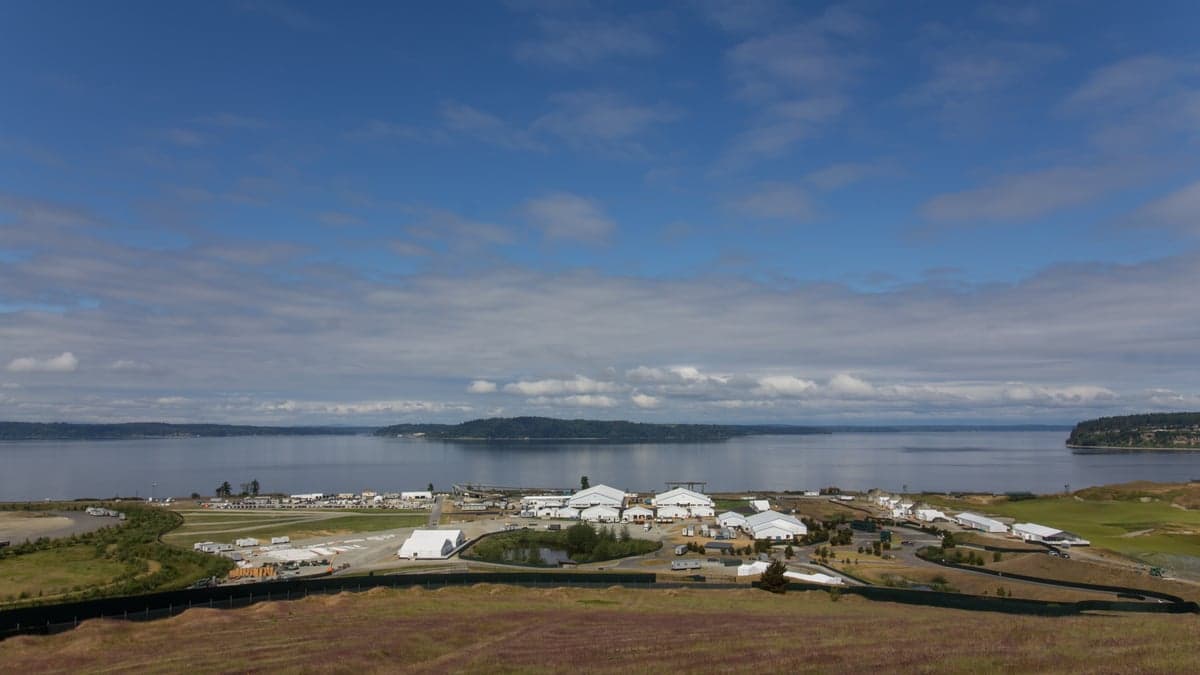
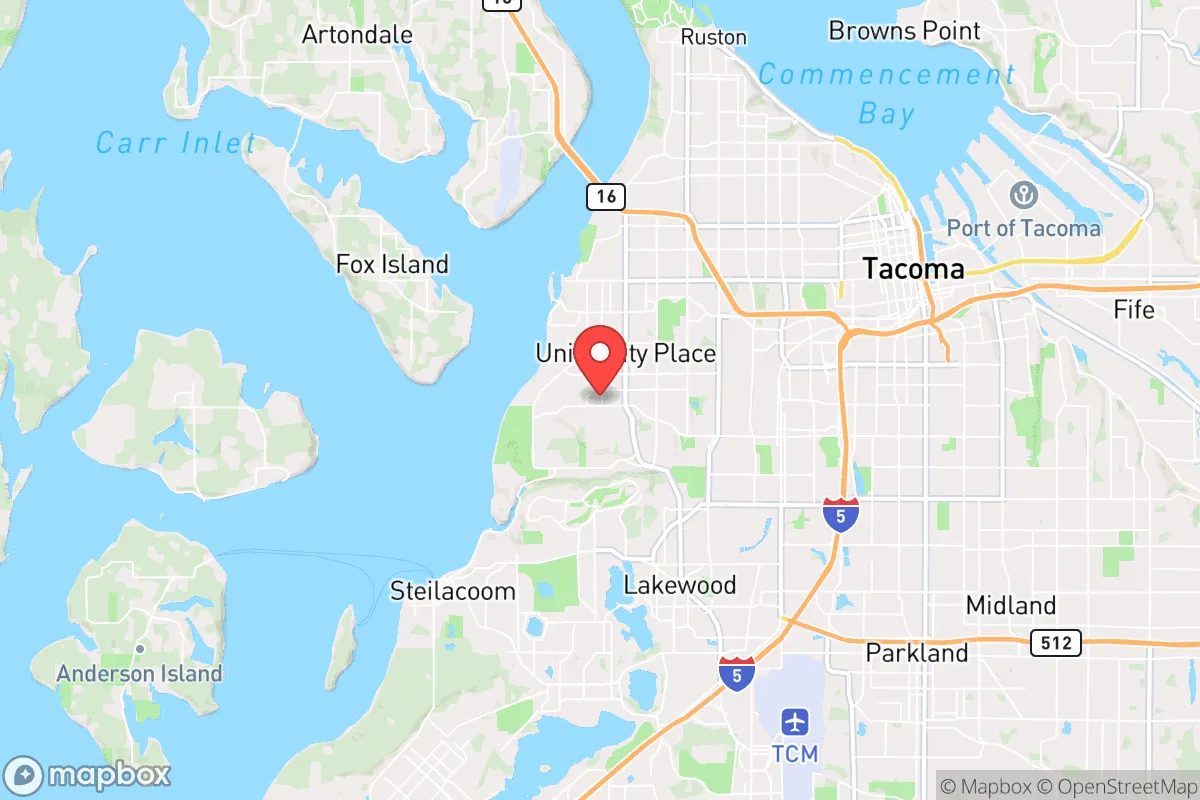
Photo: Wikipedia
Demographics of University Place, WA
Affluence Level in University Place, WA
An upper-middle-class area. Household wealth, education levels, and homeownership run ahead of national benchmarks.
People of University Place, WA
University Place, Washington, is a suburban city of roughly 34,850 residents with a distinctly family-oriented, middle-to-upper-middle-class character. The population is predominantly white (60.6%) but has grown notably more diverse over the past two decades, with significant Hispanic (11.6%), East/Southeast Asian (9.7%), and Black (7.2%) communities, alongside a small Indian-subcontinent population (1.0%). The city’s identity is shaped by its high educational attainment (43.5% college-educated) and a low foreign-born share (4.5%), reflecting a largely native-born, professional-class suburb that has absorbed waves of domestic in-migration from Seattle and Tacoma rather than international immigration.
How the city was settled and grew
University Place’s human history begins not with colonial settlement but with the Puyallup Tribe, who used the bluffs overlooking Puget Sound for seasonal fishing and gathering. The area remained sparsely populated until the early 20th century, when Tacoma’s expansion pushed middle-class families southward. The city’s name derives from the University of Puget Sound, which briefly operated a campus here in the 1920s. The first major residential wave came in the 1940s and 1950s, driven by defense-industry jobs at the nearby McChord Air Force Base and the Port of Tacoma. These early subdivisions—Chambers Creek Estates and Sunset Beach—were built for white, blue-collar families working in manufacturing and logistics. The 1960s saw the development of Westwood, a master-planned neighborhood of ranch-style homes that attracted Tacoma professionals and military officers. By 1970, University Place was nearly 95% white, with a small Japanese American community concentrated around the Narrows View area, many of whom had returned to the region after wartime incarceration.
Modern era (post-1965)
The post-1965 immigration reforms had a muted effect on University Place compared to nearby Tacoma or Seattle, as the city’s housing stock and school reputation drew primarily domestic migrants. The major demographic shift began in the 1990s, when the expansion of Joint Base Lewis-McChord brought a more racially diverse military population. Black and Hispanic service members and their families settled in the Chambers Creek and Cirque Drive neighborhoods, drawn by newer, affordable townhomes and proximity to the base. The 2000s saw a surge of East/Southeast Asian families—particularly Vietnamese and Filipino—moving into the Westwood and University Place South areas, attracted by the highly rated University Place School District and the growing Asian commercial corridor along Bridgeport Way. The Hispanic population grew steadily from 5% in 2000 to 11.6% today, concentrated in the Narrows View and Chambers Creek neighborhoods, where older, smaller homes offered entry-level affordability. The Indian-subcontinent community remains small (1.0%) and is dispersed rather than clustered, with families typically moving in for tech and healthcare jobs in Tacoma or Seattle.
The future
University Place is homogenizing in some respects and tribalizing in others. The white share has declined from 75% in 2000 to 60.6% today, but the city remains less diverse than Tacoma or Lakewood. The foreign-born share is low (4.5%) and has plateaued, suggesting that future diversification will come from domestic migration rather than new immigration. The Hispanic and East/Southeast Asian communities are growing but not forming distinct ethnic enclaves; instead, they are dispersing across the city, particularly in newer developments like University Place South and the Chambers Creek corridor. The Black population, heavily tied to the military, is stable but not expanding, as base housing options shift. Over the next 10–20 years, University Place will likely become slightly more diverse but remain a predominantly white, college-educated suburb. The key demographic trend is aging: the median age has risen to 41, and the city is attracting fewer young families than nearby Puyallup or Bonney Lake, which offer newer, larger homes. This could slow population growth and reinforce the city’s character as a stable, established community rather than a rapidly changing one.
For someone moving in now, University Place is a mature, well-educated suburb with a stable but slowly diversifying population. The city offers a safe, family-oriented environment with strong schools and a low crime rate, but it lacks the rapid growth or ethnic vibrancy of nearby Tacoma. New residents will find a community that values stability, education, and outdoor recreation, with a demographic trajectory that points toward gradual diversification rather than dramatic change. The city is becoming more inclusive but remains fundamentally a place where native-born, professional-class families set the tone.

* Values derived from national, state, county, city and local statistics and may differ in a specific area. Last updated: 2026-04-21T11:15:54.000Z
Narrative content on this page is AI-generated and may contain mistakes. Verify any details that matter before acting on them.
ReloMaps may earn a commission from affiliate links at no extra cost to you.

