Photo: Wikipedia
Political ClimatePolitical Climate in University Place, WA
District shown is the primary district for this city’s centroid. Cities may span multiple districts.
Local Political AnalysisPolitical Analysis of University Place, WA
University Place, Washington, leans heavily Democratic, with a Cook PVI of D+9, meaning it votes about nine points more Democratic than the national average. This wasn't always the case—twenty years ago, this was a solidly purple, middle-class suburb where folks voted on local issues, not party lines. But the shift has been steady, especially since the 2016 election, and the 2024 results only cemented that trend. If you're looking for a place where your vote for limited government and personal freedom might actually tip the scales, University Place is not that place anymore.
How it compares
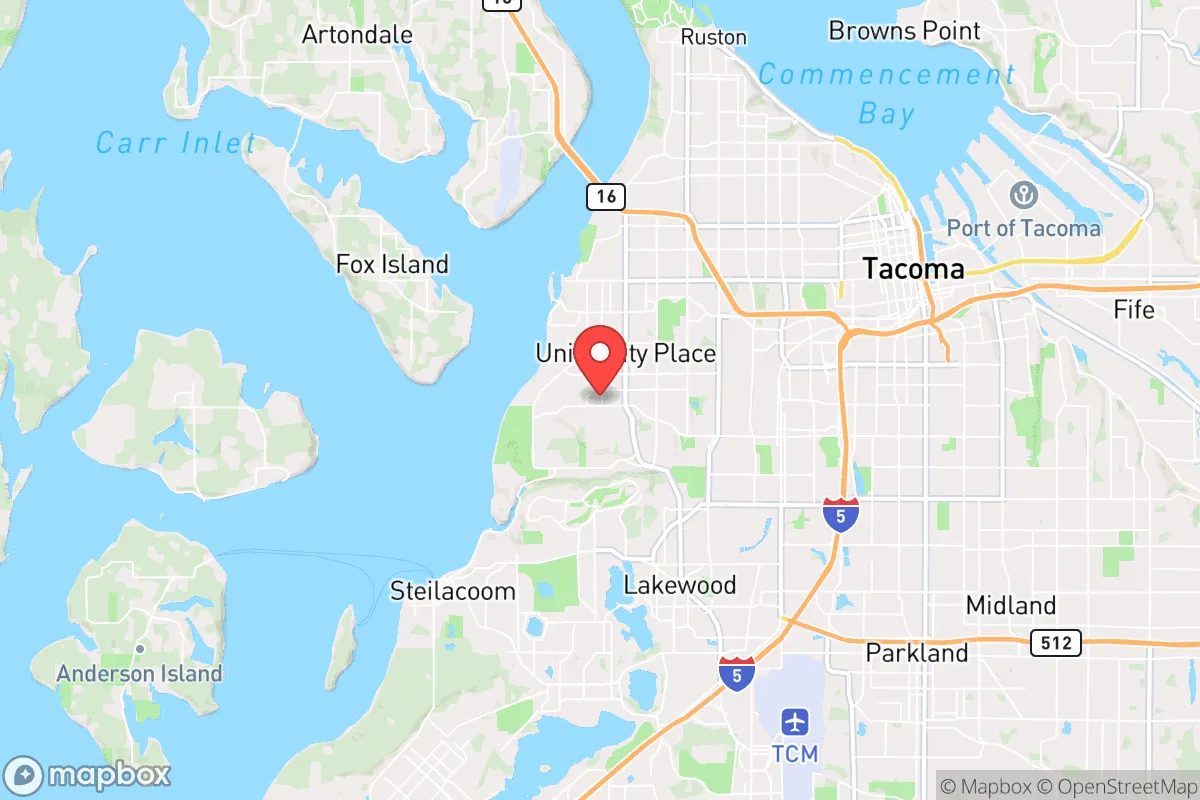
To understand University Place, you have to look at its neighbors. Head south to Lakewood, and you'll find a more working-class, diverse city that still leans blue but has a stronger libertarian streak—people there are skeptical of new taxes and zoning overreach. Go east to Tacoma, and you're in a deep-blue urban core where progressive policies on housing, policing, and taxes are the norm. But the real contrast is to the west and north: Gig Harbor and Fox Island are reliably red, with voters who prioritize property rights, school choice, and keeping government out of their backyards. University Place sits in the middle, but it's been drifting toward Tacoma's politics for years. The city council and school board are dominated by Democrats, and local ballot measures—like the 2023 property tax levy for parks—passed easily, even as similar measures failed in Gig Harbor.
What this means for residents
For a conservative or libertarian-leaning resident, the practical effect is that your voice is often drowned out. Local zoning laws have become more restrictive, with the city pushing for "missing middle" housing mandates that override what homeowners can do with their own property. The school district has adopted curriculum that emphasizes social-emotional learning and equity initiatives, which some parents see as government overreach into how their kids are taught. And while crime rates remain low compared to Tacoma, the city council has resisted expanding the police budget, instead funding social worker programs—a move that feels good in theory but leaves some residents uneasy about response times. The tax burden is also creeping up: property taxes in Pierce County have risen about 8% annually since 2020, and University Place's utility taxes are among the highest in the county. If you value keeping more of your own money and making your own choices about your home and family, you'll feel the squeeze here.
One cultural distinction worth noting: University Place still has a strong sense of community, with well-kept parks and a popular farmers market. But the political drift is real. The long-term trajectory points toward more progressive policies—denser housing, higher taxes, and a bigger role for government in daily life. If you're considering a move here, I'd say come for the schools and the views of the Sound, but don't expect the political climate to swing back anytime soon. It's a comfortable place to live if you keep your head down, but if you're the type who likes to push back against the tide, you'll find yourself swimming upstream more and more each year.

State Political ClimatePolitical Climate in Washington
State Political AnalysisPolitical Environment in the State
Washington State has shifted from a classic swing state to a solidly Democratic stronghold over the past two decades, with Democrats controlling every statewide office and both legislative chambers since 2012. The state’s overall partisan lean is roughly D+8 to D+10 in presidential elections, but that top-line number masks a deep and growing urban-rural chasm. While King County (Seattle) and a handful of other urban centers drive the blue wave, vast swaths of Eastern Washington and even parts of the Puget Sound exurbs remain deeply red. For a conservative considering relocation, the key takeaway is that Washington is not a monolith—but the state-level policy direction is increasingly progressive and, from a freedom perspective, concerning.
Urban vs. rural divide
The political map of Washington is a tale of two states. The western third, anchored by the Seattle metro area (King, Snohomish, and Pierce counties), generates roughly 60% of the state’s vote and leans heavily Democratic. King County alone gave Joe Biden 73% of the vote in 2020. Meanwhile, Eastern Washington—counties like Spokane, Yakima, Grant, and Whitman—votes reliably Republican, often by 20-30 point margins. The real battlegrounds are the suburban and exurban counties that have been trending blue: Clark County (Vancouver) flipped from red to purple to blue over the last decade, and even traditionally conservative areas like Kitsap County (Bremerton) now lean Democratic. The most politically distinct conservative strongholds are the Tri-Cities (Kennewick, Pasco, Richland) and Spokane Valley, where GOP candidates routinely win by double digits. But these areas lack the population mass to counterbalance Seattle’s dominance.
Policy environment
Washington’s policy environment is a mixed bag for conservatives. On the plus side, there is no state income tax—a major draw for high earners and business owners. Property taxes are moderate, and sales taxes are high (averaging 8-9% statewide) but not crushing. However, the regulatory posture is aggressively progressive. The state has a strict carbon cap-and-trade program (Climate Commitment Act), a capital gains tax that was upheld by the state Supreme Court in 2023, and a long-term care payroll tax (WA Cares) that many residents view as an overreach. Education policy is dominated by teachers’ unions, and school choice is virtually nonexistent—no vouchers, no charter schools to speak of. Healthcare is heavily regulated, with a state-based insurance exchange and a public option (Cascade Care) that has struggled to gain traction. Election laws are among the most liberal in the country: universal mail-in voting, same-day registration, and no voter ID requirement at the polls. For a conservative, the lack of income tax is a lifeline, but the regulatory creep is real.
Trajectory & freedom
On the freedom front, Washington is trending in the wrong direction. The state has enacted some of the nation’s strictest gun laws: a ban on “assault weapons” (HB 1240, 2023), a ban on high-capacity magazines (HB 1143, 2022), and a 10-day waiting period for all firearm purchases. Magazine bans and the assault weapons ban are currently being challenged in court, but the trend is clear. Parental rights have taken a hit: the state passed a “shield law” for gender-affirming care (SB 5599, 2023) that allows minors to receive treatment without parental consent in some circumstances, and a 2024 law (HB 1231) expanded this to include out-of-state travel for such care. Medical autonomy is constrained by the state’s vaccine mandates for healthcare workers and school employees, which remain in place post-pandemic. Property rights are under pressure from the state’s Growth Management Act, which limits development in rural areas and has driven up housing costs. The state’s “public records act” is strong, but the legislature has carved out exemptions for itself. The bottom line: personal liberty is being eroded in the name of public health, safety, and equity.
Civil unrest & political movements
Washington has a long history of political activism, and recent years have seen flashpoints on both sides. The 2020 CHOP/CHAZ occupation in Seattle’s Capitol Hill neighborhood was a national symbol of progressive overreach, with a six-block area taken over by activists for weeks, resulting in multiple shootings and a police retreat. On the right, the “WAGOP” has been riven by internal battles between moderates and the more populist “MAGA” wing, but conservative activism is alive in the form of “Moms for Liberty” chapters in suburban counties like Clark and Spokane, and the “Washington State Grange” remains a rural organizing force. Immigration politics are contentious: Washington is a “sanctuary state” (SB 5297, 2019), limiting local law enforcement cooperation with ICE. Election integrity has been a flashpoint, with the 2020 and 2022 cycles seeing lawsuits over ballot drop-box security and signature verification—though no widespread fraud has been proven. The most visible flashpoint for a new resident would be the homelessness crisis in Seattle and Portland-adjacent Vancouver, which has spawned tent encampments and a political backlash that has yet to produce meaningful policy change.
Projection
Over the next 5-10 years, Washington will likely become more progressive, not less. In-migration is slowing, but the people moving in are still disproportionately from blue states like California and Oregon, while out-migration is trending toward red states like Texas and Idaho. The state’s Democratic supermajority in the legislature is unlikely to be broken, given the population concentration in King County. Expect more gun control, more environmental regulation, and more expansion of the social safety net. The capital gains tax will likely be expanded into a full income tax if the state Supreme Court allows it. The one wild card is the housing crisis: if affordability continues to deteriorate, it could drive a political realignment in the suburbs, but that’s a long shot. For a conservative moving in now, the realistic expectation is that state-level policy will continue to feel like a hostile environment, but local control in red counties like Spokane, Yakima, and the Tri-Cities offers some buffer.
For a conservative considering Washington, the practical takeaway is this: you can find a community that shares your values in the eastern half of the state or in the exurbs of Spokane and the Tri-Cities, but you will be fighting an uphill battle at the state level. The lack of income tax is a genuine advantage, but it comes with a heavy regulatory price tag. If you value low taxes and a rural lifestyle, Washington still has appeal—but be prepared for a political climate that is increasingly at odds with your principles. The state is not lost, but it is trending in a direction that requires vigilance and active engagement to preserve what freedom remains.
* Values derived from national, state, county, city and local statistics and may differ in a specific area. Last updated: 2026-04-21T11:15:54.000Z
Narrative content on this page is AI-generated and may contain mistakes. Verify any details that matter before acting on them.
ReloMaps may earn a commission from affiliate links at no extra cost to you.

