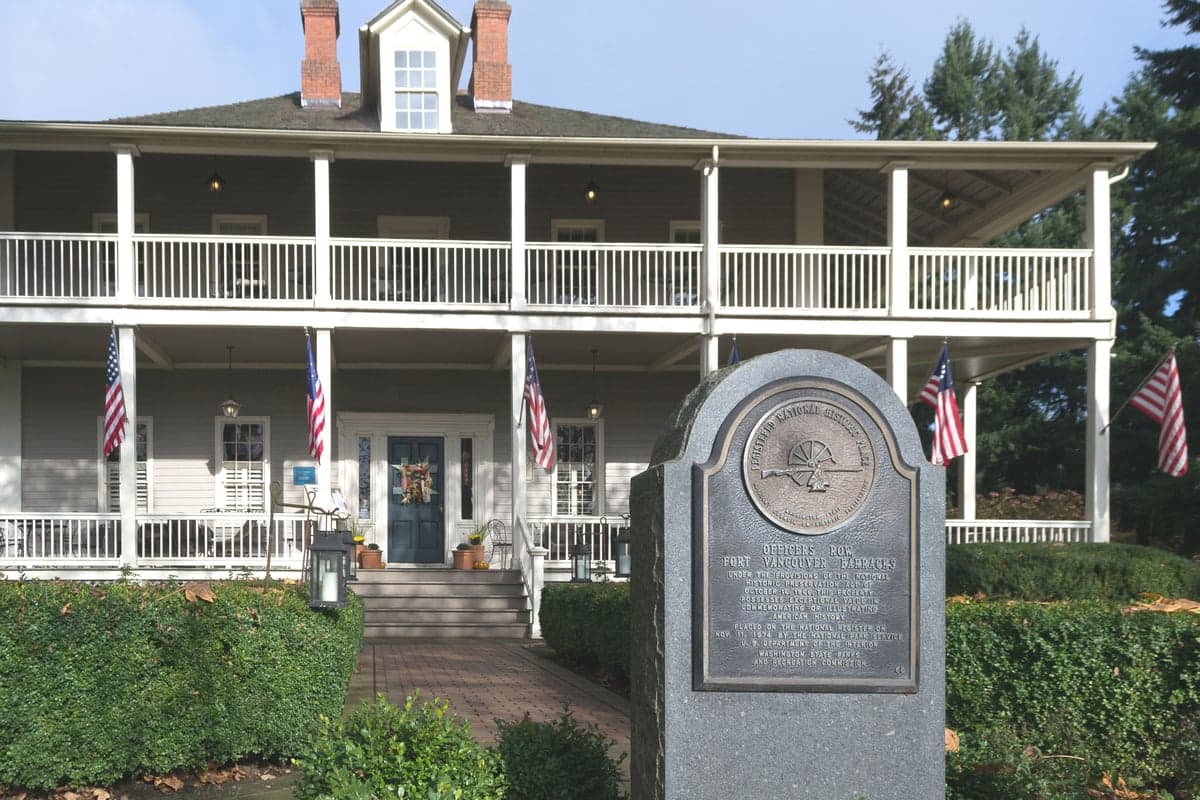
Photo: Wikipedia
Strategic Assessment of Vancouver, WA
Multiple tactical vulnerabilities. Population density, target proximity, or disaster risk are likely compounding. A retreat property and exit planning is required.
What does the Strategic Assessment tell us?
Our Strategic Assessment grades tactical survivability of an area. Major population centers, military targets, fallout zones, natural disasters, and border exposure all drive risk — lower exposure means a more defensible position in a crisis.
This is heavily inspired by Joel Skousen's Strategic Relocation book. Highly recommended you checkout the book ($)What does this tell us?
Our Strategic Assessment grades tactical survivability of an area. Major population centers, military targets, fallout zones, natural disasters, and border exposure all drive risk — lower exposure means a more defensible position in a crisis.
This is heavily inspired by Joel Skousen's Strategic Relocation book. Highly recommended you checkout the book ($)Strategic Pillars

Key Distances
Regional Safe Places
Below is our recommended "safe zones" in Washington and the surrounding area based on our strategic heuristics. For most people, it's unrealistic to live in a “safe zone” full-time due to work, family or other personal reasons. They tend to be more rural. However, many of these areas are perfect for second homes and retreat properties that double as a vacation home or even a short-term rental.
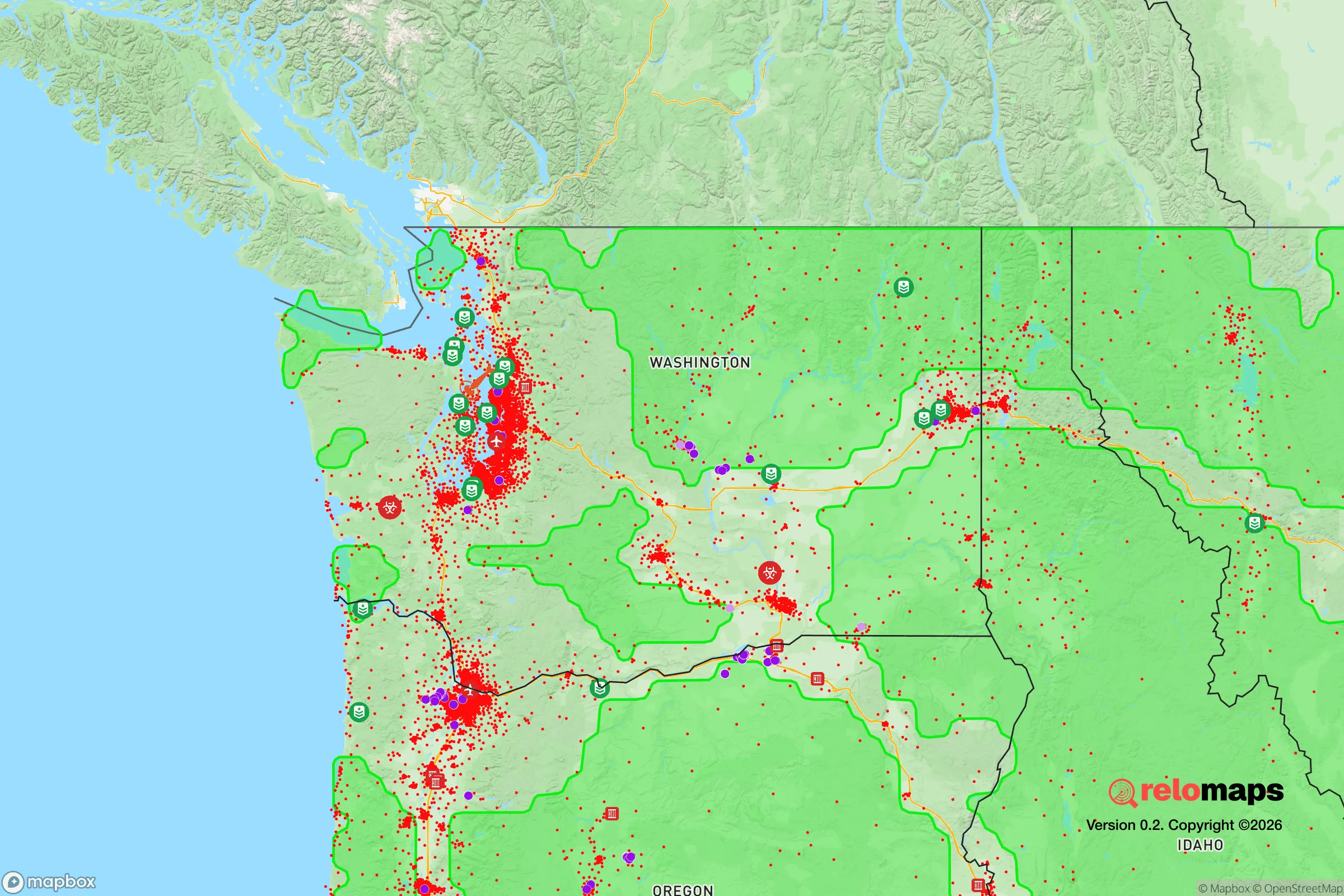
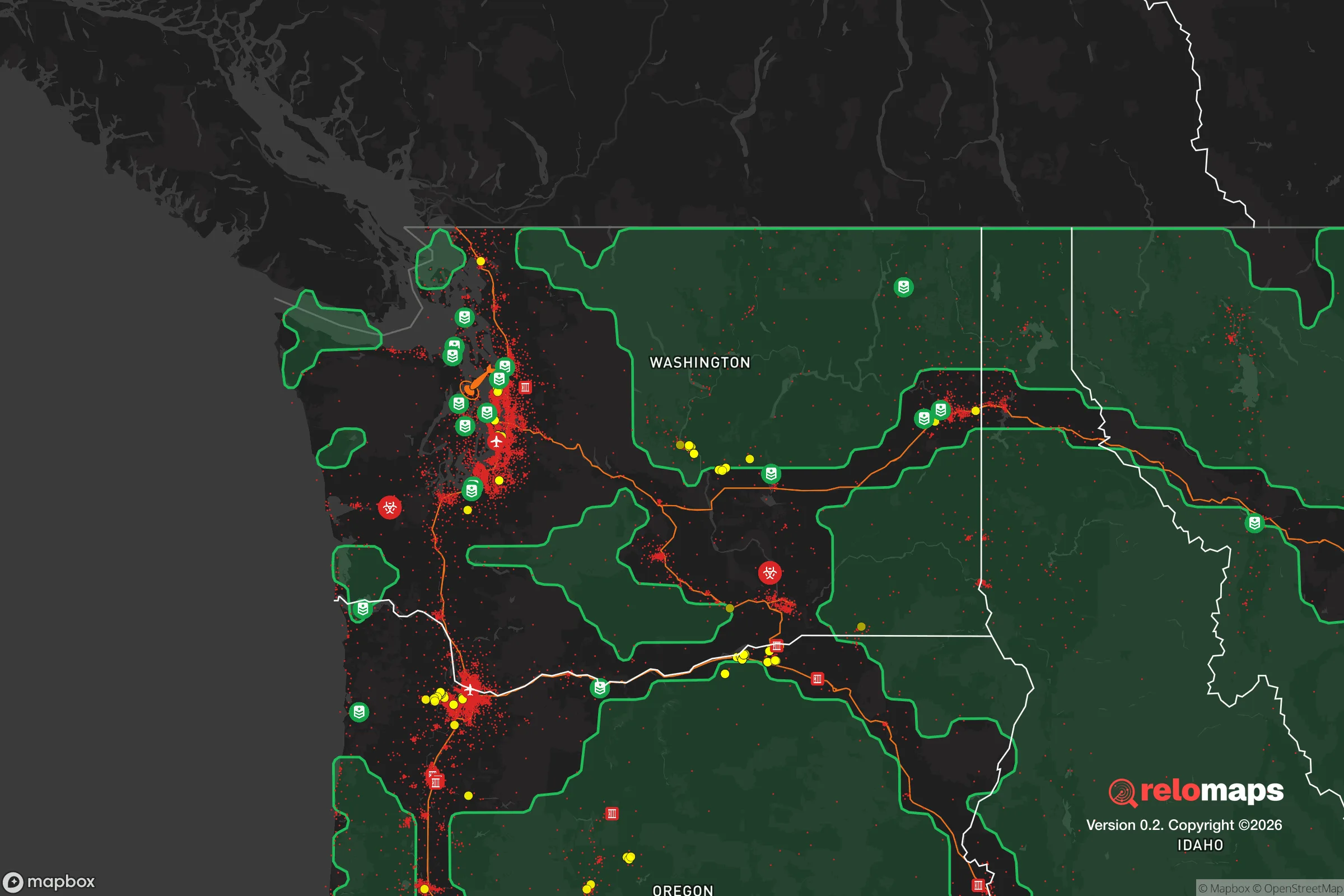


Important Note: For informational purposes only. This does not mean nothing bad ever happens in the green zones. Please use common sense. This is based on public data and modeled with AI. We tried to take a conservative approach but mistakes happen. We update this regularly as new information becomes available.
Solar Generator Recommendations
Backup power matters more here than in safer locations. We've picked three solar generators across budgets and capacity tiers — start with the budget unit if you only need a few essentials, or step up if you want to run a fridge and HVAC for days at a time.

Jackery Portable Power Station Explorer 300
Budget OptionPower on the Go: Weighing only 11 lbs, it's convenient to set up and store with book-sized foldable solar panels

BLUETTI Portable Power Station AC180
Designed for both indoor and outdoor scenarios, AC180 is highly capable as it has a robost capacity and continuous output power.

EF ECOFLOW DELTA Pro Ultra Power Station
Upgraded PickEcoFlow DELTA Pro Ultra is a whole-home energy system designed to grow with your family. Integrated with the Smart Home Panel 2, it scales to meet your evolving energy needs — keeping your home powered, intelligent, and secure through every stage of life.
We earn a commission, at no additional cost to you.
Strategic Assessment Analysis
Vancouver, Washington, sits in a strategic paradox: it offers the economic and infrastructure benefits of being adjacent to Portland, Oregon, while remaining legally and politically distinct in a state with more favorable gun laws, lower income taxes, and a less centralized governance structure. For a relocator with a prepper mindset, the city’s resilience hinges on its ability to leverage the Columbia River as a natural barrier and its position as a secondary hub away from the densest urban core, but its proximity to a major metropolitan area introduces significant vulnerabilities. The key question is whether Vancouver’s geographic advantages—access to water, timber, and agricultural land—outweigh the risks of being within the blast radius of Portland’s potential collapse.
Geographic position and natural advantages for long-term survival
Vancouver’s location at the confluence of the Columbia and Willamette rivers provides a dual-edged resource. The Columbia River Gorge offers a natural choke point for movement from the east, while the river itself is a reliable water source for filtration and transport. The city sits in the Willamette Valley’s northern edge, which is one of the most fertile agricultural regions in the Pacific Northwest, with nearby farms producing apples, berries, and grains. The Cascade Range to the east provides a buffer against seismic activity from the Cascadia Subduction Zone, though Vancouver is still within the zone’s impact area. The city’s elevation—averaging around 200 feet—keeps it above most tsunami risks from a major earthquake, but the low-lying areas near the river are vulnerable to liquefaction. For a relocator, the natural advantages are clear: abundant freshwater, moderate climate for year-round gardening, and forested terrain for timber and game. The Columbia River also serves as a defensible boundary, making it harder for unrest from Portland to spill north without crossing a major bridge, which could be monitored or blocked.
Risks, exposures, and proximity to fallout-relevant landmarks
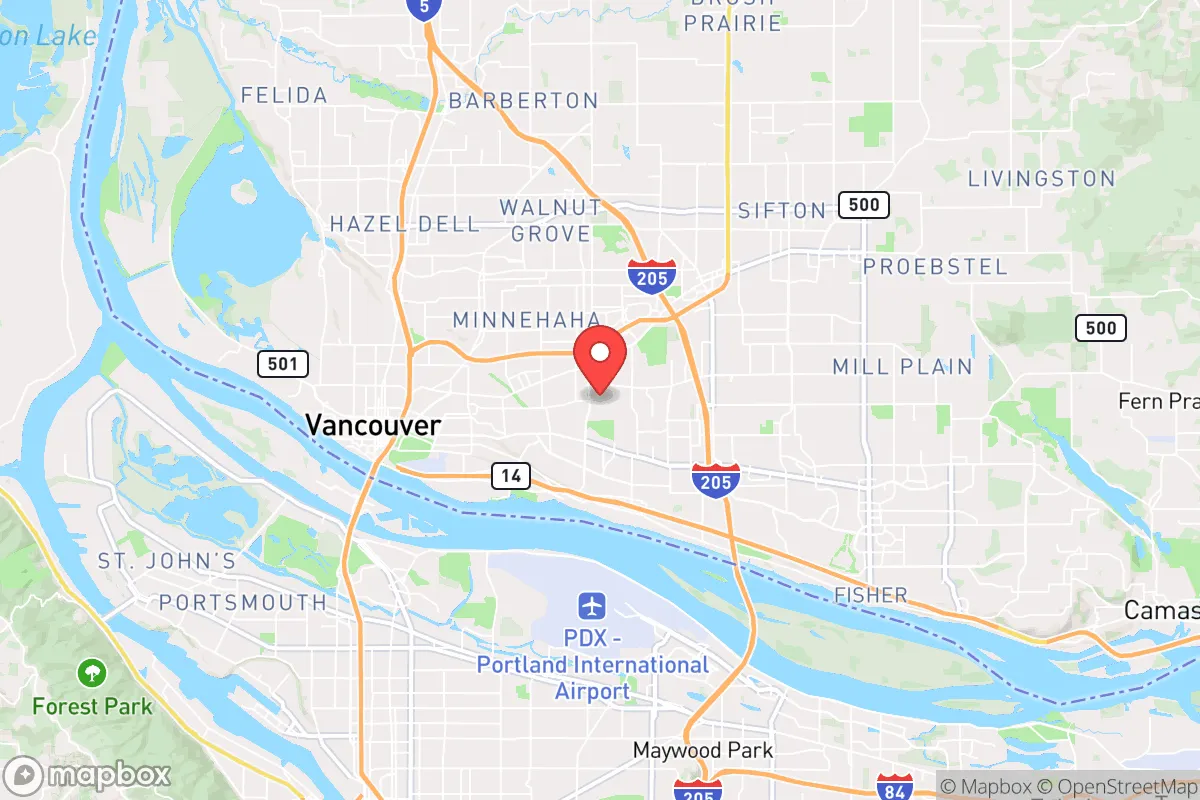
The most glaring risk for Vancouver is its adjacency to Portland, a city of roughly 650,000 people that has experienced significant civil unrest, property crime spikes, and drug-related issues since 2020. Portland’s proximity means that any mass casualty event—whether from a Cascadia earthquake, a terrorist attack on the numerous bridges, or a pandemic resurgence—would send waves of displaced people north across the I-5 and I-205 bridges. Vancouver’s population of about 200,000 is not large enough to absorb a refugee surge without straining resources. The city is also within 50 miles of the Portland International Airport and major rail yards, which are high-value targets for sabotage or infrastructure collapse. Additionally, the Hanford Nuclear Site in eastern Washington is roughly 150 miles away, meaning fallout from a catastrophic event there could drift over Vancouver depending on wind patterns. The Portland-Vancouver metro area’s reliance on a single major interstate (I-5) for north-south movement creates a critical chokepoint; a bridge failure or blockade would effectively isolate the city from Seattle and the rest of Washington. For a prepper, the exposure to Portland’s instability is the primary reason to consider more rural alternatives like Camas or Washougal, which offer better defensible positions east of the city.
Practical resilience for a relocator: food, water, energy, and defensibility
For a single individual or family looking to establish a resilient setup, Vancouver offers mixed prospects. The city’s water supply comes from the Bull Run Watershed, which is vulnerable to seismic damage and wildfire contamination, but many residents have access to private wells in the outlying areas like Felida or Ridgefield. The local energy grid is tied to the Bonneville Dam system, which provides cheap hydroelectric power but is a single point of failure; a Cascadia earthquake could knock out the dams for months. Food resilience is better than most urban areas: the Vancouver Farmers Market and local CSAs provide direct access to regional produce, and the city’s zoning allows for backyard chickens and small livestock in many residential areas. However, the city’s defensibility is poor in the core neighborhoods—dense housing, limited escape routes, and proximity to Portland’s crime spillover. The Vancouver Police Department has been understaffed relative to population growth, with response times for property crimes often exceeding 30 minutes. For a relocator, the practical strategy is to buy property in the northern or eastern edges of Clark County, such as Hockinson or Battle Ground, where lot sizes are larger, neighbors are more self-reliant, and the terrain offers natural cover. Gun laws in Washington are more restrictive than Oregon’s, with a 2023 ban on many semi-automatic rifles and a 10-day waiting period for handguns, so preppers should secure their firearms before moving or consider the legal workarounds like bolt-action rifles and shotguns for home defense.
The overall strategic picture for Vancouver is that it works best as a staging area rather than a final retreat. Its strengths—economic opportunity, river access, and a moderate climate—make it a viable base for building supplies, networking with like-minded individuals, and establishing a secondary bug-out location further east in the Gorge or north toward Mount St. Helens. But the city’s dependence on Portland’s stability and its exposure to Cascadia seismic risks mean that a relocator should not view Vancouver as a long-term survival haven. Instead, treat it as a high-functioning buffer zone: close enough to urban resources to stockpile and earn a living, but with a clear exit plan for when the bridges go down or the unrest reaches your doorstep. For a conservative-leaning individual or family, the political climate in Clark County is more balanced than Portland’s—the county voted +3 for Trump in 2020—but the state government in Olympia is increasingly hostile to gun rights and energy independence. The smart move is to buy land with a well and septic in the rural outskirts, keep a low profile, and maintain a network of contacts in both Oregon and Washington to monitor the flow of threats. Vancouver is not a fortress, but it is a defensible forward operating base for those who understand its limits.

* Values derived from national, state, county, city and local statistics and may differ in a specific area. Last updated: 2026-04-21T11:07:28.000Z
Narrative content on this page is AI-generated and may contain mistakes. Verify any details that matter before acting on them.
ReloMaps may earn a commission from affiliate links at no extra cost to you.

