Photo: Wikipedia
Demographics of Caledonia County
Affluence Level in Caledonia County
A middle-class area roughly in line with national averages across income, home values, education, and employment.
People of Caledonia County
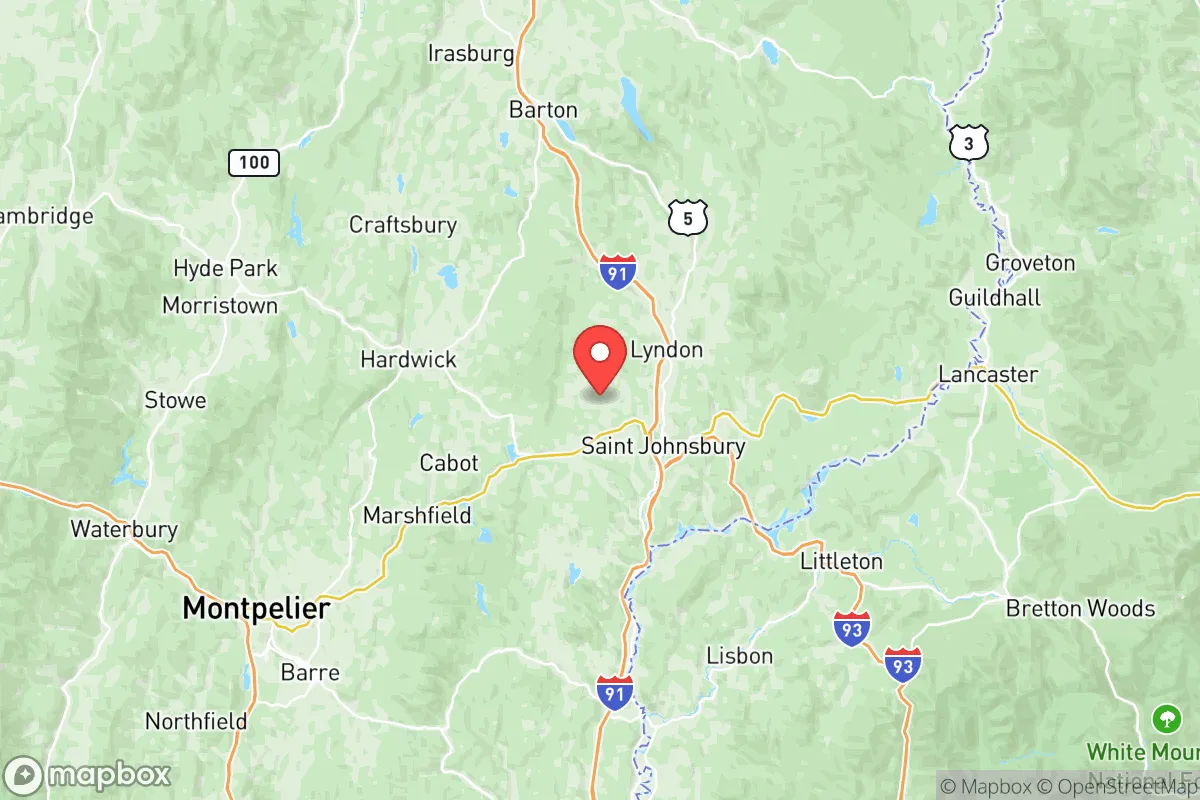
Today, the population of Caledonia County, Vermont stands at just over 30,400, making it one of the state's smaller and more rural counties. White residents account for 92.6 percent of the population, a figure well above Vermont’s already high average, with foreign-born residents making up only 0.7 percent of the county’s people. The largest concentration of residents lives in and around the county seat, St. Johnsbury, with smaller clusters in towns like Lyndon, Hardwick, Danville, and Barnet. The county’s character is shaped by a deep, persistent Yankee and French-Canadian heritage, a low population density, and an economy historically tied to agriculture, logging, and light manufacturing.
Settlement & growth (pre-1960)
Long before European settlers arrived, the land now called Caledonia County was part of the traditional territory of the Western Abenaki people, who lived in seasonal villages along the Passumpsic River and the Connecticut River valley. Their presence dates back centuries, with evidence of habitation near present-day St. Johnsbury and Barnet. European colonization began in the late 1700s, when New England Land Grants—part of the New Hampshire Grants—drew English-speaking settlers from Connecticut, Massachusetts, and New Hampshire. The town of St. Johnsbury was chartered in 1786 and named after John and Duncan St. John, early speculators. The first wave of permanent settlers arrived between 1790 and 1820, mostly farmers of English and Scots-Irish descent who cleared forests for subsistence agriculture and small-scale cattle farming.
By the mid-19th century, the industrial revolution reshaped the county’s economy and population. The Fairbanks Scale Company was founded in St. Johnsbury in 1830, drawing skilled workers and Irish immigrants to the area. In Hardwick, the granite quarrying industry boomed after the railroad reached the town in the 1870s. Thousands of French-Canadian immigrants crossed the border from Quebec between 1850 and 1910 to work in St. Johnsbury’s mills, Hardwick’s granite sheds, and Lyndonville’s lumber yards. These migrants concentrated in neighborhoods near the factories, forming tight-knit Catholic parishes that remain visible in towns like St. Johnsbury and Lyndon. Smaller numbers of Italian and Polish laborers arrived during the same period, though they never formed large enclaves.
The early 20th century saw a plateau in population growth as industries consolidated and farming declined. By the 1930s, out-migration of young adults to more urban areas began, a trend that continued after World War II. Between 1940 and 1960, the county’s population actually fell slightly, from about 25,000 to 24,000, as rural depopulation took hold. Many of the small hamlets—Peacham, Burke, Groton—retained their Yankee character, while French-Canadian families remained concentrated in St. Johnsbury and Hardwick. The 1960 census recorded that well over 98 percent of the county’s residents were white, with a tiny fraction foreign-born.
Modern era (post-1965)
The 1965 Hart-Cellar Act had almost no effect on Caledonia County’s demographics. Unlike many areas of the United States that saw a surge of immigration from Asia and Latin America, this corner of Vermont remained isolated from those flows. The foreign-born share in 2024 still stands at only 0.7 percent, and the number of residents born outside the United States has rarely exceeded 300 in any census since 1970. That said, small numbers of Hispanic residents have moved into the county since 2000, primarily from Mexico and Central America, finding work in dairy farming and food processing. Today, Hispanic residents represent 2.1 percent of the population, with the largest concentrations in Hardwick and St. Johnsbury. Black residents account for 0.7 percent, East/Southeast Asian residents 0.2 percent, and Indian-subcontinent residents 0.1 percent—each group numbering in the dozens rather than hundreds.
Domestic migration since 1970 has been modest. A small counterculture “back-to-the-land” movement brought a handful of young, college-educated families to towns like Danville, Peacham, and Barnet during the 1970s, drawn by cheap land and a pastoral ideal. Many of those arrivals have since integrated into the local economy, often working in education, healthcare, or remote white-collar jobs. Suburbanization has been minimal; the county lacks a major freeway corridor, and the largest town, St. Johnsbury, has a population of only about 6,100. The county’s population hovered around 27,000 in 1980 and grew slowly to 30,425 by 2024, largely through natural increase and the retention of retirees and remote workers. The college-educated share has risen to 31.9 percent, reflecting an influx of second-home owners and telecommuters, but the overall cultural identity remains rooted in the Yankee and French-Canadian families who have lived here for generations.
The future
Caledonia County appears likely to remain one of Vermont’s most homogeneous places for the foreseeable future. The foreign-born share shows no signs of rising significantly, and the county’s remote location and limited job growth in manufacturing or services are unlikely to attract large immigrant communities. The Hispanic and Asian populations are growing slowly from a very small base, but will probably remain at or below 3 to 4 percent of the total by 2040. Domestic in-migration—primarily from other parts of New England and the mid-Atlantic—is boosting the share of college-educated residents, but these newcomers tend to assimilate into the existing rural culture rather than creating distinct enclaves. The county’s median age is 46, several years above the national median, and out-migration of young adults to Burlington or out of state continues. The population is thus aging, with a modest increase in remote workers and retirees offsetting the loss of youth.
What does the next 10 to 20 years likely look like demographically? The county will become slightly more diverse in the sense of small Hispanic and Asian segments growing from trace to measurable, but the overall character will remain overwhelmingly white and rooted in its historic Yankee, French-Canadian, and Scots-Irish heritage. The towns of St. Johnsbury, Lyndon, and Hardwick will remain the primary population centers, while villages like Peacham and Danville may see a continued trickle of telecommuters and second-home owners from southern New England. The cultural identity is resilient rather than fragile; in-migrants are absorbed, not resisted. For someone moving in now, Caledonia County offers a stable, low-diversity community where generational roots run deep and newcomers are expected to respect the rhythm of rural life.

* Values derived from national, state, county, city and local statistics and may differ in a specific area. Last updated: 2026-06-01T15:15:49.000Z
Narrative content on this page is AI-generated and may contain mistakes. Verify any details that matter before acting on them.
ReloMaps may earn a commission from affiliate links at no extra cost to you.

