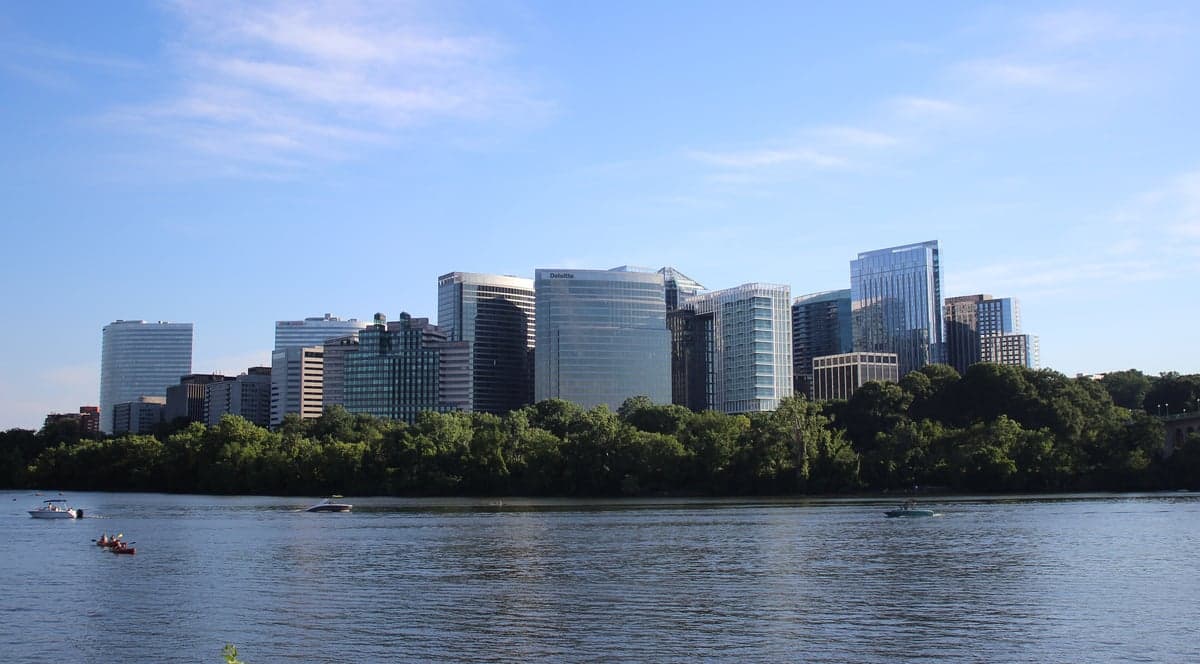
Photo: Wikipedia
Personal Sovereignty in Arlington County
Viable for self-reliance. Generally workable, though some barriers may limit total independence.
What does Personal Sovereignty tell us?
Personal Sovereignty measures your capacity for self-reliance and independence with minimal government friction. Higher scores mean fewer barriers between you and the way you want to live... but it assumes you have the space you need and good neighbors.
What does this tell us?
Personal Sovereignty measures your capacity for self-reliance and independence with minimal government friction. Higher scores mean fewer barriers between you and the way you want to live... but it assumes you have the space you need and good neighbors.
State Policy
Energy independence: Importer (20% of energy produced in-state)
Personal Liberty
Homesteading

Personal Liberty Analysis
Arlington County, Virginia presents a complex personal sovereignty landscape where high state-level autonomy in areas like self-defense and parental rights is counterbalanced by a dense, heavily regulated local environment that limits self-reliance and homesteading. As a compact, urbanized county of just 26 square miles directly across the Potomac from Washington, D.C., Arlington offers residents strong legal protections for gun ownership and medical choice under Virginia law, but those freedoms are exercised within a jurisdiction that imposes some of the highest property taxes in the state and strictly controls land use. For a freedom-minded individual or family, the trade-off is clear: Arlington provides robust personal liberties in theory, but the practical ability to live independently—off-grid, with space for a garden, or without navigating a thicket of county codes—is severely constrained.
Tax burden and regulatory posture: How Arlington compares to the rest of Virginia
Arlington County’s tax and regulatory environment is among the most demanding in Virginia, a state that itself ranks in the middle of the pack nationally for tax burden. The county’s real property tax rate of $1.026 per $100 of assessed value (2025 rate) is significantly higher than the state average of roughly $0.80, and because home values in neighborhoods like Clarendon, Courthouse, and Rosslyn routinely exceed $700,000, the effective annual tax bill for a median-priced home often surpasses $7,000. This is a heavy load compared to more rural Virginia counties like Fauquier or Loudoun, where rates are lower and assessments are more modest. Beyond property taxes, Arlington imposes a personal property tax on vehicles at a rate of $5.00 per $100 of assessed value, plus a local sales tax of 6% (matching the state rate, with no additional local option). The county’s regulatory posture is similarly hands-on: zoning is dense and prescriptive, with strict limits on short-term rentals, home-based businesses, and building modifications. Permitting for even minor renovations—like adding a deck or replacing a fence—requires county approval and can take weeks. For a reader accustomed to lighter-touch governance in places like Texas or Florida, Arlington’s combination of high taxes and active regulation will feel like a significant constraint on financial and operational autonomy.
Self-defense and gun law specifics: What Virginia’s framework means in Arlington
Virginia is a “shall-issue” state for concealed handgun permits, and Arlington County does not impose any local ordinances that restrict the possession, carrying, or purchase of firearms beyond state law. This means that lawful residents 21 and older can obtain a concealed carry permit from the county circuit court without a discretionary approval process—the sheriff must issue it if the applicant meets statutory requirements (background check, training, and residency). Open carry is legal for anyone 18 or older who can legally possess a firearm, though in practice it is rare in Arlington’s urban environment. The county does not have its own assault weapons ban or magazine capacity restrictions, and state preemption prevents localities from enacting such measures. However, Arlington is home to numerous “gun-free zones” by state law: schools, courthouses, government buildings, and airports (Reagan National Airport is partially within the county). Additionally, private property owners—including the many apartment complexes and office buildings in Ballston and Pentagon City—can and do post “no firearms” signs, which carry the force of law for trespassing. For a gun owner, the legal framework is permissive at the state level, but the practical reality in Arlington is that carrying in many public spaces is either prohibited by law or discouraged by private policy. This contrasts sharply with more rural Virginia counties like Augusta or Rockingham, where gun-friendly culture and fewer restricted zones make daily carry more straightforward.
Self-reliance and homesteading viability: Lot sizes, zoning, and off-grid feasibility
Arlington County is one of the least viable places in Virginia for homesteading or off-grid living. The county’s zoning code is designed for high-density urban and suburban development, with minimum lot sizes typically ranging from 5,000 to 7,500 square feet in single-family residential zones (R-5 and R-6 districts). Even in neighborhoods like Lyon Village or Cherrydale, where older homes sit on larger lots, the average parcel is under a quarter-acre. Raising livestock is effectively prohibited: chickens are allowed only with a special permit and strict setback requirements, and larger animals like goats or pigs are banned outright. Gardening is permitted, but homeowners’ associations in areas like Arlington Forest or Woodlawn often impose additional restrictions on front-yard gardens, compost piles, and clotheslines. Off-grid systems—solar panels, rainwater collection, composting toilets—are heavily regulated. Solar panels are allowed but must comply with historic district guidelines in neighborhoods like Maywood or Ashton Heights, and net metering is available through Dominion Energy, but the county’s tree canopy and roof orientations limit practical generation. Rainwater harvesting for outdoor use is permitted, but indoor use requires a permit and connection to the public water system. For a reader seeking self-reliance through land-based independence, Arlington offers almost none of the feasibility found in Virginia’s exurban counties like Fauquier or Culpeper, where 5-acre lots and relaxed zoning make small-scale farming and off-grid systems attainable.
Personal liberties: Parental rights, medical autonomy, speech, and property
Virginia law provides strong protections for several key personal liberties, and Arlington County generally does not add local restrictions. Parental rights in education are robust: Virginia’s 2022 “Parents’ Bill of Rights” (Code § 1-240.1) guarantees parents the right to review instructional materials, opt their children out of certain lessons, and be notified of medical services provided at school. Arlington Public Schools has implemented these provisions, though some parents report that opt-out processes for sex education and LGBTQ+ content can be cumbersome. Medical autonomy is similarly protected: Virginia does not require parental consent for minors to receive mental health counseling or substance abuse treatment, but it does require parental consent for most other medical procedures. The state has no vaccine mandate for adults, and COVID-19 mandates were lifted in 2023. Free speech is protected under the First Amendment and Virginia’s own constitution, and Arlington has no local ordinances restricting public assembly or leafleting beyond standard time-place-manner rules. Property rights are limited by the county’s aggressive use of zoning and historic preservation. The Arlington County Board has broad authority to regulate land use, and property owners in historic districts like Clarendon-Courthouse or Aurora Highlands must obtain approval from the Historic Affairs and Landmark Review Board for exterior changes. This can delay or block renovations, fencing, and even paint colors. For a property owner, the balance of personal liberty in Arlington tilts heavily toward community standards over individual discretion, a posture that differs markedly from the more permissive regulatory environments in Virginia’s western counties.
Overall, Arlington County offers a mixed personal sovereignty profile: strong state-level protections for gun rights, parental authority, and medical choice, but a dense, high-tax, heavily regulated local environment that constrains financial independence, self-reliance, and property autonomy. For a freedom-oriented individual or family, the county is best suited to those who value legal liberties over practical independence—someone who wants to carry a concealed firearm and have a say in their child’s education, but is willing to pay high taxes and accept tight zoning in exchange for urban amenities and proximity to D.C. Compared to more autonomy-friendly areas in Virginia like Fauquier, Loudoun, or Augusta counties, Arlington ranks low on homesteading viability and regulatory freedom, but high on personal liberty protections. It is a place where personal sovereignty exists primarily in the abstract, filtered through the lens of a well-funded, interventionist local government.

* Values derived from national, state, county, city and local statistics and may differ in a specific area. Last updated: 2026-10-03T13:55:08.000Z
Narrative content on this page is AI-generated and may contain mistakes. Verify any details that matter before acting on them.
ReloMaps may earn a commission from affiliate links at no extra cost to you.

