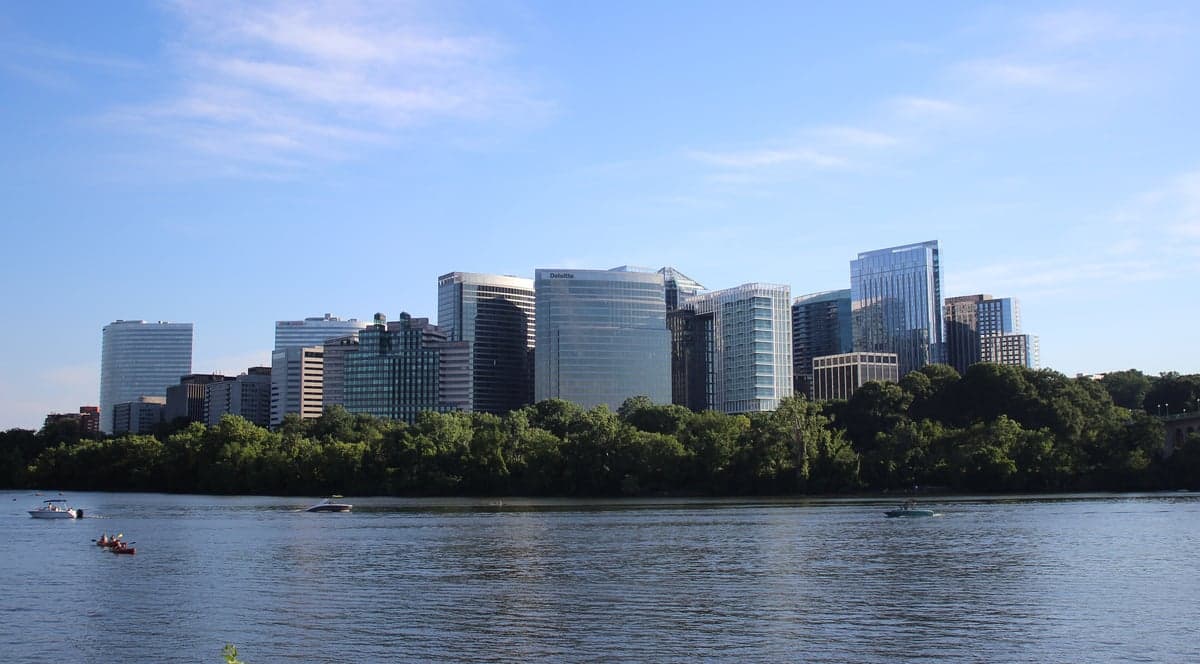
Photo: Wikipedia
Political ClimatePolitical Climate in Arlington County
Showing district-level results — no local-only data available.
Local Political AnalysisPolitical Analysis of Arlington County
Arlington County is one of the most reliably Democratic jurisdictions in the entire country, carrying a Cook Partisan Voting Index (PVI) of D+26. That means the county votes about 26 points more Democratic than the national average in presidential elections. To put that in perspective, the state of Virginia as a whole sits at D+4, so Arlington is an extreme outlier—a deep-blue urban core in a state that’s only slightly left of center. The county hasn’t voted for a Republican presidential candidate since 1984, and in 2020, Joe Biden took over 80% of the vote here. The trajectory is only getting bluer: as the county densifies and attracts more young professionals and federal workers, the GOP has essentially become a non-factor in local elections.
How it compares
Compared to the rest of Virginia, Arlington is a political island. While the state as a whole is competitive—with a D+4 PVI that reflects a mix of deep-red rural areas, purple suburbs, and blue cities—Arlington is as blue as it gets. For example, Clarendon and Ballston are heavily Democratic, with precincts routinely delivering 85-90% of the vote to Democrats. Even the more residential, family-oriented neighborhoods like Lyon Village or Cherrydale lean strongly blue, though they sometimes show slightly more moderate margins—around 70-75% Democratic. There are no real "red" precincts in Arlington; the closest you get are a few pockets near Fort Myer or Navy Annex where military families might push Republican turnout to 25-30%, but that’s still a deep minority. By contrast, a suburb like Loudoun County (D+8) or Fairfax County (D+18) is more purple, with swing precincts in places like Ashburn or Chantilly. Arlington has no such swing territory—it’s a Democratic stronghold through and through.
What this means for residents
For liberal residents, Arlington is a comfortable place to live. Local policies reflect the county’s lean: strong tenant protections, heavy investment in public transit (the Metro, bike lanes, and bus rapid transit), and a school board that prioritizes equity initiatives. Conservative residents, however, aren’t exactly shut out—they just have to accept that they’re in a deep-blue environment. You’ll find a small but active Arlington GOP group, and some neighborhoods like Donaldson Run or Waycroft-Woodlawn have a slightly higher share of Republican-leaning voters, but they’re still a minority. In practice, this means conservative residents often focus on local issues like property taxes or development density rather than national politics. The county board is all-Democratic, so there’s no real partisan debate on policy—just internal Democratic faction fights between urbanists and preservationists.
Cultural and policy distinctions
Arlington’s political culture is distinct from the rest of Virginia in a few key ways. The county has a county board form of government (no mayor or city council), which means decisions are made by a five-member board that’s been Democratic since the 1990s. This board has pushed aggressive affordable housing policies, like the Missing Middle zoning changes that allowed duplexes and triplexes in single-family neighborhoods—a move that sparked intense local debate but ultimately passed. Culturally, Arlington feels more like an extension of Washington, D.C. than Virginia. The county’s identity is tied to federal employment, the Pentagon, and a highly educated, transient population. This creates a political environment where national issues (healthcare, climate, immigration) dominate local conversation, unlike in more rural parts of Virginia where local taxes and school funding are the main topics. For anyone moving here, expect a place where progressive values are the baseline, but where the practical challenges of urban living—traffic, housing costs, and school overcrowding—are what actually drive day-to-day politics.

State Political ClimatePolitical Climate in Virginia
State Political AnalysisPolitical Environment in the State
Virginia has shifted from a reliably purple swing state to a solidly Democratic-leaning one over the past two decades, carrying a Cook Partisan Voting Index of D+4. The state’s transformation is driven overwhelmingly by the explosive growth of the Washington, D.C. suburbs in Northern Virginia, which now supply enough Democratic votes to outweigh the rest of the state combined. While Republicans still hold strong majorities in rural and exurban areas, the statewide trajectory has been consistently leftward since 2008, with Democrats now controlling the governorship, both chambers of the General Assembly, and both U.S. Senate seats.
Urban vs. rural divide
The political map of Virginia is a textbook case of the urban-rural split. The Democratic stronghold is the crescent from Arlington and Alexandria through Fairfax County and down to Richmond. Fairfax County alone, with over 1.1 million residents, delivers a net Democratic margin of roughly 200,000 votes — enough to cancel out the entire Republican vote in the rest of the state. Virginia Beach and Norfolk in Hampton Roads are competitive but lean Democratic, while Charlottesville and Blacksburg are deep-blue college towns. The Republican base is concentrated in the Shenandoah Valley, Southside Virginia, and the southwestern coalfields — places like Roanoke, Lynchburg, and Harrisonburg are conservative anchors. The 2021 gubernatorial race showed the divide clearly: Republican Glenn Youngkin won by flipping suburban Loudoun County and Prince William County — areas that had gone for Biden by double digits — but Democrats rebounded in 2023 by winning back those same suburbs and flipping the House of Delegates.
Policy environment
Virginia’s policy environment is a mixed bag that reflects its purple-to-blue trajectory. The state income tax is a flat 5.75% on all income over $17,000, with no local income tax — a relatively moderate rate compared to neighboring Maryland (up to 5.75% state plus local). Sales tax is 5.3% (6% in Northern Virginia and Hampton Roads for transportation funding). Property taxes are set locally and vary widely: Loudoun County levies about $1.20 per $100 of assessed value, while rural counties like Grayson County are under $0.50. The state has a right-to-work law, but the minimum wage is $12.00 per hour (rising to $13.50 in 2025) — higher than the federal floor but below Maryland’s $15. Education policy has been a flashpoint: the state has no school choice voucher program, but it does have charter schools (though only a handful exist). The Virginia Department of Education under Youngkin adopted new "cellphone-free" school policies and revised history standards to emphasize "patriotic education," but the Democratic legislature blocked many of his K-12 initiatives. Healthcare is dominated by the expansion of Medicaid under the Affordable Care Act, which Virginia adopted in 2019 — roughly 600,000 low-income adults are now covered. Election laws are moderately restrictive: voter ID is required (photo or non-photo), no-excuse absentee voting is allowed, and same-day registration is not permitted. The state has a 45-day residency requirement to vote.
Recent policy direction
The last five years have seen Virginia lurch left on most cultural and regulatory fronts, then partially pull back under Youngkin. On gun and self-defense law, Democrats passed a 2020 package that included universal background checks, a one-handgun-per-month limit, a "red flag" law (extreme risk protective orders), and a ban on assault weapons for those under 21. Youngkin signed a 2022 bill allowing permitless concealed carry for those 21 and older, but the red flag law remains in place. On parental and education rights, Youngkin issued executive orders banning "inherently divisive concepts" in schools and requiring parental notification of sexually explicit content, but the Democratic legislature blocked codification. The state’s "Model Policies" on transgender students — which required schools to allow students to use bathrooms and pronouns matching their gender identity — were rescinded by Youngkin in 2023, but local school boards in Fairfax and Arlington continue to enforce similar policies. On speech and privacy, Virginia passed the Consumer Data Protection Act in 2021, giving residents rights to access, correct, and delete personal data held by companies — one of the strongest state privacy laws. On medical and bodily autonomy, abortion remains legal up to 26 weeks (with a 24-hour waiting period and parental consent for minors), and the state has no trigger law — the 2023 elections were widely seen as a referendum on abortion, with Democrats winning on a platform of protecting access. On property rights, Virginia has no statewide rent control, but localities can impose it — Arlington and Alexandria have considered it. The state’s "right to farm" law protects agricultural operations from nuisance lawsuits. On taxation, Youngkin proposed eliminating the state income tax entirely, but the Democratic legislature rejected it; instead, the standard deduction was doubled and the grocery tax was eliminated in 2023. On voting and ballot access, the state has 45 days of early voting (including two Saturdays), no-excuse absentee voting, and automatic voter registration at the DMV — but no same-day registration and no permanent absentee list.
Civil unrest & political movements
Virginia has been a flashpoint for national political movements. The 2017 "Unite the Right" rally in Charlottesville, which turned violent and resulted in the death of counter-protester Heather Heyer, remains a defining scar — the city has since removed Confederate statues and passed a ban on carrying firearms at public demonstrations. The 2020 George Floyd protests in Richmond led to the toppling of the Robert E. Lee statue on Monument Avenue and a statewide debate over Confederate memorials. On the right, the "Parents Matter" movement exploded in Loudoun County in 2021 after a sexual assault incident in a school bathroom, fueling Youngkin’s victory and a wave of conservative school board wins in 2022. Immigration politics are relatively muted compared to border states, but Prince William County and Arlington have "sanctuary" policies limiting cooperation with ICE, while Youngkin has ordered state police to assist with federal immigration enforcement. Election integrity remains a live issue: the 2020 election in Virginia was certified without major controversy, but the 2021 gubernatorial race saw Republicans allege irregularities in Fairfax County (none were proven). The state has no secession or nullification rhetoric of note, but the "Virginia is for Lovers" slogan has been co-opted by both sides in culture-war messaging.
Projection
Over the next 5-10 years, Virginia will likely continue its slow drift leftward, but not as fast as Maryland or New Jersey. The key driver is demographic: Northern Virginia is adding population at roughly 1% per year, while rural areas are flat or declining. The 2030 census will likely cost Virginia one congressional seat (from 11 to 10), with the loss coming from a rural district. However, the 2023 elections showed that Republicans can still win statewide if they run a moderate, culturally conservative candidate who can peel off suburban women — Youngkin’s coalition of rural voters plus suburban parents is replicable. The wild card is the D.C. exodus: if federal workers return to the office full-time, Northern Virginia’s growth could accelerate; if remote work persists, the exurbs could become more competitive. Expect continued fights over education (school choice, transgender policies), housing (upzoning in Arlington and Alexandria), and energy (the state is part of the Regional Greenhouse Gas Initiative, but Youngkin is trying to withdraw). A new resident moving in now should expect a state where the political center of gravity is in the D.C. suburbs, but where rural and exurban conservatives still have enough power to block the most aggressive progressive policies — at least for now.
For a conservative relocator, Virginia offers a mixed picture: low taxes relative to the Northeast, strong gun rights (with some restrictions), and a governor who shares your values — but a legislature that will block most of his agenda. For a liberal relocator, the state provides strong abortion protections, a robust safety net, and a political environment that is increasingly friendly — but you’ll pay higher taxes than in the South and face culture-war battles in your local school board. The bottom line: Virginia is not a red state, not a blue state, but a state where the two sides are locked in a grinding, year-round trench war — and the outcome depends entirely on which suburb you live in and which election cycle you’re watching.
* Values derived from national, state, county, city and local statistics and may differ in a specific area. Last updated: 2026-10-03T13:55:08.000Z
Narrative content on this page is AI-generated and may contain mistakes. Verify any details that matter before acting on them.
ReloMaps may earn a commission from affiliate links at no extra cost to you.

