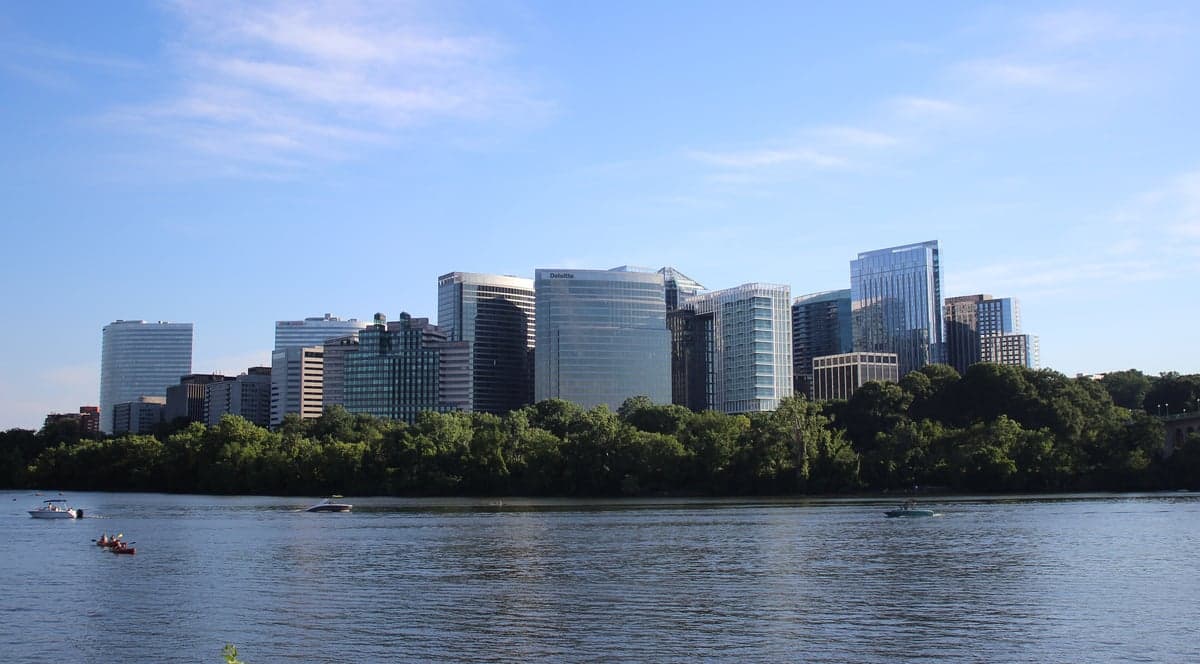
Photo: Wikipedia
Demographics of Arlington County
Affluence Level in Arlington County
An upper-middle-class area. Household wealth, education levels, and homeownership run ahead of national benchmarks.
People of Arlington County
Arlington County, Virginia, is a dense, highly educated urban enclave of 235,463 residents, defined by its direct adjacency to Washington, D.C., and a population that is 58.8% White, 15.7% Hispanic, 9.2% Black, 6.8% East and Southeast Asian, and 3.6% Indian. With 77.1% of adults holding a college degree and a foreign-born population of 10.6%, Arlington is a magnet for professionals in government, defense, and technology, creating a culture that blends transient federal service with deep-rooted local communities. Its identity is shaped by a history of strategic location—first as a Potomac River crossing, then as a military and bureaucratic hub—that has attracted successive waves of settlers, workers, and immigrants.
Settlement & growth (pre-1960)
Before European colonization, the area now known as Arlington County was inhabited by the Powhatan Confederacy, specifically the Nacotchtank (or Anacostan) people, who lived along the Potomac River. English settlers began arriving in the mid-1600s, establishing tobacco plantations on land grants from the Crown. The region was part of the vast Fairfax County until 1801, when the portion directly across from Washington, D.C., was ceded to the federal government as part of the District of Columbia. This area, known as Alexandria County, was retroceded to Virginia in 1846, forming the core of what would become Arlington.
The county's modern identity began with the Civil War. In 1861, the U.S. Army occupied the land to defend Washington, building forts and establishing Arlington National Cemetery on the grounds of Robert E. Lee's estate. The war brought thousands of Union soldiers, freed slaves, and laborers to the area. After the war, the Freedmen's Village was established near the cemetery, housing formerly enslaved people. Many of these families settled in what is now Green Valley (formerly known as Johnson's Hill), one of Arlington's oldest Black communities.
Growth accelerated in the late 19th and early 20th centuries with the expansion of the federal government. The 1900s saw the construction of the Pentagon (completed in 1943) and the rise of the defense industry, which drew workers from across the country. Streetcar suburbs like Clarendon, Ballston, and Rosslyn developed along the Washington, Arlington & Falls Church Railway, attracting middle-class White families. By 1950, Arlington's population had surged to 135,449, fueled by New Deal agencies and Cold War military spending. The county remained overwhelmingly White (over 90%) through the 1950s, with a small but established Black population concentrated in Nauck and Hall's Hill.
Modern era (post-1965)
The 1965 Hart-Cellar Act fundamentally reshaped Arlington's demographics, though the county's transformation was initially driven more by domestic migration than by foreign immigration. The 1970s and 1980s saw an influx of professionals from across the United States, drawn by the expanding federal bureaucracy and the rise of the defense and technology sectors. The construction of the Metrorail system, with stations opening in Rosslyn, Court House, and Pentagon City in the late 1970s, spurred dense, transit-oriented development. This period also saw the beginning of White flight from nearby Washington, D.C., as middle-class families moved into Arlington's established neighborhoods.
Immigration from Asia and Latin America began to accelerate in the 1980s and 1990s. East and Southeast Asian communities—particularly Vietnamese, Korean, and Chinese—settled in Clarendon and Ballston, though they never formed the large, concentrated enclaves seen in other D.C. suburbs like Annandale. Hispanic residents, primarily from El Salvador, Guatemala, and Mexico, arrived in significant numbers, establishing a visible presence in Columbia Pike and Shirlington. The Indian subcontinent community (from India, Pakistan, and Bangladesh) grew more slowly, clustering in Lyon Village and Virginia Square, drawn by tech and medical jobs.
By 2000, Arlington's population had become 62.3% White, 19.5% Hispanic, 9.3% Black, and 8.6% Asian (including Indian). The county's Black population, however, began to decline in absolute numbers as gentrification pushed long-time residents out of neighborhoods like Green Valley and Nauck. The 2010s saw an acceleration of this trend: rising housing costs and the influx of highly paid tech and consulting workers transformed Arlington into one of the wealthiest and most educated counties in the nation. The foreign-born share, while significant, remained lower than in neighboring jurisdictions like Fairfax County, as Arlington's high cost of living limited immigration from lower-income groups.
The future
Arlington's population is projected to become slightly more diverse over the next decade, but the pace of change is slowing. The Hispanic share is expected to grow modestly, from 15.7% to around 18-20%, driven by natural increase and continued immigration from Central America. The East and Southeast Asian population is likely to remain stable or grow slowly, as many younger professionals in these groups move to more affordable suburbs in Loudoun and Prince William counties. The Indian subcontinent community, currently at 3.6%, may see modest growth as tech and biotech sectors expand, but Arlington's high housing costs will limit large-scale influxes.
The most significant demographic trend is the continued aging and out-migration of the White population, particularly families with children, who are moving to lower-cost areas in Virginia and North Carolina. This is offset by an influx of young, single professionals and childless couples, keeping the county's median age low (around 34). The Black population, now at 9.2%, is projected to continue its slow decline, as gentrification and displacement push families to Prince George's County, Maryland, and other more affordable areas. New immigrant communities are dispersing rather than forming enclaves, with Columbia Pike remaining the most visible corridor for Hispanic and African immigrants.
Arlington County is becoming a place of high turnover and high selectivity—a dense, expensive, and highly educated urban hub that attracts a transient workforce of government and tech professionals. For someone moving in now, the county offers unparalleled access to federal jobs, excellent schools, and a walkable urban environment, but at the cost of extreme housing prices and a population that is increasingly homogeneous in income and education. The county's cultural identity is less about rooted ethnic enclaves and more about a shared professional class, making it a stable but exclusive destination for those who can afford it.

* Values derived from national, state, county, city and local statistics and may differ in a specific area. Last updated: 2026-10-03T13:55:08.000Z
Narrative content on this page is AI-generated and may contain mistakes. Verify any details that matter before acting on them.
ReloMaps may earn a commission from affiliate links at no extra cost to you.

