Photo: Wikipedia
Quality of Life in Arlington County
A livable area that tracks near national norms for affordability, walkability, and neighborhood health.
What does Quality of Life tell us?
Quality of Life measures an area by evaluating factors like cost of living, nearby amenities, country club access, airport proximity, socioeconomic signals and neighborhood character. For large states, this is a general average — quality of life can vary dramatically between metro areas, suburbs, and rural communities within the same state.
What does this tell us?
Quality of Life measures an area by evaluating factors like cost of living, nearby amenities, country club access, airport proximity, socioeconomic signals and neighborhood character. For large states, this is a general average — quality of life can vary dramatically between metro areas, suburbs, and rural communities within the same state.
Cost of Living
140% above national average
57%
The Real Cost of Living in Arlington County for 2026
| Tier | Individual | Family (4) |
|---|---|---|
| Survival | $36k | $68k |
| Comfortable | $168k | $247k |
| Luxury | $249k+ | $387k+ |
| Elite (Top 5%) | $294k+ | $455k+ |
Quality-of-Life Analysis
Arlington County, Virginia, is a dense, urbanized county that is effectively a single contiguous city, leaving no room for the traditional spectrum of larger towns, smaller communities, and rural areas. The entire 26-square-mile county is a high-density, transit-oriented environment where the "towns" are actually distinct Metro-served urban villages. This geography attracts two primary groups: young professionals and federal employees who want a walkable, amenity-rich lifestyle within minutes of Washington, D.C., and families who are willing to pay a premium for top-ranked public schools and a suburban feel within an urban framework.
Largest town(s) & population centers
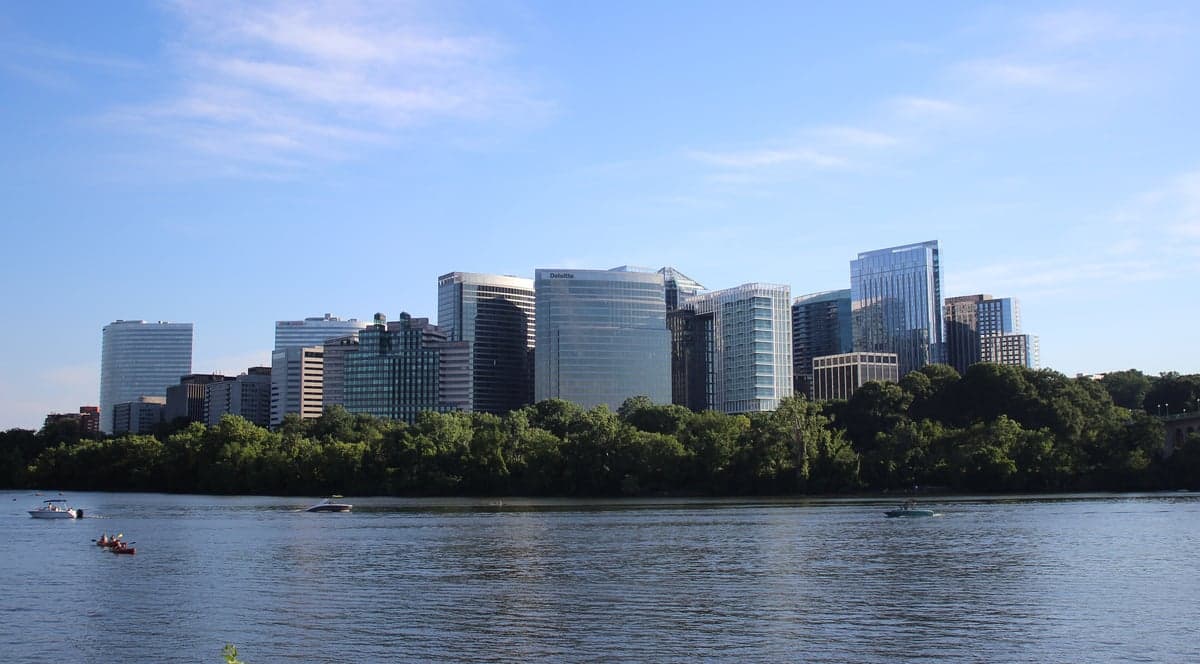
Arlington has no incorporated towns; its population centers are defined by Metro rail stations. The largest and most iconic is Rosslyn, a skyline-defining business district with a dense cluster of high-rise office towers, hotels, and apartments. Daily life here is fast-paced and vertical, dominated by commuters walking to the Rosslyn Metro and workers grabbing lunch at the many fast-casual spots along Wilson Boulevard. Clarendon and Courthouse form the county's social and nightlife heart, packed with bars, restaurants, and a younger crowd. Ballston and Virginia Square offer a more balanced mix of offices, George Mason University's Arlington campus, and mid-rise apartments. Crystal City and Pentagon City are major employment hubs, home to many defense contractors and the U.S. Department of Defense headquarters, with a daily rhythm driven by the Pentagon Metro stop and the massive Fashion Centre at Pentagon City mall.
Smaller towns & rural pockets
Arlington County contains no smaller towns or rural pockets in the traditional sense. The entire county is built out with a grid of streets, sidewalks, and urban infrastructure. The closest approximation to a "smaller community" is the Waverly Hills and Donaldson Run neighborhoods in the northern part of the county, which feature larger single-family homes on tree-lined streets and a quieter, more suburban character than the Rosslyn-Ballston corridor. The Barcroft and Arlington Forest neighborhoods offer a similar feel with mid-century homes and a strong sense of local identity. However, these are still part of the same dense county, with no unincorporated areas or rural land. The only true "rural" remnant is the Arlington National Cemetery and the adjacent Fort Myer military base, which are large, open, non-residential spaces.
Cost & lifestyle range
The cost of living in Arlington County is extreme, with a Cost of Living Index of 240 (more than double the national average). The median home value is $864,800, and median rent is $2,275. The lifestyle range is narrow but real. At the high end, neighborhoods like Country Club Hills and Maywood feature multi-million-dollar homes, large lots, and proximity to the Washington Golf & Country Club, offering a quiet, affluent suburban lifestyle. At the more accessible end, areas like Columbia Pike and Arlington Mill offer older garden apartments and condos with lower rents, a more diverse population, and a vibrant, walkable commercial corridor with international restaurants and shops. The average commute of 26.6 minutes is relatively short for the region, largely because most residents work within the county or in nearby D.C., accessible via the Metro, bus, or bike.
Arlington County is not a place for those seeking a rural or small-town lifestyle. It is a dense, expensive, and highly urban environment where the "range" is between high-rise urban living and quiet, leafy single-family neighborhoods. The county thrives for professionals, federal employees, and families who prioritize walkability, transit access, and exceptional public schools above all else, and who are willing to pay a premium for a lifestyle that is both urban and safe.

Crime in Arlington County
Generally safer than 60% of comparable U.S. locations.
Violent CrimeViolent Crime Analysis
Property CrimeProperty Crime Analysis
Crime Analysis
Arlington County, Virginia, presents a mixed safety profile for prospective residents, with property crime rates significantly exceeding national averages while violent crime remains below the U.S. median. The county recorded a violent crime rate of 210.4 per 100,000 residents and a property crime rate of 1,393.7 per 100,000 in the most recent reporting period, placing it in a middle tier among Northern Virginia jurisdictions. These figures reflect the challenges of a dense, transit-oriented urban county bordering Washington, D.C., where opportunistic theft and vehicle-related crimes are persistent concerns.
Crime in context
Arlington’s violent crime rate of 210.4 per 100,000 is roughly 40% lower than the national average of 380 per 100,000, but its property crime rate of 1,393.7 per 100,000 is about 25% higher than the national average of 1,100 per 100,000. Compared to neighboring jurisdictions, Arlington is safer than Alexandria (which reported a violent crime rate of 310 per 100,000) but more crime-prone than Falls Church (with a violent crime rate of 120 per 100,000). The county’s property crime rate is notably higher than in McLean and Great Falls, where rates hover around 800–900 per 100,000, reflecting the impact of Arlington’s higher population density and Metro-adjacent commercial corridors. Statewide, Virginia’s violent crime rate sits at approximately 220 per 100,000, meaning Arlington aligns closely with the state average for violent offenses but exceeds it for property crimes by roughly 25%.
What residents experience
Residents most frequently encounter property crimes such as larceny from vehicles, package theft, and bicycle theft, particularly in the densely populated Rosslyn-Ballston corridor and around the Crystal City and Pentagon City neighborhoods. Vehicle break-ins are concentrated near Metro stations, with the Ballston and Courthouse stations reporting the highest numbers of incidents. Violent crime is less common but not absent: aggravated assaults and robberies occur sporadically, often near late-night entertainment venues in Clarendon and along Columbia Pike. The Arlington County Commonwealth’s Attorney’s office, led by Parisa Dehghani-Tafti since 2020, has implemented progressive policies including declining to prosecute certain low-level drug offenses and reducing cash bail. Critics argue these policies contribute to a perception of leniency that may embolden repeat property offenders, though data on recidivism specifically tied to these reforms remains limited. Residents in the more suburban neighborhoods of Arlington Forest, Lyon Village, and Donaldson Run report fewer incidents than those in the urban core, with property crime rates roughly half those of the Ballston area.
Neighborhood-level variation is significant. The Buckingham and Shirlington areas experience moderate property crime, while the Barcroft and Nauck neighborhoods have historically reported higher rates of violent crime, though these have declined over the past decade. The county’s police department has increased patrols along the Columbia Pike corridor and installed additional surveillance cameras in high-theft zones. For families considering relocation, the safest bets are the single-family-home neighborhoods west of Glebe Road, where crime rates are consistently lower. However, the county’s progressive judicial philosophy—shared with much of the D.C. metro area—means that even in safer pockets, residents should remain vigilant about property security and consider comprehensive insurance coverage for vehicles and packages.
* Values derived from national, state, county, city and local statistics and may differ in a specific area. Last updated: 2026-10-03T13:55:08.000Z
Narrative content on this page is AI-generated and may contain mistakes. Verify any details that matter before acting on them.
ReloMaps may earn a commission from affiliate links at no extra cost to you.

