
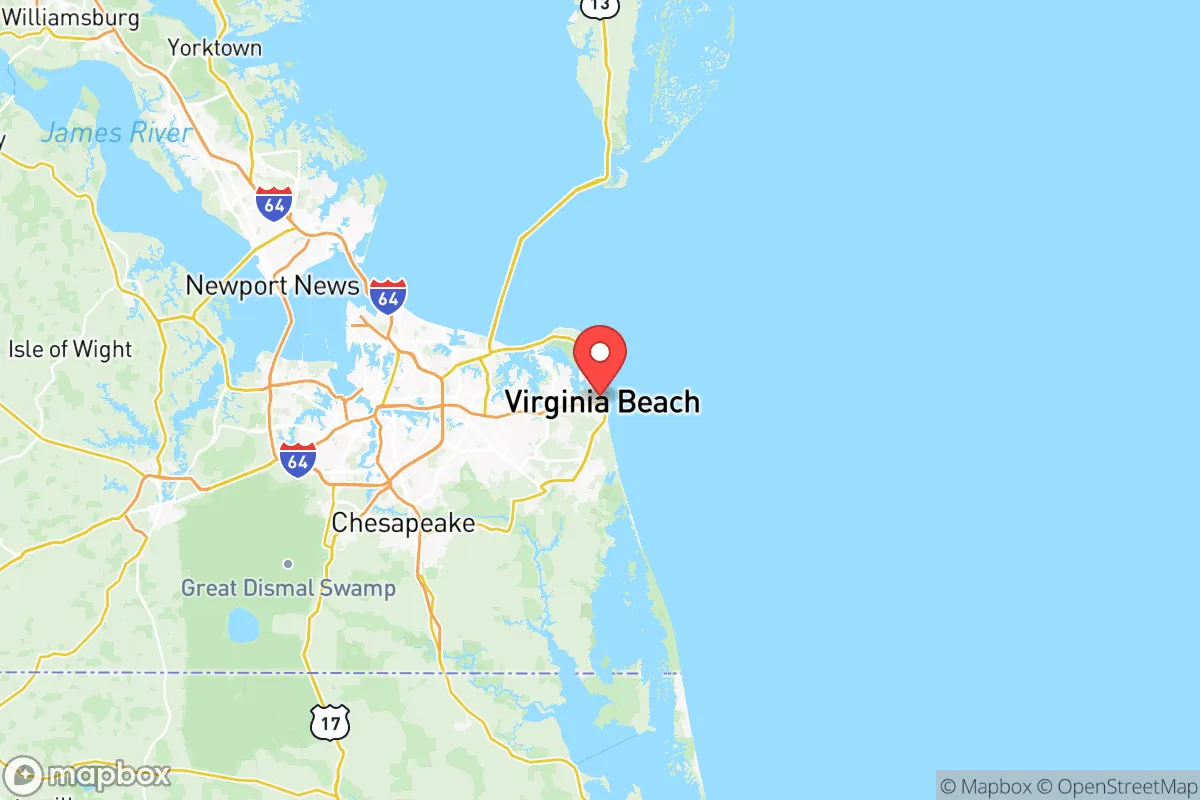
Photo by Daniel Halseth on Unsplash
Demographics of Virginia Beach City County
Affluence Level in Virginia Beach City County
A middle-class area roughly in line with national averages across income, home values, education, and employment.
People of Virginia Beach City County
Today, Virginia Beach City County is home to 457,066 residents, making it the most populous city in Virginia and a distinct blend of military, tourism, and suburban life. The population is 59.4% White, 18.3% Black, 8.9% Hispanic, 6.0% East/Southeast Asian, and 1.0% Indian, with only 3.2% foreign-born — a figure far below the national average, reflecting a region shaped more by domestic migration than international immigration. The city carries a strong military identity, anchored by Naval Air Station Oceana and Joint Expeditionary Base Little Creek, and its residents are notably well-educated, with 40.4% holding a college degree. This is a place where Southern coastal culture meets a transient military population, creating a community that is simultaneously rooted and in flux.
Settlement & growth (pre-1960)
The area now known as Virginia Beach was originally inhabited by the Chesapeake people, a Algonquian-speaking tribe, who lived along the Lynnhaven River and the Atlantic coast. English colonists from the Virginia Company of London arrived in 1607 at Cape Henry, near what is now the intersection of Atlantic Avenue and 89th Street, marking the first landing of English settlers in North America. The Chesapeake tribe was decimated by disease and conflict within decades, and the land was parceled into tobacco plantations worked by enslaved Africans, who arrived as early as 1619. By the late 1600s, the region was dotted with small farming communities like Princess Anne (the original county seat) and Kempsville, where English-descended families like the Walkers and the Landons established plantations along the Lynnhaven River.
Through the 18th and 19th centuries, the population remained overwhelmingly English and African American, with a small number of Scots-Irish and German families filtering in through the port of Norfolk. The area was rural and agricultural, with tobacco, corn, and livestock as economic mainstays. After the Civil War, freedmen established communities like Pungo in the southern part of the county, where Black families farmed and built churches and schools that remain community anchors today. The arrival of the Norfolk Southern Railroad in the 1880s opened the coast to tourism, and the small resort village of Virginia Beach (now the Oceanfront area) began attracting summer visitors from Norfolk and Richmond. By 1900, the population of Princess Anne County (which would later become Virginia Beach) was roughly 11,000, still overwhelmingly rural and agricultural.
The single most transformative event for the region was World War II. The U.S. Navy built Naval Air Station Oceana in 1940 and expanded Joint Expeditionary Base Little Creek in 1942, drawing tens of thousands of military personnel and civilian workers from across the country. These newcomers were predominantly White families from the Midwest, Northeast, and Appalachia, along with a significant number of Black service members and defense workers. The population of Princess Anne County surged from 19,000 in 1940 to 42,000 by 1950. In 1963, the city of Virginia Beach and Princess Anne County consolidated into the independent city of Virginia Beach City County, a move driven by the need for coordinated infrastructure to manage breakneck growth. By 1960, the population had reached 85,000, and the city was already shifting from a rural farming community to a military-anchored suburb.
Modern era (post-1965)
The 1965 Hart-Cellar Act had a modest effect on Virginia Beach compared to other U.S. cities, because the region's growth has been driven primarily by domestic migration — military transfers, retirees, and Sun Belt job seekers — rather than international immigration. The foreign-born share remains just 3.2%, far below the national average of roughly 14%. However, the post-1965 era did bring new diversity. The end of the Vietnam War in 1975 brought a wave of Vietnamese refugees, many of whom had been sponsored by military families they had worked with in South Vietnam. These families settled primarily in the Kempsville and Great Neck areas, where they established small businesses, restaurants, and Buddhist temples. Today, the East/Southeast Asian population stands at 6.0%, with Vietnamese and Filipino communities being the largest subgroups, heavily concentrated in the central and northern parts of the city.
The Indian population, at 1.0%, is smaller and more dispersed, with families drawn by professional opportunities in healthcare, engineering, and information technology. Many Indian residents work at Sentara Healthcare or the naval base's civilian contractor sector and live in newer subdivisions in Salem and Landstown. The Hispanic population, now 8.9%, grew steadily from the 1990s onward, driven by Puerto Rican families (who are U.S. citizens) relocating from the Northeast and by Mexican and Central American immigrants working in construction, hospitality, and landscaping. The largest Hispanic concentrations are in the Oceanfront area and the Rosemont neighborhood, where Spanish-language churches and bodegas have become visible. The Black population, 18.3%, is a mix of families whose roots go back to the Pungo and Princess Anne farming communities and newer arrivals from the Northeast and Mid-Atlantic drawn by military and civilian jobs.
Domestic migration has been the dominant force shaping modern Virginia Beach. The 1980s and 1990s saw massive suburban expansion as military families and Norfolk commuters pushed south and west into Salem, Landstown, and Centerville. These areas filled with single-family homes, strip malls, and schools designed for a growing middle class. The city's population peaked at around 452,000 in 2010 and has been essentially flat since, as younger adults move to higher-opportunity metros and the military presence has stabilized. The city has also become a retirement destination for former military personnel and federal employees, who are drawn by the mild climate, beach access, and relatively low cost of living compared to Northern Virginia.
The future
Virginia Beach's population is projected to grow slowly, reaching roughly 470,000 by 2035, driven primarily by natural increase and modest domestic in-migration. The city is becoming slightly more diverse: the White share is declining gradually (from 64% in 2010 to 59.4% today), while the Hispanic and East/Southeast Asian shares are rising. The Indian population is expected to grow slowly as the technology and healthcare sectors expand. The foreign-born share will likely remain low compared to national averages, because the city lacks the dense ethnic enclaves and chain-migration networks that drive high immigration in places like Northern Virginia or Houston. The military population will remain the city's demographic anchor, but the trend toward consolidating naval operations in Norfolk and Hampton may slightly reduce the active-duty presence over the next decade.
The most significant demographic shift is generational: the city's median age is rising as Baby Boomer retirees stay in place and younger adults leave for larger job markets. The school-age population has declined slightly since 2010, and the city is investing in attracting young professionals through redevelopment of the Town Center and the Oceanfront. New residential construction is concentrated in the Dam Neck and Sandbridge areas, where higher-end homes are drawing affluent families and retirees. The cultural identity of Virginia Beach is evolving from a purely military-suburban town into a more diversified coastal city, but it remains a place where the rhythms of the Navy, the beach, and the school calendar still set the pace of life.
For someone moving in now, Virginia Beach offers a stable, family-oriented community with strong schools, a robust military presence, and a slowly diversifying population. The city is not a high-growth boomtown, but a mature, well-established community where the cost of living is reasonable for the coastal lifestyle. The people here are shaped by service, stability, and the sea — and that character is likely to persist for decades to come.

* Values derived from national, state, county, city and local statistics and may differ in a specific area. Last updated: 2026-08-23T15:06:34.000Z
Narrative content on this page is AI-generated and may contain mistakes. Verify any details that matter before acting on them.
ReloMaps may earn a commission from affiliate links at no extra cost to you.

