
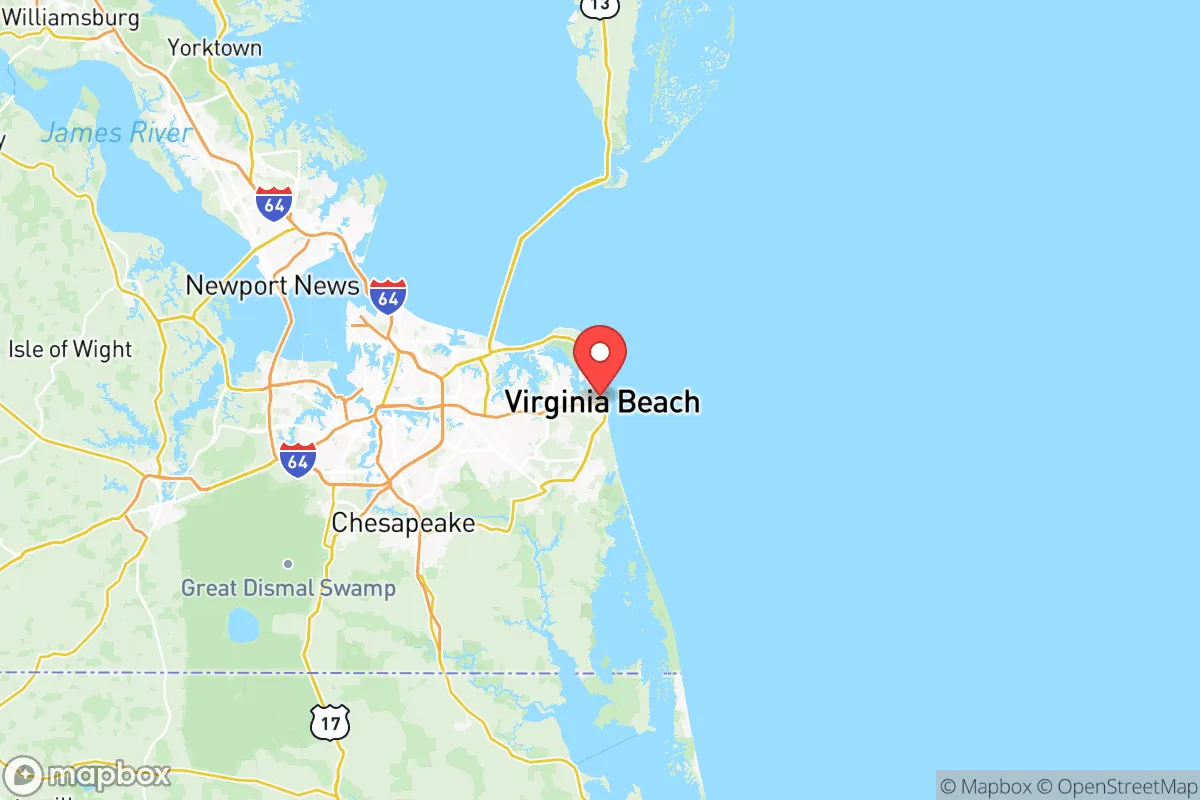
Photo by Daniel Halseth on Unsplash
Political ClimatePolitical Climate in Virginia Beach City County
Showing district-level results — no local-only data available.
Local Political AnalysisPolitical Analysis of Virginia Beach City County
Virginia Beach City County is a genuine political battleground, with a Cook PVI rating of EVEN that makes it one of the most competitive large jurisdictions in the entire state. Unlike the rest of Virginia, which leans Democratic overall with a D+4 PVI, Virginia Beach has historically swung between parties and remains deeply divided. In the 2024 presidential election, the county voted for Kamala Harris by a razor-thin margin of about 1.5 points, reflecting its status as a true toss-up where neither party can take victory for granted. This isn't a recent fluke—the area has been trending leftward slowly since the 2000s, but it still holds onto a strong conservative base, especially in the southern and rural parts of the county.
How it compares
The contrast between Virginia Beach and the rest of Virginia is stark. While the state as a whole has shifted blue over the past two decades—driven by explosive growth in Northern Virginia suburbs like Arlington and Fairfax—Virginia Beach has moved more gradually. The county's political geography breaks down into clear zones: the northern coastal neighborhoods around the Oceanfront and the resort area, including the North End and Croatan, lean reliably Democratic, often voting 55-60% for Democratic candidates. In contrast, the southern half of the county, particularly Pungo, Blackwater, and the rural areas near the North Carolina border, are deeply conservative, frequently voting 65-70% Republican. The swing precincts are concentrated in the central corridor—places like Kempsville, Great Neck, and parts of Lynnhaven—where educated professionals and military families create a volatile mix. This internal divide means Virginia Beach often mirrors the national popular vote more closely than the state does, making it a bellwether for suburban America.
What this means for residents
For conservative residents, Virginia Beach offers a rare environment where their votes genuinely matter. Unlike in deep-blue Northern Virginia or deep-red Southwest Virginia, a Republican candidate can win the county with a strong ground game and moderate messaging. Local elections are fiercely competitive, with city council seats often decided by a few hundred votes. For liberal residents, the trend is encouraging but not dominant—Democratic gains have been steady, especially among younger voters and newcomers drawn to the area's growing tech and healthcare sectors. The practical result is a government that tends toward moderation: the city has a Republican-leaning mayor (Bobby Dyer, elected in 2018 and re-elected in 2022) but a council that includes both parties and often votes pragmatically on issues like development, tourism, and military base support. Neither side gets everything they want, which keeps policy from swinging too far in either direction.
Culturally, this political split creates a unique atmosphere. The county's identity is heavily shaped by the massive military presence—Naval Air Station Oceana, Joint Expeditionary Base Little Creek, and Fort Story bring in thousands of active-duty personnel and their families, many of whom lean conservative but are also transient, diluting long-term partisan entrenchment. At the same time, the growing tourism and hospitality industry, centered on the Oceanfront, attracts a more liberal workforce. This mix means you'll find everything from gun shows and evangelical churches in the south to craft breweries and LGBTQ+ friendly events near the coast. The biggest policy distinction from the rest of Virginia is the county's fierce independence on land use and development—Virginia Beach has resisted the kind of dense, transit-oriented growth seen in Arlington or Alexandria, preserving its suburban and rural character even as the population pushes toward 460,000. For anyone moving here, the political climate is less about red vs. blue and more about a constant, healthy negotiation between two very different visions of what the city should be.

State Political ClimatePolitical Climate in Virginia
State Political AnalysisPolitical Environment in the State
Virginia has shifted from a reliably purple swing state to a solidly blue-leaning commonwealth over the past two decades, carrying a Cook PVI of D+4 that reflects its current Democratic tilt. The transformation has been driven primarily by explosive population growth in the Washington, D.C. suburbs, particularly in Northern Virginia, which now dominates state elections and policy direction. While the state still elects Republican governors in off-years—Glenn Youngkin won in 2021—the legislature has been under Democratic control since 2020, and the state has not voted for a Republican presidential candidate since George W. Bush in 2004. For a conservative relocator, the reality is that Virginia is a blue state with red pockets, not the other way around.
Urban vs. rural divide
The political map of Virginia is a textbook case of the urban-rural split that defines American politics. The entire Democratic majority is generated by three regions: Northern Virginia (Fairfax, Loudoun, Prince William counties and the cities of Arlington and Alexandria), the Richmond metro (Henrico County and the city of Richmond itself), and the Hampton Roads corridor (Norfolk, Virginia Beach, Chesapeake). Northern Virginia alone accounts for roughly one-third of the state's population and votes Democratic by margins of 30 to 50 points. Loudoun County, once a conservative stronghold, flipped from +20 Republican in 2004 to +25 Democratic by 2020. Meanwhile, rural and exurban areas—Southwest Virginia (Bristol, Roanoke, the coal counties), the Shenandoah Valley (Harrisonburg, Staunton, Winchester), and Southside Virginia (Danville, Martinsville)—vote Republican by similarly lopsided margins. The result is a state where a conservative living in Lynchburg or Fredericksburg feels politically at home locally but is consistently outvoted at the state level by the D.C. suburbs.
Policy environment
Virginia's policy environment reflects its Democratic lean, though it remains more moderate than deep-blue states like California or New York. The state income tax is a flat 5.75%—higher than most southern states but lower than the northeastern corridor. Sales tax is 5.3% (higher in Northern Virginia and Hampton Roads due to local add-ons). Property taxes are set at the local level and vary widely; Loudoun County has some of the highest rates in the state, while Pittsylvania County in Southside is among the lowest. Education policy is largely controlled by the state Board of Education and the governor's office; Youngkin pushed for expanded school choice and parental rights, but the Democratic legislature blocked most of his agenda. Virginia has no right-to-work law in the state constitution (though it has a statutory one), and union activity is growing in Northern Virginia. Election laws are moderately restrictive: voter ID is required, but same-day registration is not allowed, and early voting is available without an excuse. The state has no permitless carry for firearms, and a Democratic-controlled legislature passed a red flag law and universal background checks in 2020.
Recent policy direction
The last five years have seen Virginia move decisively left on several fronts. In 2020, Democrats passed the Virginia Clean Economy Act, mandating a carbon-free electric grid by 2050 and effectively blocking new natural gas infrastructure. The same session saw the repeal of the death penalty, the legalization of marijuana (with retail sales still not operational as of 2025), and the passage of the Virginia Values Act, which added sexual orientation and gender identity to the state's anti-discrimination laws. On gun policy, the legislature passed a red flag law (allowing temporary seizure of firearms from individuals deemed a threat), universal background checks, and a one-handgun-per-month limit. On education, the Youngkin administration attempted to implement model policies on transgender students that would have required parental notification and restricted bathroom access, but the courts blocked them. Property rights remain relatively strong—Virginia is not a "taking" state—but zoning reform in Northern Virginia has allowed for increased density near transit stations. Voting access expanded with no-excuse absentee voting and 45 days of early voting, though the state still does not offer automatic voter registration at DMVs.
Civil unrest & political movements
Virginia has been a flashpoint for political conflict in recent years. The 2017 Unite the Right rally in Charlottesville and the subsequent violence remain the most visible example of far-right organizing in the state, and the city is still deeply polarized over the removal of Confederate statues. On the left, the 2020 protests in Richmond over the killing of George Floyd led to the removal of the Robert E. Lee statue on Monument Avenue and a broader reckoning with Confederate iconography. Immigration politics are less heated than in border states, but Prince William County and Fairfax County have declared themselves "welcoming" jurisdictions, limiting cooperation with ICE. Election integrity has been a persistent issue: the 2020 election in Virginia was secure and uncontroversial, but Republican activists continue to question the security of mail-in voting and electronic machines. The 2021 gubernatorial race saw Youngkin win by focusing on education and parental rights, a strategy that Republicans hope to replicate statewide. There is no serious secession or nullification movement in Virginia, though some rural counties have discussed joining West Virginia—a symbolic gesture with no legal path.
Projection
Over the next five to ten years, Virginia is likely to become more Democratic, not less. The population growth in Northern Virginia shows no signs of slowing, and the in-migration is overwhelmingly from blue states and leans left. The 2024 presidential election saw Virginia vote for the Democratic candidate by a comfortable margin, and the state's U.S. Senate seats are both held by Democrats (Tim Kaine and Mark Warner). The Republican Party in Virginia is increasingly confined to rural and exurban areas, and its path to statewide victory depends on a moderate candidate who can peel off suburban voters—a strategy that worked for Youngkin but may not be repeatable in a presidential year. For a conservative relocator, the practical reality is that Virginia will continue to pass progressive legislation on climate, guns, and social policy, and the state's tax burden is likely to increase as Northern Virginia's infrastructure demands grow. The best bet for a conservative is to settle in a red-leaning locality like Virginia Beach (which votes Republican in local elections) or Chesterfield County (a Richmond suburb that is still purple but trending red), where local governance can provide a buffer against state-level policies.
For a new resident, the bottom line is that Virginia offers a high quality of life, strong schools, and proximity to D.C., but it is not a conservative haven. If you are moving to the state, expect to live under Democratic governance at the state level, with all that entails for taxes, regulation, and social policy. The best strategy is to choose your locality carefully—Loudoun County and Arlington are deep blue, while Roanoke and Fredericksburg offer a more balanced political environment. Virginia is a state where your experience of politics depends heavily on which zip code you choose, and that is unlikely to change anytime soon.
* Values derived from national, state, county, city and local statistics and may differ in a specific area. Last updated: 2026-08-23T15:06:34.000Z
Narrative content on this page is AI-generated and may contain mistakes. Verify any details that matter before acting on them.
ReloMaps may earn a commission from affiliate links at no extra cost to you.

