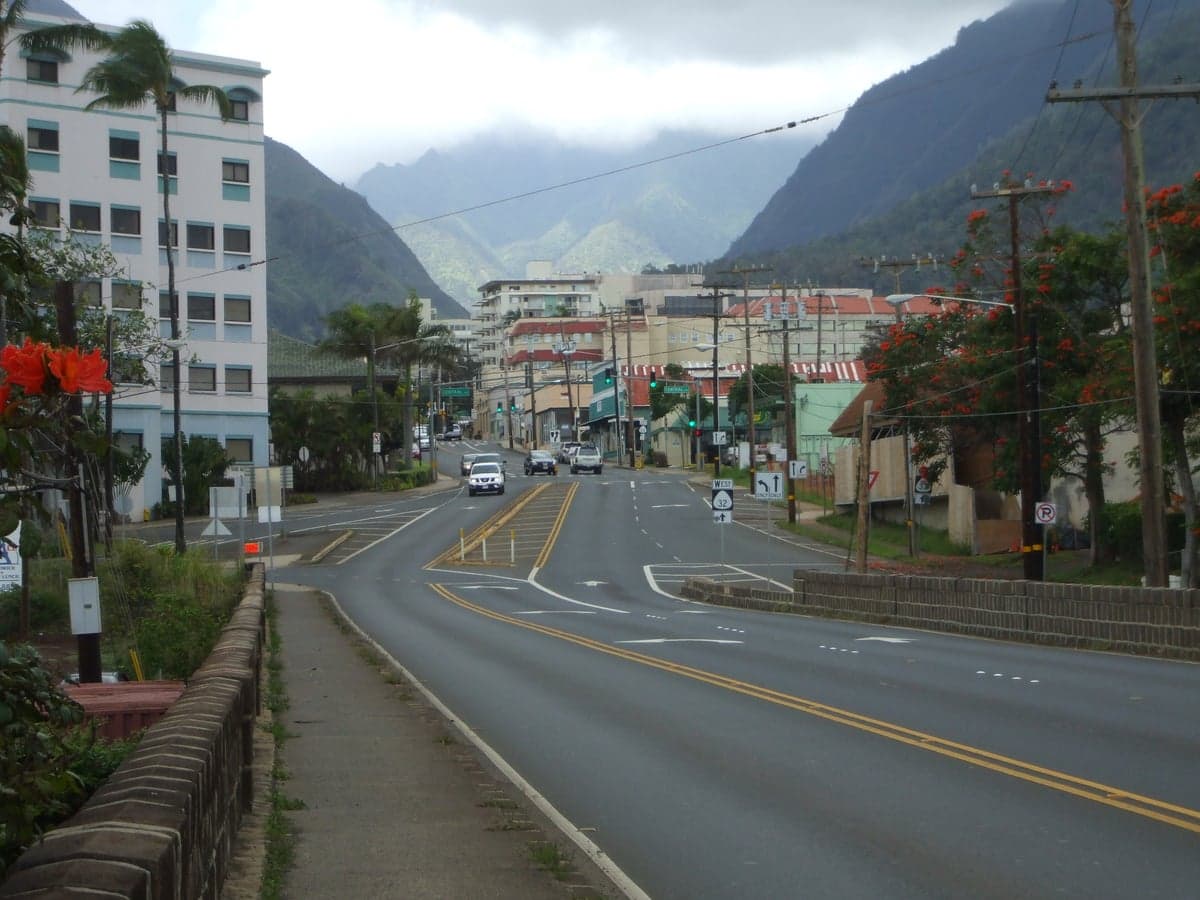
Photo: Wikipedia
Personal Sovereignty in Wailuku, HI
Moderate friction. Expect trade-offs in some aspect of personal liberty and independence.
What does Personal Sovereignty tell us?
Personal Sovereignty measures your capacity for self-reliance and independence with minimal government friction. Higher scores mean fewer barriers between you and the way you want to live... but it assumes you have the space you need and good neighbors.
What does this tell us?
Personal Sovereignty measures your capacity for self-reliance and independence with minimal government friction. Higher scores mean fewer barriers between you and the way you want to live... but it assumes you have the space you need and good neighbors.
State Policy
Energy independence: Importer (2% of energy produced in-state)
Personal Liberty
Homesteading

Personal Liberty Analysis
Wailuku, as the county seat of Maui, operates under Hawaii’s uniquely centralized state government, which significantly constrains personal sovereignty compared to mainland alternatives. The state’s single-county structure means that local autonomy is minimal, with nearly all regulatory, tax, and law enforcement powers held in Honolulu, 100 miles away. For a conservative-leaning individual or family prioritizing self-reliance and minimal government interference, this creates a challenging environment where state-level mandates directly override local preferences, from land use to self-defense rights. The trade-off is a tight-knit, rural community feel within a valley that still retains some agricultural character, but the legal framework is decidedly top-down.
Tax burden and regulatory posture in a centralized state
Hawaii’s tax burden is among the highest in the nation, and Wailuku residents face no escape from it. The state imposes a general excise tax (GET) of 4% on nearly all goods and services, including groceries and rent, which effectively functions as a hidden sales tax that compounds at every transaction level. Property taxes are comparatively low—around 0.3% of assessed value for owner-occupied homes—but this is offset by a state income tax that tops out at 11% on income over $200,000, with a progressive structure that hits middle earners hard. There is no local income tax, but the county property tax rate for non-owner-occupied homes jumps to 0.65%, discouraging investment properties. Regulatory posture is heavily interventionist: Hawaii’s land use commission classifies nearly all land into urban, rural, or agricultural districts, with strict limits on building, subdivision, and business operations. Permitting for even minor home improvements can take months, and the state’s rent control and tenant-friendly laws tilt heavily against landlords. For a prepper or survivalist, this means that building a self-sufficient compound or running a home-based business faces substantial bureaucratic hurdles, and the cost of living—already inflated by shipping—is compounded by a tax system that penalizes consumption and income alike.
Self-defense and gun law specifics in Hawaii
Hawaii has some of the most restrictive gun laws in the United States, and Wailuku is no exception. The state requires a permit to purchase any firearm, a process that involves a background check, fingerprinting, and a 14-day waiting period. Open carry is effectively banned, and concealed carry permits are issued only on a "may-issue" basis—meaning the county police chief has near-total discretion, and historically, permits are rarely granted to ordinary citizens. Following the Bruen decision in 2022, Hawaii revised its law to allow some concealed carry, but the process remains onerous: applicants must demonstrate "good moral character," complete a training course, and pay fees, with approval rates still below 5% in Maui County. Assault weapons and large-capacity magazines (over 10 rounds) are banned, and all firearm purchases must be registered with the county police. For a survivalist, this means that self-defense options are severely limited: a bolt-action rifle or a revolver for home defense is possible, but building a defensive arsenal or carrying a firearm for personal protection is legally impractical. The state’s "red flag" law also allows for temporary seizure of firearms based on a petition, adding another layer of government overreach into personal security decisions.
Self-reliance and homesteading viability in Wailuku
Wailuku’s location in a valley with fertile soil and consistent rainfall offers genuine potential for small-scale agriculture, but zoning and water rights create significant barriers. Residential lots in the town core are typically 5,000 to 10,000 square feet, with many older homes having established fruit trees and garden space. However, the county’s zoning code restricts keeping livestock—chickens are generally allowed, but goats, pigs, or larger animals require special permits in residential zones. Agricultural-zoned land exists in the surrounding areas like Waikapu and along the slopes of Haleakala, with lot sizes starting at 1 acre, but prices are steep—often $200,000 to $400,000 per acre for raw land. Off-grid feasibility is low: Hawaii law requires all new homes to connect to the electrical grid unless a costly photovoltaic system with battery storage is installed, and rainwater catchment systems are legal but must meet strict health department standards for potable water. The state’s solar access laws are favorable, but net metering policies have been revised to reduce payouts, making energy independence a long-term investment. For a prepper, the climate allows year-round food production, but the regulatory environment—including strict composting rules and limits on selling homegrown produce without a license—means that true self-reliance requires navigating a thicket of permits and inspections.
Personal liberties: parental rights, medical autonomy, speech, and property
Hawaii’s state government has a strong track record of overriding local and parental preferences on key liberty issues. Parental rights in education are limited: the state mandates comprehensive sex education that includes LGBTQ+ topics, and parents cannot opt their children out of specific lessons—only the entire curriculum. Homeschooling is legal but requires annual notification and submission of a curriculum plan to the Department of Education, with periodic assessments. Medical autonomy is constrained by Hawaii’s strict vaccine mandates, which require all schoolchildren to be fully vaccinated against a broad list of diseases, with only medical exemptions allowed—no religious or philosophical exemptions. During the COVID-19 pandemic, the state imposed some of the longest-lasting indoor mask mandates and vaccine passport requirements in the nation, signaling a willingness to enforce public health measures over individual choice. Property rights are similarly curtailed: the state’s land use commission can rezone land without local input, and the county’s building codes require seismic and hurricane-resistant construction, adding 20-30% to building costs. Free speech is protected under the First Amendment, but Hawaii’s strong anti-discrimination laws and hate speech statutes create a legal environment where controversial political expression can lead to civil liability. For a conservative individual, this means that while day-to-day life in Wailuku is peaceful, the legal framework is designed to enforce progressive social norms, with limited recourse for those who dissent.
Overall, personal sovereignty in Wailuku is significantly lower than in most mainland states, particularly those in the Mountain West or Southeast. The combination of high taxes, restrictive gun laws, heavy land-use regulation, and state-level mandates on education and health creates an environment where government overreach is the norm rather than the exception. For a survivalist or prepper, the climate and agricultural potential are genuine assets, but they come at the cost of navigating a bureaucratic system that prioritizes collective compliance over individual freedom. Compared to areas like rural Texas or Idaho, where property rights, self-defense, and tax burdens are far more favorable, Wailuku offers a trade-off: a beautiful, isolated island setting with a tight community, but a legal and political climate that is fundamentally hostile to the conservative ideal of personal autonomy. For those willing to work within the system, it is possible to carve out a self-reliant life, but it requires constant vigilance against a state that views personal sovereignty as a threat to its authority.

* Values derived from national, state, county, city and local statistics and may differ in a specific area. Last updated: 2026-04-24T00:40:22.000Z
Narrative content on this page is AI-generated and may contain mistakes. Verify any details that matter before acting on them.
ReloMaps may earn a commission from affiliate links at no extra cost to you.

