Photo: Wikipedia
Demographics of Wake Forest, NC
Affluence Level in Wake Forest, NC
An upper-middle-class area. Household wealth, education levels, and homeownership run ahead of national benchmarks.
People of Wake Forest, NC
Wake Forest, North Carolina, is a rapidly growing town of 51,199 residents that has transformed from a rural college settlement into a predominantly white-collar, family-oriented suburb of Raleigh. The population is notably well-educated, with 57.8% holding a college degree, and is overwhelmingly native-born, with only 2.8% foreign-born. Racially, the town is 65.6% white, 19.7% Black, 7.8% Hispanic, 1.4% East/Southeast Asian, and 1.0% Indian (subcontinent), creating a community that is more diverse than its rural past but still largely defined by its role as a bedroom community for the Research Triangle.
How the city was settled and grew
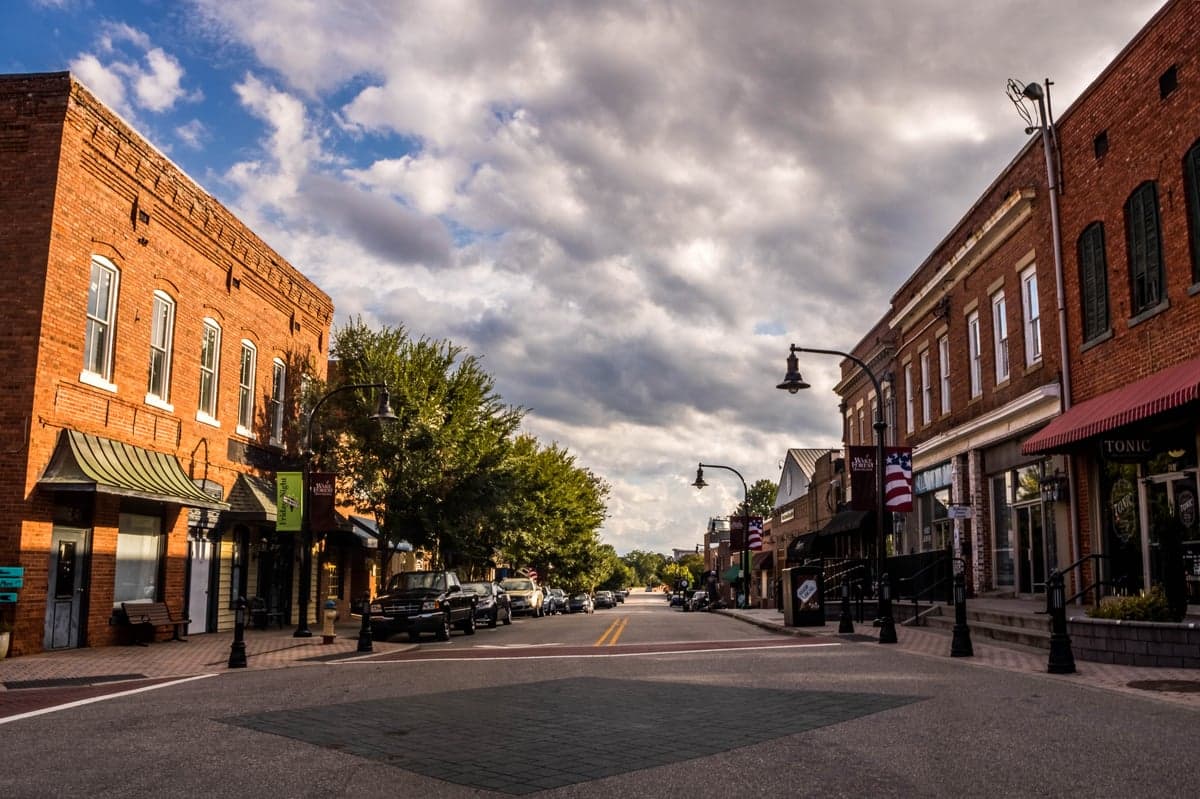
Wake Forest’s human history begins not with industry but with education. The town was founded in 1832 when the Wake Forest Manual Labor Institute (later Wake Forest College) was established on a 615-acre tract donated by Dr. Calvin Jones. The original population was a mix of faculty, students, and the enslaved laborers who built and maintained the campus. After the Civil War, the town remained a small, insular college community, with most residents being white Southerners tied to the school or local agriculture. The historic Downtown Wake Forest district, centered around South White Street, was the original hub where faculty homes, boarding houses, and small shops clustered. The Renaissance at Heritage area, now a master-planned community, sits on land that was once part of the college’s original farm holdings. The first major demographic shift came in 1956 when Wake Forest College moved to Winston-Salem, leaving the town without its economic anchor. The state took over the campus to create a psychiatric hospital, and the population stagnated for decades, remaining overwhelmingly white and rural through the 1970s.
Modern era (post-1965)
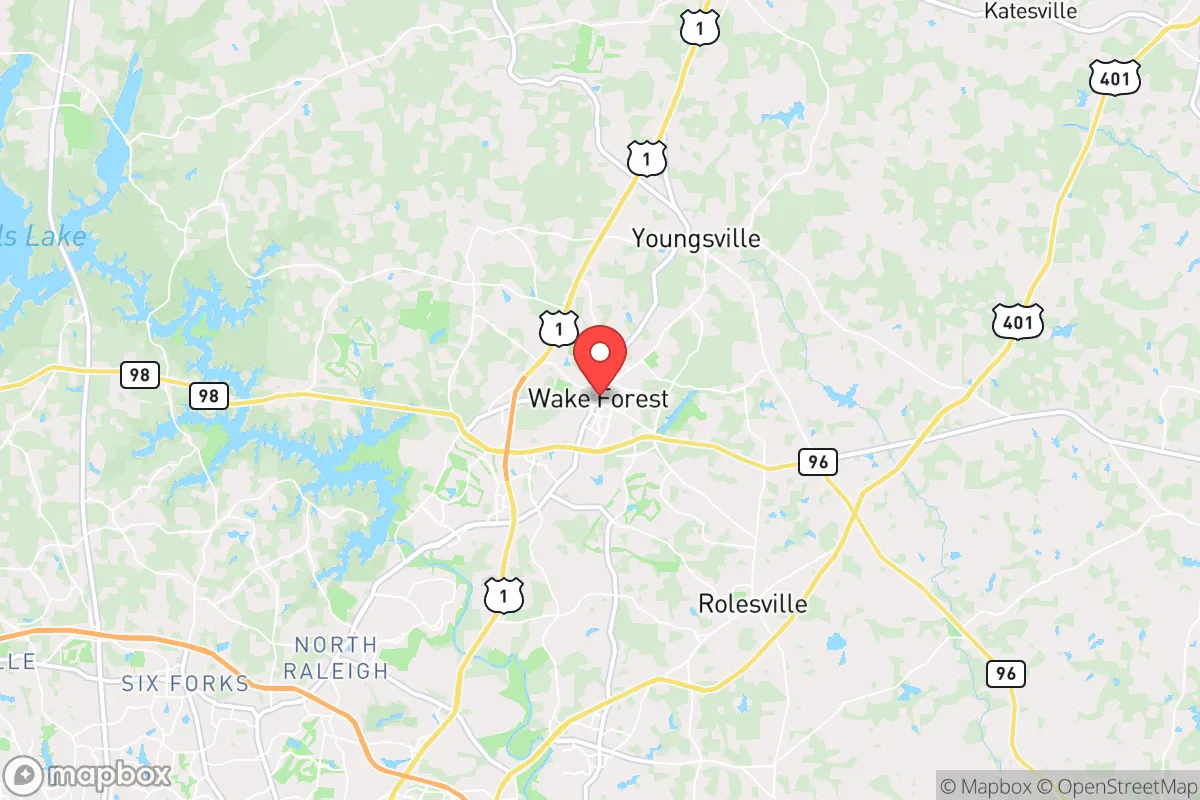
The modern population of Wake Forest is almost entirely a product of post-1980 suburbanization. The 1965 Hart-Cellar Act had little direct effect here—the foreign-born share remains very low—but the domestic migration wave that began in the 1990s reshaped the town completely. As Raleigh’s tech and biotech sectors boomed, families seeking larger lots and newer schools pushed north along Capital Boulevard (US-1). The Heritage neighborhood, a massive planned community launched in the 1990s, became the primary landing zone for white professional families moving from other parts of the Triangle or from out of state. Its golf course, swim clubs, and top-rated Wake Forest Elementary drew a heavily white, college-educated cohort. Meanwhile, the Holden’s Crossroads area, developed in the 2000s, attracted a more mixed demographic, including Black professionals and a smaller number of Hispanic families working in construction and services. The Black population, which had been a small minority in the pre-1960s town, grew steadily as middle-class African American families moved from Raleigh’s historically Black neighborhoods like Southeast Raleigh into newer subdivisions such as St. Andrews at Heritage and Bentley Ridge. The Hispanic population, now 7.8%, is concentrated in the Forest Ridge area and along the Capital Boulevard corridor, where older apartment complexes and mobile home parks provide more affordable entry points. East/Southeast Asian residents (1.4%) and Indian residents (1.0%) are small but growing, typically settling in the newer sections of Heritage and the Stadium Drive area near the new high school.
The future
Wake Forest’s population trajectory points toward continued growth and modest diversification, but not rapid change. The town is projected to reach 60,000–65,000 by 2035, driven almost entirely by domestic in-migration from other parts of the United States. The foreign-born share is likely to remain low (under 5%) because the town lacks the rental stock, public transit, and entry-level jobs that attract immigrant gateways. The Hispanic share is growing slowly, mainly through births rather than new immigration, and is concentrated in the Forest Ridge and Capital Boulevard corridor. The Black population is stable and well-integrated, with no signs of resegregation into a single enclave. The East/Southeast Asian and Indian communities are growing from a very small base, drawn by the same schools and housing that attract white professionals, but they are unlikely to reach double-digit shares without a major shift in regional employment patterns. The most notable trend is age homogenization: the town is becoming more uniformly composed of married couples with school-age children, while the elderly and young singles are shrinking as shares of the population. New developments like Villages at Wake Forest and Bishop’s Grant are targeting this family demographic with 4-bedroom homes and HOA amenities, reinforcing the town’s character as a family-oriented suburb.
For a conservative-leaning family or individual considering relocation, Wake Forest is becoming a more polished, more expensive version of its 1990s self: whiter and more educated than the national average, with a stable but modest Black middle class and a small, growing Hispanic presence. It is not a melting pot—it is a well-managed suburb where demographic change is slow and incremental. The town’s appeal lies in its schools, safety, and proximity to Raleigh jobs, not in diversity or urban energy. New arrivals will find a community that is welcoming to families who share those priorities, but less so to those seeking a more cosmopolitan or economically diverse environment.

* Values derived from national, state, county, city and local statistics and may differ in a specific area. Last updated: 2026-04-21T16:44:59.000Z
Narrative content on this page is AI-generated and may contain mistakes. Verify any details that matter before acting on them.
ReloMaps may earn a commission from affiliate links at no extra cost to you.

