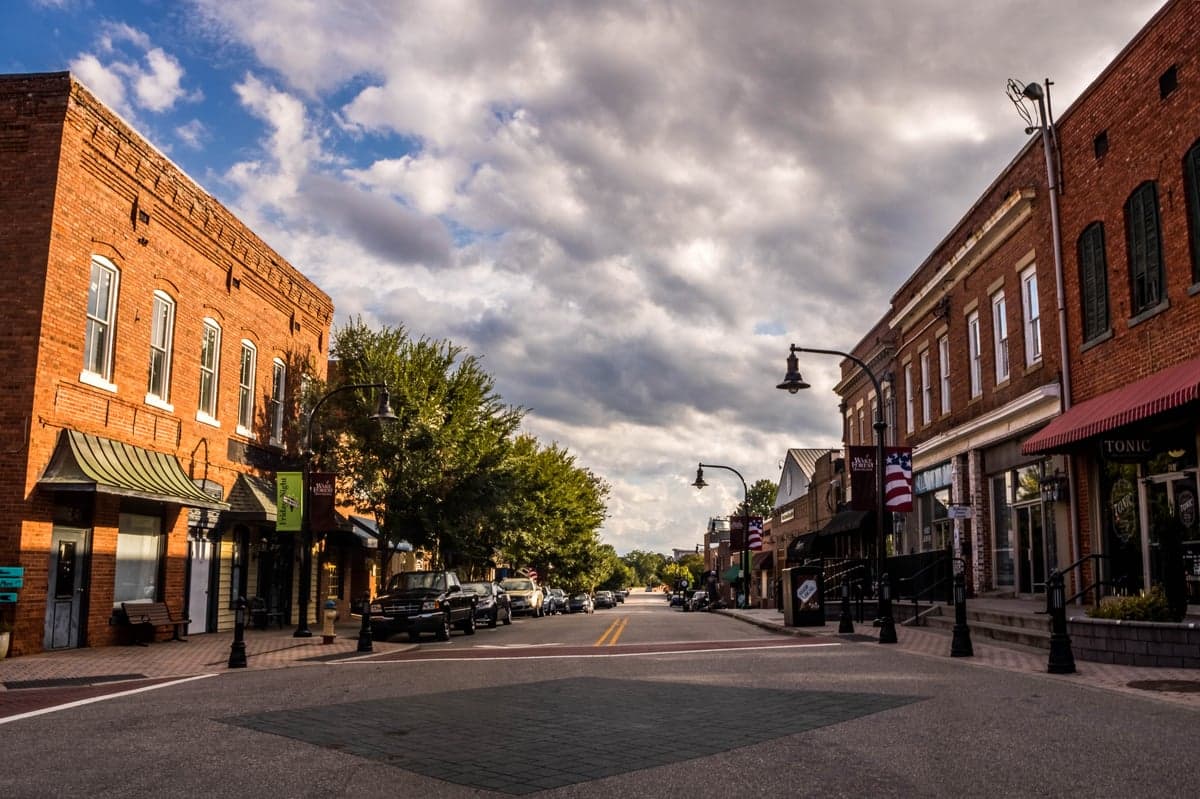
Photo: Wikipedia
Political ClimatePolitical Climate in Wake Forest, NC
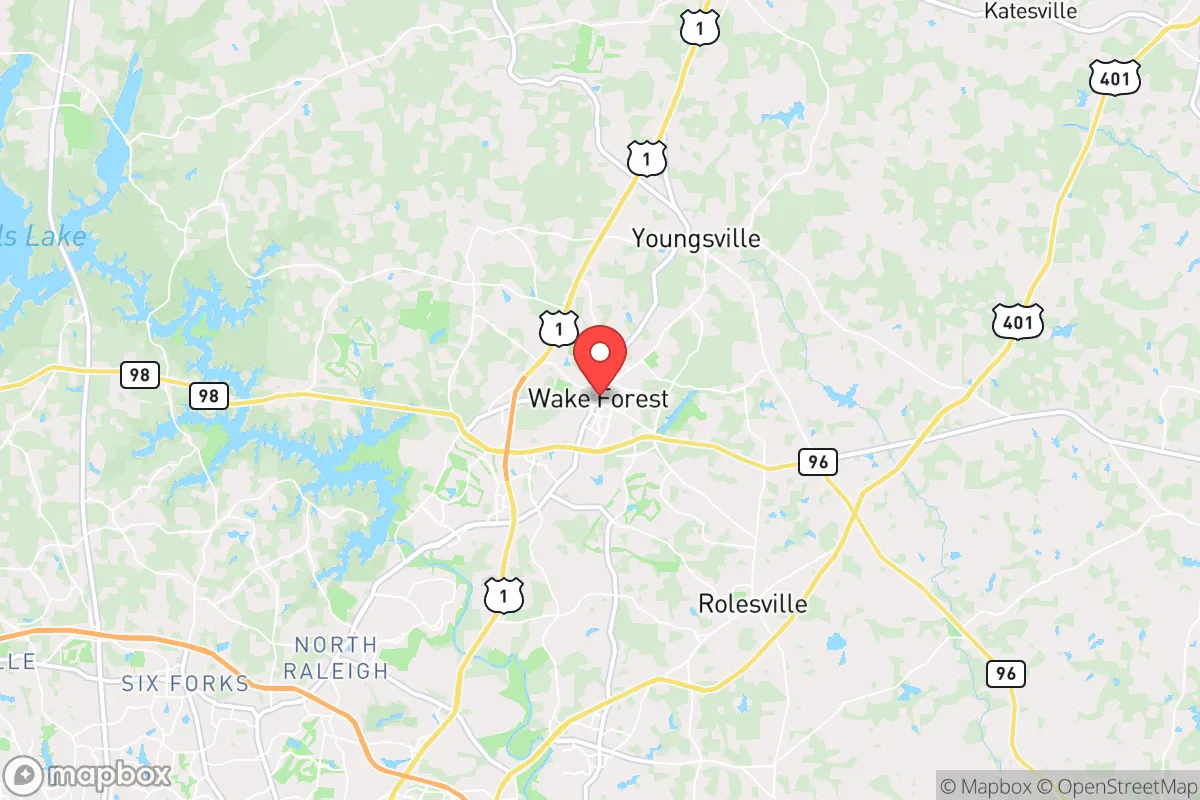
District shown is the primary district for this city’s centroid. Cities may span multiple districts.
Local Political AnalysisPolitical Analysis of Wake Forest, NC
Wake Forest has long been a reliably conservative community, but like much of the fast-growing Triangle region, it’s feeling the pressure of shifting demographics and political winds. The area’s Cook Partisan Voting Index (PVI) of R+8 tells you the baseline is still solidly Republican, but that number masks a lot of churn underneath. If you’ve been here a while, you’ve watched the old farm roads turn into subdivisions, and with those new rooftops come folks from blue states who bring a different set of expectations about what government should do. The trajectory is clear: Wake Forest is still red, but it’s no longer the deep, comfortable red it was twenty years ago, and the trend line is bending leftward with each election cycle.
How it compares
To understand Wake Forest’s politics, you have to look at the towns around it. Drive ten miles south into Raleigh proper, and you’re in a blue stronghold where progressive policies on zoning, policing, and taxes are the norm. Head west to Durham, and you’re in one of the most liberal cities in the Southeast. But go north or east—into the rural parts of Franklin County or toward the more traditional communities of Louisburg and Youngsville—and you’ll find the kind of conservative values that built this area: low taxes, limited government, and a general distrust of overreach from Raleigh or Washington. Wake Forest sits right on that fault line. It’s the buffer zone where the suburban expansion of the liberal Triangle meets the rural, freedom-minded countryside. That tension is what makes the local politics so interesting—and, frankly, a little concerning if you value your personal liberties.
What this means for residents
For the average resident, the political shift shows up in the small but steady creep of government into daily life. You’re seeing more zoning restrictions, talk of “affordable housing” mandates that really mean higher taxes and more bureaucracy, and a school board that’s increasingly influenced by progressive activists pushing curriculum changes that would have been unthinkable a decade ago. The town council has become a battleground where every new development proposal turns into a fight over density, traffic, and who gets to decide how you live. If you value the freedom to use your property as you see fit, or if you don’t want the government telling you what’s best for your kids’ education, these are red flags. The long-term worry is that Wake Forest could follow the path of Cary or Chapel Hill—places that were once conservative-leaning but got overwhelmed by rapid growth and progressive governance. It’s not there yet, but the foundation is cracking.
Culturally, Wake Forest still holds onto some distinctions that set it apart from its neighbors. The annual Christmas parade, the strong presence of local churches, and the general expectation that neighbors look out for each other without a government program are still the norm. But you’ll notice more “In This House We Believe” signs popping up in yards, more out-of-state license plates, and a growing divide between the old-timers and the newcomers. The policy battles that matter most here are the ones that touch personal freedom: property rights, school choice, and the Second Amendment. So far, Wake Forest has held the line on most of those, but it takes constant vigilance. If you’re thinking of moving here, understand that you’re buying into a community that’s fighting to stay free—and that fight is only going to get harder as the Triangle’s influence spreads north.

State Political ClimatePolitical Climate in North Carolina
State Political AnalysisPolitical Environment in the State
North Carolina has long been the quintessential swing state of the Southeast, but over the last 10-20 years, it has settled into a reliably red-leaning posture, though by razor-thin margins. The state voted for Donald Trump in both 2016 and 2024, while also electing a Democratic governor in every cycle since 1992. The dominant coalition is a mix of rural and suburban conservatives, military veterans, and a growing population of fiscally conservative transplants, but the state’s urban centers—Charlotte, Raleigh-Durham, and Asheville—are increasingly blue, creating a tense, competitive environment that keeps the state from tipping fully either way. The trajectory is a slow, grinding shift leftward in the metros, but the rural and exurban vote has held firm, making North Carolina a state where every election feels like a knife fight.
Urban vs. rural divide
The political map of North Carolina is a study in stark contrasts. The major metros—Charlotte (Mecklenburg County), Raleigh-Durham (Wake and Durham Counties), and Asheville (Buncombe County)—are deep blue strongholds, driven by transplants from the Northeast and West Coast, a large university and tech workforce, and a growing minority population. In 2024, Mecklenburg County went +28 for Kamala Harris, Wake County +22, and Buncombe County +19. These three counties alone account for nearly a third of the state’s population and are the engine of Democratic turnout. Meanwhile, the rural east—places like Greenville (Pitt County) and Fayetteville (Cumberland County)—are more mixed, with military communities and agricultural voters leaning red but with significant minority populations that vote blue. The real conservative firepower comes from the exurbs and small towns: Mooresville in Iredell County, Hickory in Catawba County, and Wilmington in New Hanover County are all reliably red, with margins of +15 to +25. The rural counties in the Piedmont and the mountains—like Yadkin County (Trump +45 in 2024) and Mitchell County (Trump +50)—are the bedrock of the GOP’s state-level dominance, ensuring control of the General Assembly and the Council of State despite the urban blue wave.
Policy environment
North Carolina’s policy environment is a mixed bag that leans conservative on most economic and cultural fronts, but with notable exceptions. The state has a flat income tax rate of 4.5% (down from 7% in 2013), with a scheduled phase-down to 3.99% by 2027, making it one of the more tax-friendly states in the region. There is no state property tax, and sales tax is capped at 7.5% in most counties. The regulatory posture is business-friendly, with right-to-work laws and a low unionization rate (around 3%). On education, the state has a robust school choice program, including Opportunity Scholarships (vouchers) that were expanded in 2023 to cover all income levels, and a growing charter school sector. However, the state’s healthcare landscape is a sore spot: Medicaid expansion was finally adopted in 2023 under Democratic Governor Roy Cooper, a move that many conservatives opposed as a federal dependency. Election laws are a battleground: the state requires voter ID (passed in 2018, upheld in 2023), has strict absentee ballot rules, and has drawn congressional maps that have been repeatedly litigated for partisan gerrymandering. The General Assembly is solidly Republican (72-48 in the House, 30-20 in the Senate), but the governor’s veto pen has been a check on the most ambitious conservative legislation.
Trajectory & freedom
On the freedom front, North Carolina has been a mixed story over the last decade. The good news: the state passed a constitutional carry law in 2023, allowing permitless concealed carry for law-abiding adults, a major win for Second Amendment rights. Parental rights were strengthened with the 2023 Parents’ Bill of Rights, which requires schools to notify parents about curriculum changes and medical services, and prohibits instruction on gender identity and sexuality in K-4 classrooms. The state also banned sanctuary cities in 2015, requiring local law enforcement to cooperate with federal immigration authorities. On the concerning side: the state’s medical autonomy took a hit with the 2023 expansion of Medicaid, which many see as a step toward government-controlled healthcare. Property rights have been under pressure from local zoning battles, particularly in Charlotte and Raleigh, where upzoning and density mandates have been pushed by progressive city councils. The state also saw a controversial 2021 law that limited the governor’s emergency powers after COVID-19 lockdowns, which was a net positive for freedom, but the underlying tension between state preemption and local control remains. Overall, the trajectory is cautiously positive for conservatives, but the urban centers are actively working to erode those gains through local ordinances and ballot initiatives.
Civil unrest & political movements
North Carolina has seen its share of political flashpoints. The 2020 protests in Charlotte and Raleigh following George Floyd’s death were significant, with property damage and clashes with police, though not on the scale of Portland or Seattle. The state has a strong organized conservative movement, anchored by groups like the John Locke Foundation and the North Carolina Family Policy Council, which have successfully pushed for school choice and parental rights. On the left, the Moral Monday movement, led by the NAACP, has been a persistent force for progressive policies since 2013, with regular protests at the General Assembly. Immigration politics are a hot-button issue: the state has no sanctuary cities, but Durham and Orange County have declared themselves “welcoming communities,” and there have been high-profile ICE detainers ignored by local sheriffs. Election integrity remains a live issue: the 2020 election saw a narrow Trump loss in the state (by 1.3 points), and subsequent audits found no widespread fraud, but the 2024 election saw a Trump win by 3.2 points, which calmed some nerves. The most visible flashpoint for a new resident would be the constant political advertising—North Carolina is a perennial swing state in presidential and Senate races, so you’ll see non-stop attack ads from both sides for months before any election.
Projection
Looking ahead 5-10 years, North Carolina is likely to remain a competitive red-leaning state, but the demographic trends are concerning for conservatives. The urban metros are growing fast—Charlotte and Raleigh are among the fastest-growing cities in the country, driven by transplants from blue states. These newcomers tend to bring their politics with them, which will slowly shift the state’s overall lean. However, the rural and exurban areas are also growing, and the state’s in-migration from Florida, Texas, and the Midwest includes many conservatives. The key battleground will be the suburbs: places like Wake Forest (north of Raleigh) and Cornelius (north of Charlotte) are currently purple, and their direction will determine the state’s future. The General Assembly is likely to remain Republican for the foreseeable future due to gerrymandering and the concentration of Democratic votes in a few counties, but the governor’s race and presidential elections will be toss-ups. A new resident moving in now should expect a state that is politically divided but functionally conservative on most policy fronts, with a constant low-grade culture war over education, taxes, and local control.
For someone choosing North Carolina, the bottom line is this: you get a low-tax, business-friendly environment with strong gun rights and school choice, but you also get a state that is politically contested at every level. If you’re moving to Mooresville or Hickory, you’ll find a solidly conservative community. If you’re moving to Charlotte or Raleigh, you’ll be in a blue city with a red state government, which means constant friction over local policies. The state is not a conservative paradise, but it’s a place where conservative values can still be lived and defended, as long as you’re willing to stay engaged in the fight.
* Values derived from national, state, county, city and local statistics and may differ in a specific area. Last updated: 2026-04-21T16:44:59.000Z
Narrative content on this page is AI-generated and may contain mistakes. Verify any details that matter before acting on them.
ReloMaps may earn a commission from affiliate links at no extra cost to you.

