Photo: Wikipedia
Personal Sovereignty in Wake Forest, NC
Viable for self-reliance. Generally workable, though some barriers may limit total independence.
What does Personal Sovereignty tell us?
Personal Sovereignty measures your capacity for self-reliance and independence with minimal government friction. Higher scores mean fewer barriers between you and the way you want to live... but it assumes you have the space you need and good neighbors.
What does this tell us?
Personal Sovereignty measures your capacity for self-reliance and independence with minimal government friction. Higher scores mean fewer barriers between you and the way you want to live... but it assumes you have the space you need and good neighbors.
State Policy
Energy independence: Importer (15% of energy produced in-state)
Personal Liberty
Homesteading

Personal Liberty Analysis
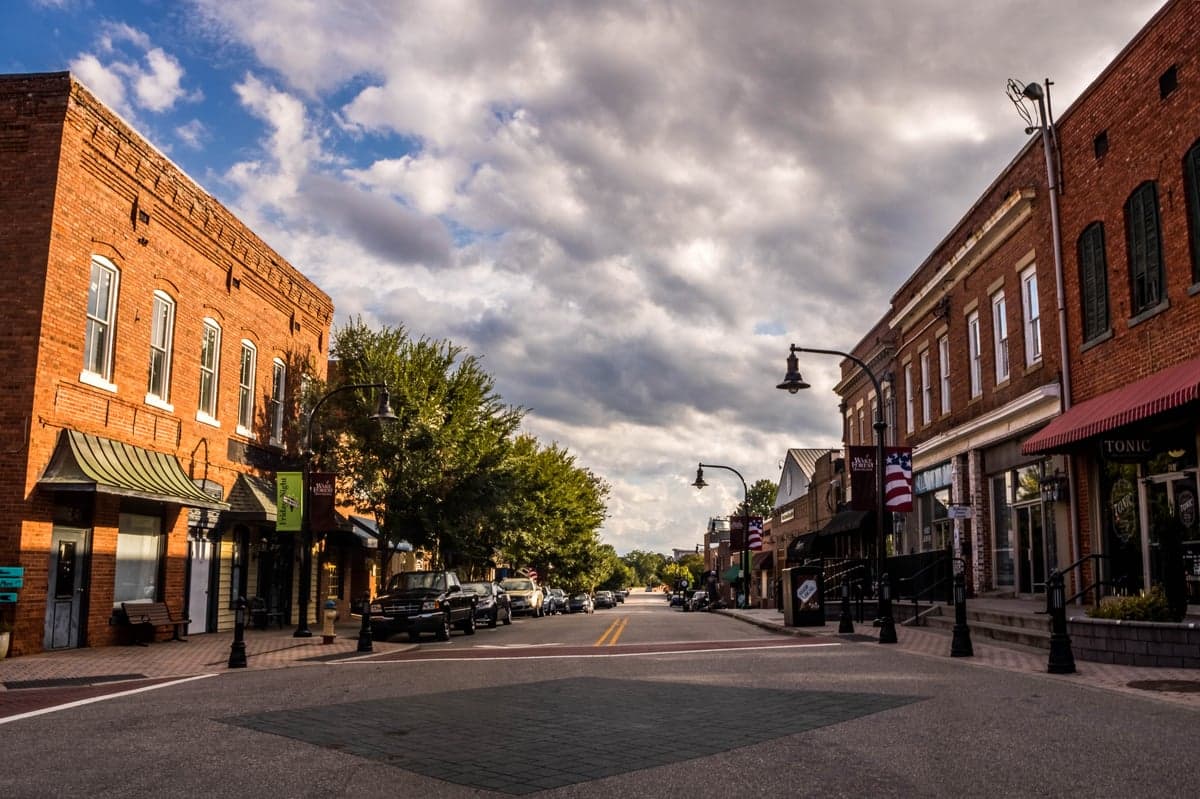
Wake Forest, North Carolina, offers a notably higher degree of personal sovereignty than many comparably sized towns in the mid-Atlantic or Northeast, largely because it sits within a state that has actively pushed back against federal overreach in recent years. For the individual or family operating from a survivalist or prepper mindset, the key question isn’t whether the town is a libertarian utopia—it isn’t—but whether the legal and cultural environment allows you to live by your own rules without constant government friction. The answer is a qualified yes: Wake Forest provides a solid baseline of autonomy, with state-level protections on self-defense, property rights, and taxation that beat the national average, though you’ll still contend with typical suburban zoning and a growing municipal appetite for regulation.
Tax burden and regulatory posture: how much the state and town take
North Carolina’s flat income tax rate of 4.75% (as of 2025, with a scheduled drop to 3.99% by 2027) is a clear win for anyone who wants to keep more of what they earn. There is no state tax on Social Security benefits, and the standard deduction for single filers is $12,750—meaningful for early retirees or those living off savings. Property taxes in Wake Forest itself run about $0.585 per $100 of assessed value, which on a $400,000 home comes to roughly $2,340 annually. That’s moderate by national standards, but note that Wake County’s overall tax rate (combining city, county, and school levies) pushes the effective rate closer to $0.85 per $100. The regulatory posture is business-friendly at the state level—North Carolina is a right-to-work state with no state-level OSHA plan (federal OSHA covers it), and occupational licensing is less burdensome than in states like California or New York. However, Wake Forest has a fairly active town planning department. If you want to run a home-based firearms manufacturing business or a small-scale food operation, you’ll need to navigate local zoning and health department rules that are stricter than in unincorporated parts of the county. The town also enforces a stormwater utility fee and has a tree preservation ordinance that can limit what you do on your own lot. The net effect: the state gives you breathing room, but the town will ask questions.
Self-defense and gun law specifics: what you can carry and where
North Carolina is a “shall issue” state for concealed carry permits, and as of 2023, permitless concealed carry is legal for anyone 18 or older who can legally possess a firearm. That means you can carry a concealed handgun in Wake Forest without a permit, though a permit still offers reciprocity with 30+ other states—worth having if you travel. The state preempts local gun ordinances, so Wake Forest cannot ban carry in parks, restaurants, or other public spaces that the state allows. Stand-your-ground law is on the books, with no duty to retreat in any place you have a lawful right to be. Magazine capacity is not restricted, and there is no state-level assault weapons ban. The only real friction points: you cannot carry on any property that posts a “no guns” sign (and those signs carry force of law in North Carolina), and you cannot carry into a building that hosts a state or federal government office. For the prepper, this is a strong environment. You can keep a rifle in your vehicle on school parking lots (with limitations), and you can store firearms in your home without registration. Wake Forest has no local gun registry or waiting period beyond the federal NICS check. If you’re coming from a state like New York, New Jersey, or California, this will feel like a liberation. If you’re coming from a free state like Texas or Arizona, you’ll find it comparable, though North Carolina’s reciprocity list is slightly shorter.
Self-reliance and homesteading viability: lot sizes, zoning, and off-grid feasibility
This is where Wake Forest shows its suburban character. Most residential lots within the town limits are between 0.25 and 0.5 acres, and the zoning code requires minimum lot sizes of 8,000 to 12,000 square feet in standard subdivisions. That’s enough for a large garden and a chicken coop, but not for a serious homestead with livestock or a private water well. The town’s zoning ordinance explicitly prohibits “agricultural uses” on residential lots under two acres, which means no goats, pigs, or horses unless you buy land in the rural buffer zones north of town (near the Franklin County line). Off-grid feasibility is low within town limits: the code requires connection to municipal water and sewer where available, and solar panels are allowed but subject to HOA restrictions in many subdivisions. If you want to drill a well or install a septic system, you’ll need to be on a lot of at least one acre and outside the town’s urban services boundary. The practical advice: if self-reliance is your primary goal, look at properties in the unincorporated areas of northern Wake County or southern Franklin County, where lot sizes of 2-10 acres are common and zoning is far looser. Wake Forest itself is a good base for supplies and community networking, but you won’t be able to live off the grid inside the town limits without constant code enforcement visits.
Personal liberties: parental rights, medical autonomy, speech, and property
North Carolina has a Parents’ Bill of Rights law (enacted in 2023) that gives parents explicit authority over their children’s education, medical decisions, and records. This means you can opt your child out of sex education, review all instructional materials, and be notified if a school changes a student’s name or pronouns. Wake Forest’s schools (part of Wake County Public Schools) have generally complied, though the district’s administration in Raleigh has been a flashpoint for parental rights battles. On medical autonomy, North Carolina does not have a state-level vaccine mandate for adults, and COVID-era emergency orders were struck down by the state legislature in 2021. You can refuse any vaccine without penalty for employment (outside of healthcare settings), and there is no state database tracking your medical choices. Speech protections are strong: North Carolina is not a “critical race theory” ban state, but it does prohibit compelled speech in public schools regarding certain racial or gender ideologies. Property rights are reinforced by the state’s “Dillon’s Rule” framework, which limits local governments to powers explicitly granted by the state—meaning Wake Forest cannot invent new restrictions on your property without state authorization. The town has a rental registration ordinance that requires landlords to register units and pay a fee, which some see as an overreach, but it does not apply to owner-occupied homes. For the prepper, the key takeaway is that you can speak your mind, raise your kids according to your values, and make medical decisions without the state second-guessing you—at least for now.
Overall, Wake Forest ranks as a solid B+ for personal sovereignty when compared to other mid-sized Southern towns. It lacks the wide-open homesteading freedom of rural Texas or the constitutional carry purity of Alaska, but it handily beats most of the Northeast, the West Coast, and even parts of the Midwest on tax burden, gun rights, and parental control. The biggest threats to your autonomy here are not state-level laws but local zoning creep and HOA restrictions—so if you buy, choose your subdivision carefully or go outside the town limits. For the single individual or family who wants to live free without being a hermit, Wake Forest offers a workable balance: enough legal protection to keep the government off your back, and enough community infrastructure to make daily life practical. Just don’t expect to disappear into the woods—this is still a growing suburb, and the town council has opinions about your front yard.

* Values derived from national, state, county, city and local statistics and may differ in a specific area. Last updated: 2026-04-21T16:44:59.000Z
Narrative content on this page is AI-generated and may contain mistakes. Verify any details that matter before acting on them.
ReloMaps may earn a commission from affiliate links at no extra cost to you.

