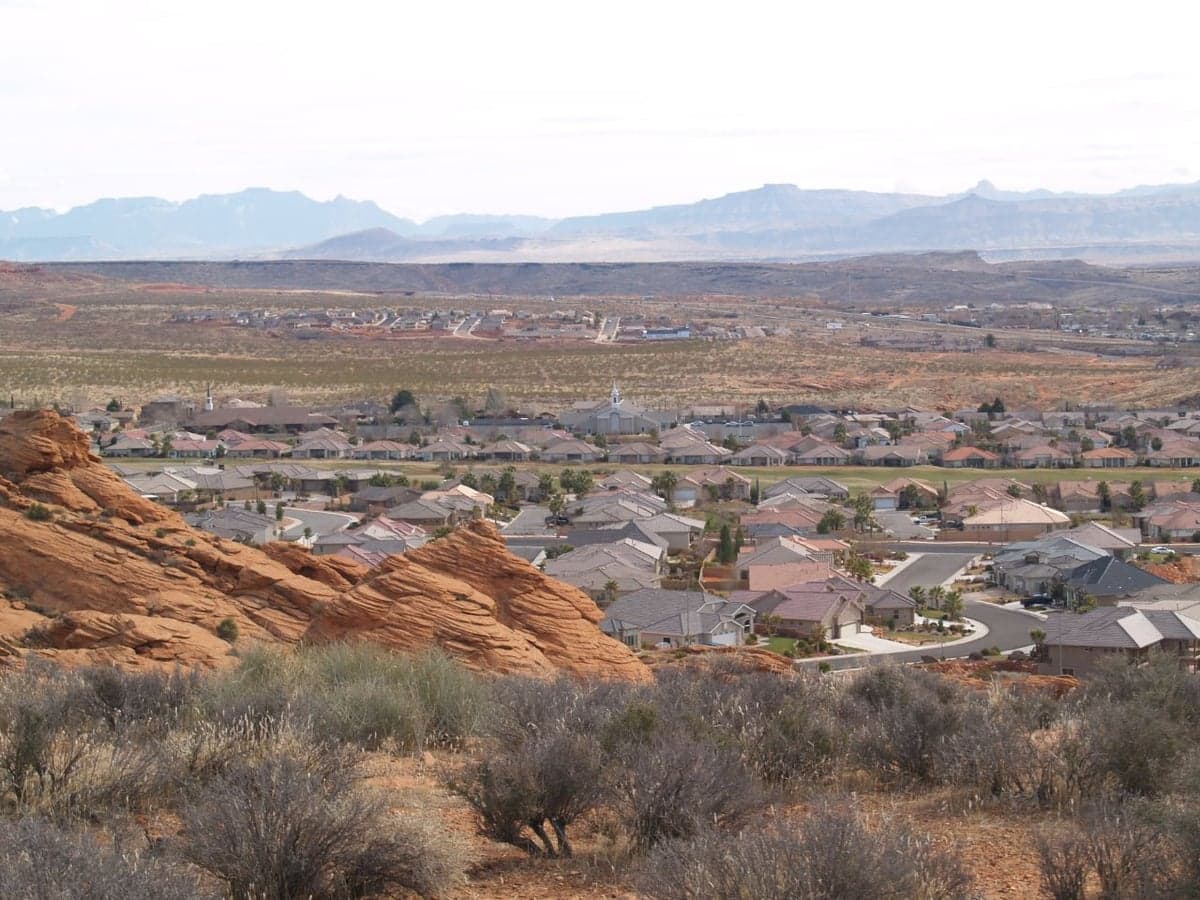
Photo: Wikipedia
Strategic Assessment of Washington, UT
Workable tactical position. Some exposure to population density or targets, but generally defensible in a crisis.
What does the Strategic Assessment tell us?
Our Strategic Assessment grades tactical survivability of an area. Major population centers, military targets, fallout zones, natural disasters, and border exposure all drive risk — lower exposure means a more defensible position in a crisis.
This is heavily inspired by Joel Skousen's Strategic Relocation book. Highly recommended you checkout the book ($)What does this tell us?
Our Strategic Assessment grades tactical survivability of an area. Major population centers, military targets, fallout zones, natural disasters, and border exposure all drive risk — lower exposure means a more defensible position in a crisis.
This is heavily inspired by Joel Skousen's Strategic Relocation book. Highly recommended you checkout the book ($)Strategic Pillars

Key Distances
Regional Safe Places
Below is our recommended "safe zones" in Utah and the surrounding area based on our strategic heuristics. For most people, it's unrealistic to live in a “safe zone” full-time due to work, family or other personal reasons. They tend to be more rural. However, many of these areas are perfect for second homes and retreat properties that double as a vacation home or even a short-term rental.


Important Note: For informational purposes only. This does not mean nothing bad ever happens in the green zones. Please use common sense. This is based on public data and modeled with AI. We tried to take a conservative approach but mistakes happen. We update this regularly as new information becomes available.
Solar Generator Recommendations
Backup power matters more here than in safer locations. We've picked three solar generators across budgets and capacity tiers — start with the budget unit if you only need a few essentials, or step up if you want to run a fridge and HVAC for days at a time.

Jackery Portable Power Station Explorer 300
Budget OptionPower on the Go: Weighing only 11 lbs, it's convenient to set up and store with book-sized foldable solar panels

BLUETTI Portable Power Station AC180
Designed for both indoor and outdoor scenarios, AC180 is highly capable as it has a robost capacity and continuous output power.

EF ECOFLOW DELTA Pro Ultra Power Station
Upgraded PickEcoFlow DELTA Pro Ultra is a whole-home energy system designed to grow with your family. Integrated with the Smart Home Panel 2, it scales to meet your evolving energy needs — keeping your home powered, intelligent, and secure through every stage of life.
We earn a commission, at no additional cost to you.
Strategic Assessment Analysis
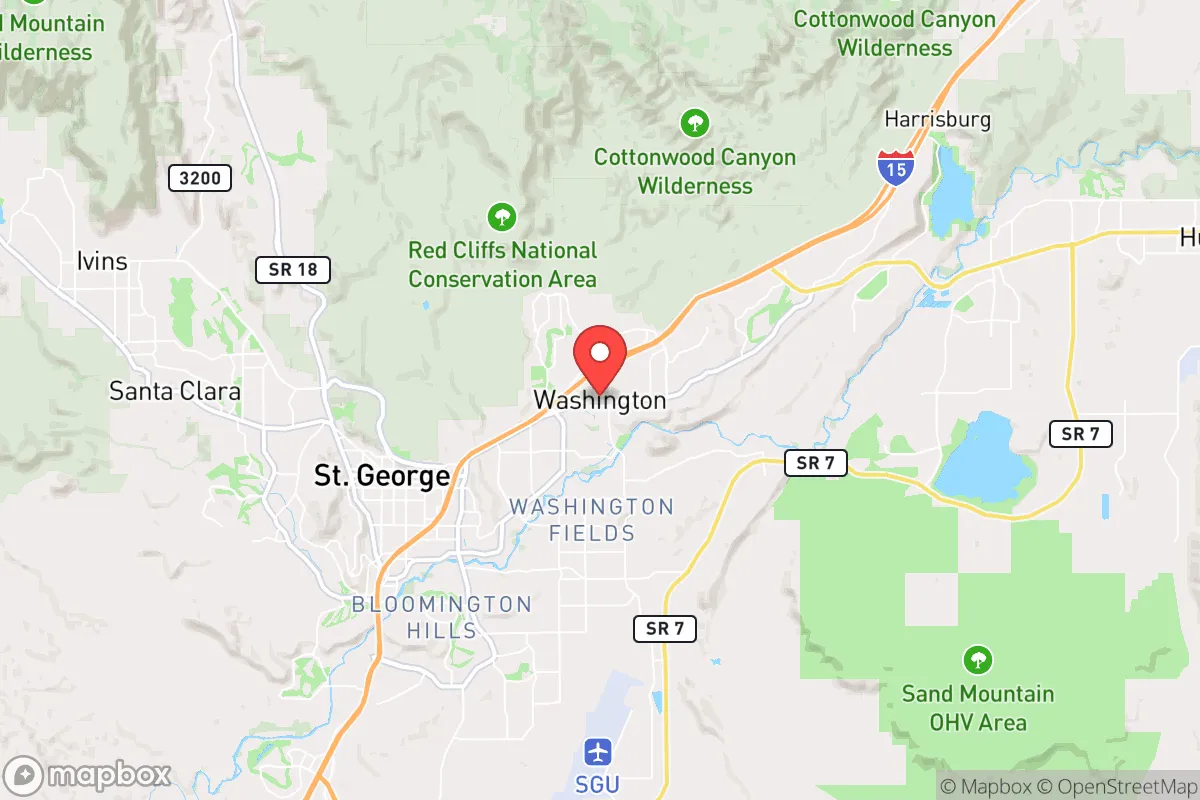
Washington, Utah, offers a compelling strategic position for those prioritizing resilience, combining a semi-arid climate with distance from major coastal population centers while maintaining access to essential infrastructure. Situated in the southwestern corner of Utah, roughly 300 miles from Las Vegas and 120 miles from Salt Lake City, this community of around 30,000 residents sits in the Virgin River Valley at the edge of the Red Cliffs Desert Reserve. For the prepper or survivalist, the area’s relative isolation from the most volatile urban corridors—coupled with its location in a state known for strong Second Amendment protections and a culture of self-reliance—makes it a candidate worth serious consideration. The surrounding geography, dominated by sandstone cliffs and high desert plateaus, provides natural barriers that could slow movement and offer defensible terrain, while the local economy’s reliance on agriculture, tourism, and a growing remote-work sector suggests a degree of economic insulation from coastal shocks.
Geographic position and natural advantages for long-term security
Washington’s location in the Washington County corridor places it near the intersection of Interstate 15 and State Route 9, offering two primary evacuation routes north toward Cedar City or east toward Zion National Park and the high country. The area sits at roughly 2,800 feet elevation, providing a moderate climate with four distinct seasons—summer highs often exceed 100°F, but low humidity makes it manageable, while winter lows rarely drop below 20°F. This climate supports year-round gardening and livestock grazing, a critical advantage for food security. The Virgin River runs through the valley, and while it’s not a major water source, the region’s groundwater aquifers are relatively robust compared to other parts of the Southwest. The surrounding topography—steep canyon walls, the Pine Valley Mountains to the north, and the Hurricane Cliffs to the east—creates natural chokepoints that could be leveraged for perimeter defense or early warning. For a relocator, the ability to retreat into the higher elevations of the Dixie National Forest (about 30 miles north) or the remote canyons of the Grand Staircase-Escalante (60 miles east) provides a fallback option if the valley becomes compromised. The area’s low population density—roughly 50 people per square mile in the broader county—reduces the risk of cascading social collapse compared to denser urban centers.
Risks, exposures, and proximity to fallout-relevant landmarks
No strategic assessment is complete without acknowledging the liabilities. Washington’s primary exposure is its proximity to the Las Vegas metropolitan area (about 120 miles southwest), which in a scenario of civil unrest or mass casualty events could become a source of refugee flow or supply chain disruption. The I-15 corridor is a double-edged sword: it provides access to resources but also a direct route for displaced populations moving north. The area is also within 200 miles of the Nevada National Security Site (formerly the Nevada Test Site) and the Yucca Mountain nuclear waste repository, though prevailing winds generally carry fallout eastward, not toward Utah. More immediate risks include the potential for earthquakes along the Hurricane Fault, which runs through the region—a major quake could disrupt water and power infrastructure. The area’s reliance on the Colorado River system (via the Lake Powell pipeline project, still under development) means water availability is tied to interstate compacts that could become contentious during prolonged drought. Wildfire risk is moderate but real, particularly in the surrounding BLM lands and national forests. For the prepper, the biggest concern is the area’s growing popularity: Washington County’s population has increased by over 30% since 2020, bringing more people, traffic, and potential competition for resources. The proximity to St. George (10 miles west), a city of 100,000, means that in a crisis, Washington could be caught in the spillover from a larger urban center’s collapse.
Practical resilience: food, water, energy, and defensibility
For a relocator serious about self-sufficiency, Washington offers a mixed bag. The growing season runs roughly April through October, allowing for two crop cycles in many years—cool-season greens in spring and fall, and heat-tolerant crops like corn, beans, and squash in summer. Local farmers’ markets and a handful of small-scale producers provide a baseline for food sourcing, but the area is not a major agricultural hub; most food is trucked in from California or the Wasatch Front. Water rights are a critical consideration: new construction often requires proof of water availability, and many homes rely on municipal systems fed by the Virgin River and local wells. For off-grid capability, rainwater harvesting is legal in Utah, but annual precipitation averages only 10-12 inches, making it insufficient as a primary source without significant storage. Solar energy is a strong suit—Washington averages over 300 sunny days per year, and net metering policies are favorable, though the local utility (Rocky Mountain Power) has faced reliability issues during peak summer demand. Defensibility is aided by the area’s layout: many neighborhoods are nestled against cliffs or in cul-de-sacs, providing natural chokepoints. However, the terrain also limits line-of-sight for observation, and the abundance of red-rock canyons could conceal approach routes. The local culture leans heavily toward self-reliance, with a strong LDS (Mormon) community that emphasizes preparedness—many households maintain food storage and have experience with emergency response. Gun ownership is common, and Utah’s constitutional carry law means no permit is needed for concealed carry, a practical advantage for personal security. The Washington County Sheriff’s Office is well-funded and responsive, but in a widespread collapse scenario, law enforcement would likely be stretched thin.
Overall, Washington, UT, presents a viable but not risk-free option for the strategic relocator. Its strengths lie in natural barriers, a climate conducive to self-sufficiency, and a cultural baseline of preparedness, while its weaknesses center on growing population pressure, water constraints, and proximity to a major urban corridor. For the conservative-minded individual or family looking to weather potential civic unrest or systemic disruptions, the area offers a middle ground—not as remote as the high deserts of northern Nevada or the Idaho panhandle, but far enough from the coasts to avoid the worst of coastal collapse scenarios. The key is to act before the area becomes overrun by the very trends that make it attractive. Secure a property with established water rights, invest in solar and storage, build relationships with local growers and like-minded neighbors, and have a plan for retreat into the surrounding high country if needed. Washington is not a fortress, but it is a defensible position in a state that still values individual liberty—and in the current climate, that counts for a lot.

* Values derived from national, state, county, city and local statistics and may differ in a specific area. Last updated: 2026-05-03T20:37:54.000Z
Narrative content on this page is AI-generated and may contain mistakes. Verify any details that matter before acting on them.
ReloMaps may earn a commission from affiliate links at no extra cost to you.

