Photo: Wikipedia
Demographics of Washington, UT
Affluence Level in Washington, UT
An upper-middle-class area. Household wealth, education levels, and homeownership run ahead of national benchmarks.
People of Washington, UT
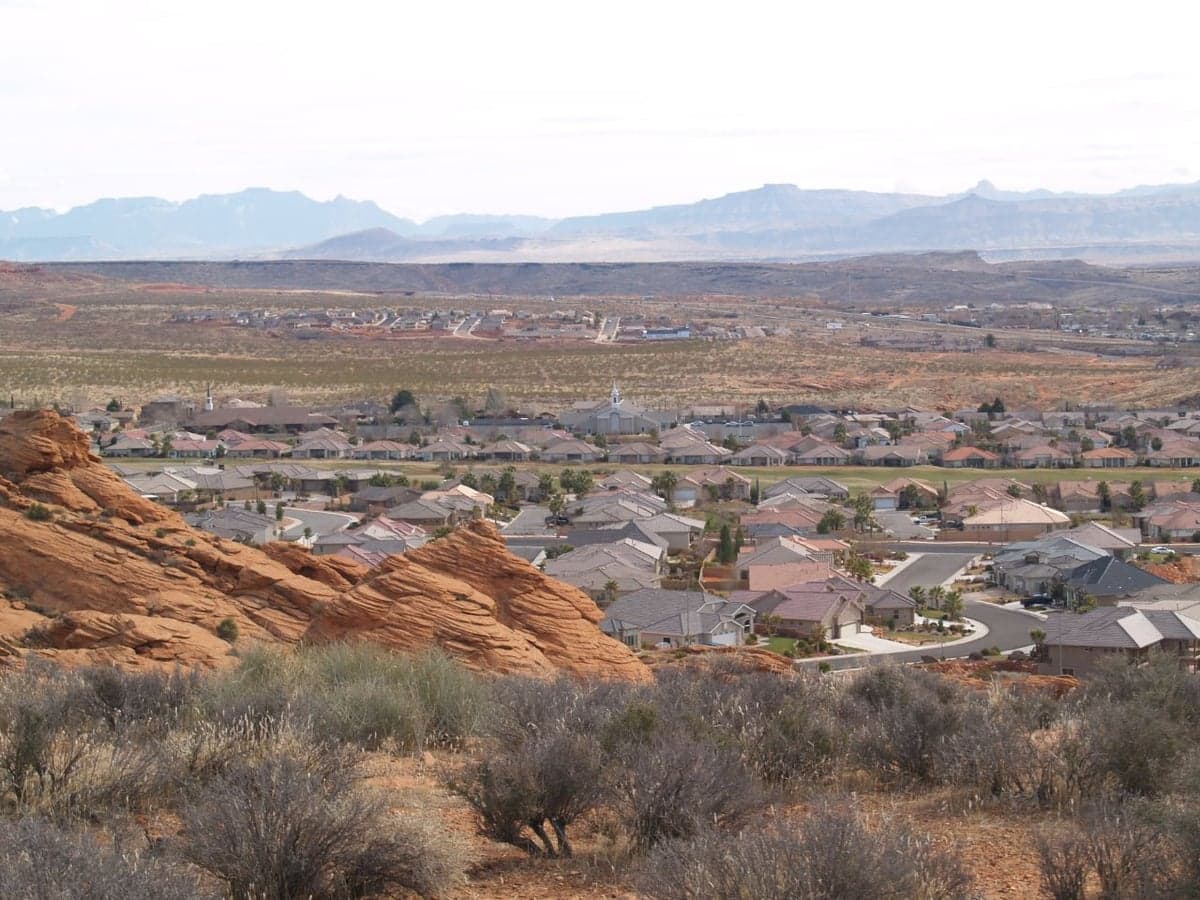
The people of Washington, Utah, today number roughly 30,686, forming a predominantly white (77.1%) and politically conservative community with a notable and growing Hispanic minority (16.7%). The city’s character is defined by its strong Latter-day Saint (LDS) cultural roots, a family-oriented suburban atmosphere, and a relatively low foreign-born population of just 2.7%. Distinctive markers include a high rate of homeownership, a median age slightly younger than the national average, and a population that is less racially diverse than the broader St. George metropolitan area, yet more ethnically varied than many neighboring Washington County towns.
How the city was settled and grew
Washington’s human history begins with Mormon pioneers sent by Brigham Young in 1857 to establish a cotton-growing mission, part of the "Dixie" settlement effort. The original settlers—mostly families from the Salt Lake Valley and northern Utah—were tasked with agricultural self-sufficiency, growing cotton, grapes, and other warm-weather crops. This initial wave built the historic Washington City Historic District, centered around the old Washington Town Square and the iconic Washington Cotton Factory. The population remained small and overwhelmingly LDS through the early 20th century, with growth driven by farming and later by the construction of the nearby Hurricane Canal and the development of the region’s fruit orchards. A second, smaller wave arrived during the Great Depression, as Dust Bowl refugees and out-of-work miners settled in the Green Valley area, then a rural farming pocket, seeking affordable land and a simpler life.
Modern era (post-1965)
The modern transformation of Washington began after 1965, driven by two forces: the expansion of Interstate 15 and the explosive growth of the St. George metropolitan area. Domestic in-migration—primarily from California, Arizona, and other Western states—surged in the 1990s and 2000s as retirees and families sought lower taxes, a slower pace, and a conservative social environment. This wave settled heavily in master-planned subdivisions like Washington Fields and SunRiver St. George, the latter an active-adult 55+ community that drew thousands of out-of-state retirees. The Hispanic population began to grow noticeably in the 2000s, driven by construction and service-sector jobs in the booming St. George economy. These families concentrated in the Dixie Springs and Green Valley neighborhoods, where more affordable housing and rental options were available. The Asian population (1.0%) and Black population (0.4%) remain very small, with no significant enclaves; these groups are dispersed across newer subdivisions like Millcreek and Washington Fields. The Indian-subcontinent population is effectively zero (0.0%), reflecting the city’s limited draw for tech or professional immigrant communities.
The future
Washington’s population is projected to continue growing steadily, likely reaching 40,000–45,000 by 2040, driven by continued domestic in-migration from high-cost Western states. The city is not tribalizing into distinct ethnic enclaves; rather, it is slowly homogenizing into a broader conservative, family-oriented suburb. The Hispanic share is expected to rise modestly, possibly to 20–22%, as second-generation families remain and new arrivals fill service and construction roles. However, the foreign-born share (2.7%) is likely to stay low, as most Hispanic growth will come from natural increase and domestic migration, not new immigration. The white, LDS-majority population will remain dominant, but the city will become slightly more ethnically diverse, particularly in the Dixie Springs and Green Valley areas. No significant growth is expected for Asian, Black, or Indian communities, as the local economy lacks the high-skilled job base that attracts those groups to larger metros.
For a conservative-leaning individual or family moving in now, Washington is becoming a stable, culturally cohesive suburb where the population is growing but not rapidly diversifying in a way that disrupts its core identity. The city offers a predictable, family-friendly environment with a strong LDS influence, a growing Hispanic community that is largely integrated, and very little of the ethnic fragmentation seen in larger Sun Belt cities. It is a place where the demographic story is one of gradual, moderate change—not transformation.

* Values derived from national, state, county, city and local statistics and may differ in a specific area. Last updated: 2026-05-03T20:37:54.000Z
Narrative content on this page is AI-generated and may contain mistakes. Verify any details that matter before acting on them.
ReloMaps may earn a commission from affiliate links at no extra cost to you.

