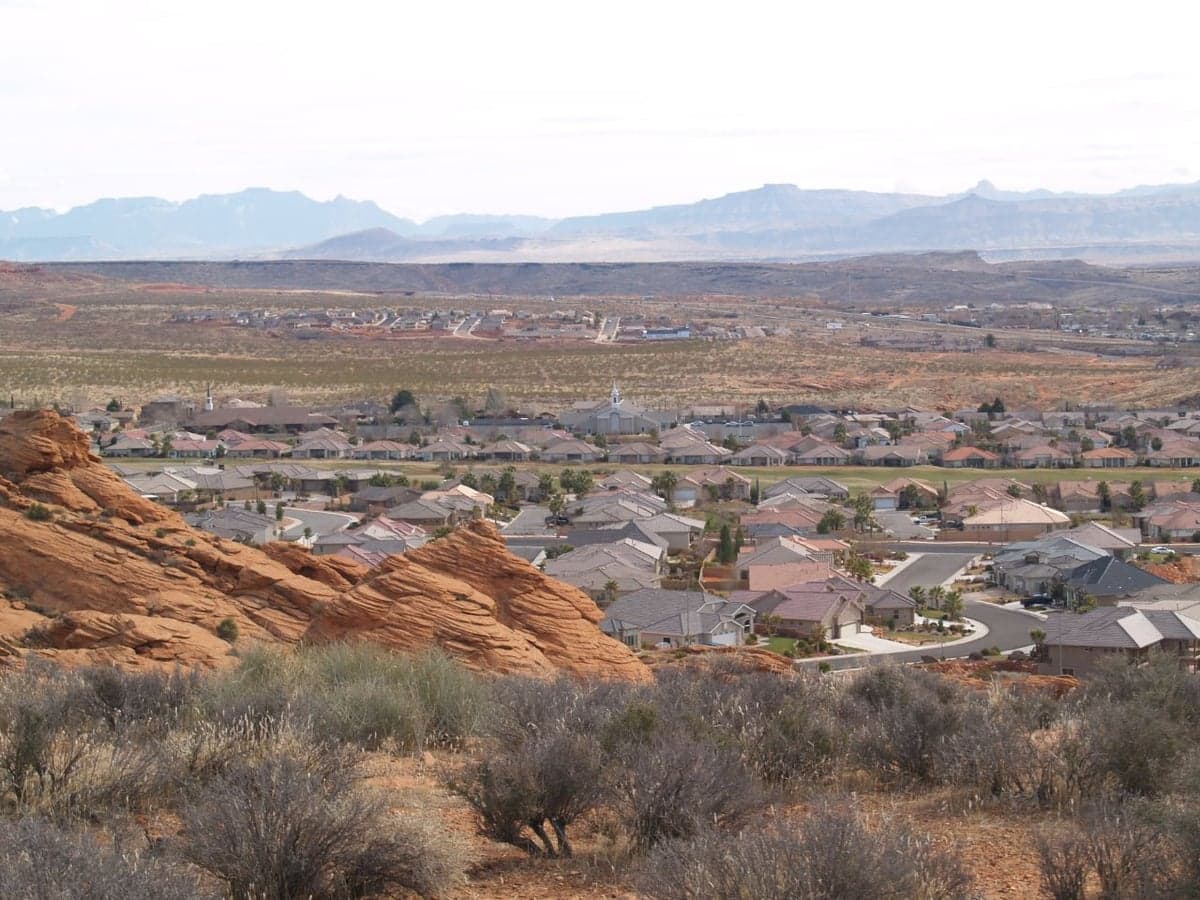
Photo: Wikipedia
Political ClimatePolitical Climate in Washington, UT
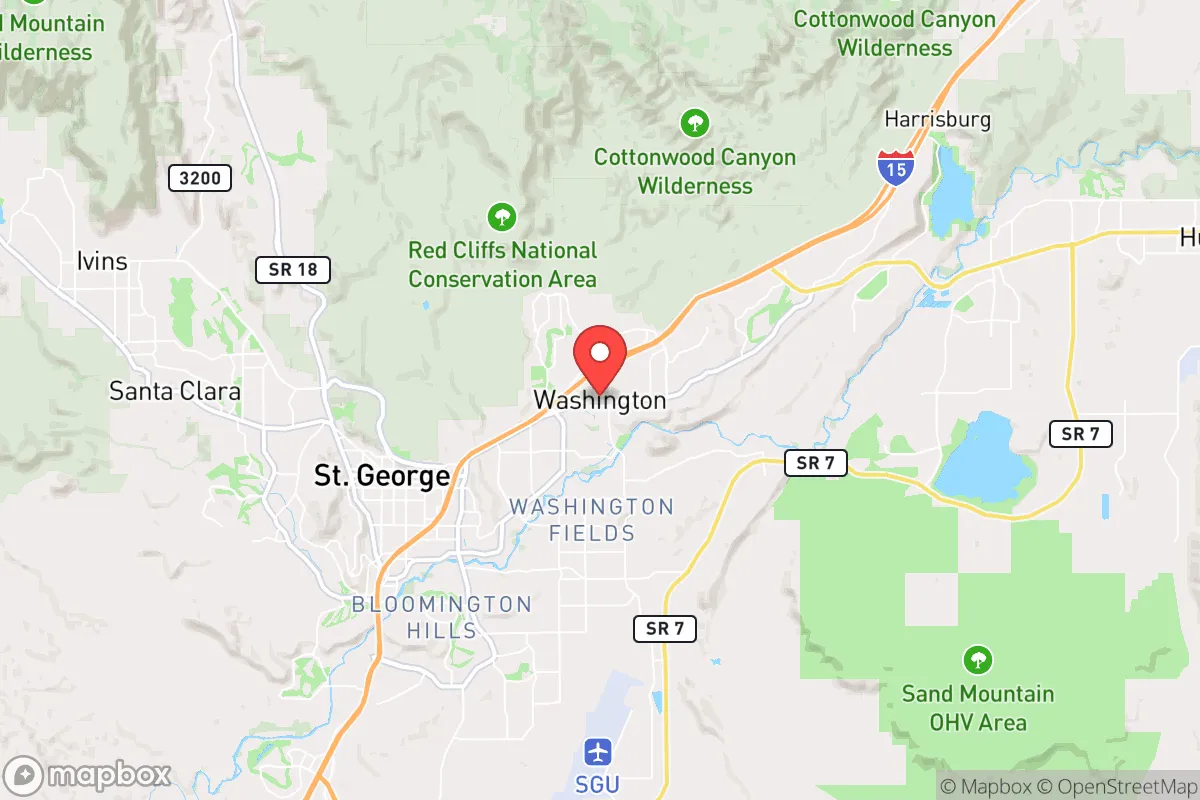
District shown is the primary district for this city’s centroid. Cities may span multiple districts.
Local Political AnalysisPolitical Analysis of Washington, UT
Washington, Utah, sits firmly in conservative territory, with a Cook PVI of R+10 that reflects a deep-rooted preference for limited government and traditional values. This isn't a purple area that flips with the national mood; it's a place where Republican candidates routinely win by double digits, and the local culture reinforces that. The political lean here is stable, but there's a growing undercurrent of concern among long-time residents about the slow creep of progressive policies from the state's more liberal pockets, like Salt Lake City, and the influx of new residents who might not fully grasp the local ethos.
How it compares
To really understand Washington, you have to look at its neighbors. Drive 15 minutes east to St. George, and you'll find a similar conservative base, but with a slightly more moderate, business-friendly vibe that sometimes accommodates a wider range of viewpoints. Head north to Cedar City, and the politics are even more ruggedly independent, with a stronger libertarian streak. The real contrast is with places like Moab or Park City, which are deep blue islands in a red state. Washington, by comparison, feels like a fortress of traditional values. It's not just about voting records; it's about the everyday conversations—people here are wary of government overreach, whether it's federal land management dictating local water use or state mandates that infringe on personal freedoms. The R+10 rating isn't just a number; it's a shield against the progressive ideology that's reshaping other parts of Utah.
What this means for residents
For someone living here, the political climate means a lot of practical things. You can generally expect local ordinances to respect property rights and personal liberties—things like minimal zoning restrictions on how you use your land, and a school board that prioritizes parental control over curriculum. The city council and county commission are reliably conservative, so there's little fear of sudden, top-down social experiments. However, the shift is real. I've seen it over the last decade: more people moving in from California and the Pacific Northwest, bringing with them a different set of expectations. They might not be actively progressive, but they're often more comfortable with government solutions to problems. The concern among locals is that this slow demographic change could dilute the area's political character, leading to more regulations, higher taxes, and a loss of the independent spirit that makes Washington a great place to raise a family. The key is staying engaged in local elections and school board meetings, because that's where the real battles over personal freedoms are fought.
Culturally, Washington still feels like a place where the Second Amendment is a given, not a debate, and where the LDS Church's influence reinforces a community-focused, self-reliant mindset. There's a strong distrust of federal overreach, especially regarding public lands and water rights—issues that hit close to home in the desert. The policy distinctions are subtle but real: you won't see the kind of aggressive housing density mandates or "equity" initiatives that are popping up in more progressive cities. Instead, the focus is on keeping taxes low, maintaining public safety, and preserving the area's rural character. For now, Washington remains a stronghold for those who value freedom over convenience, but keeping it that way requires constant vigilance against the tide of progressive ideology that's washing over so many other communities.

State Political ClimatePolitical Climate in Utah
State Political AnalysisPolitical Environment in the State
Utah has long been one of the most reliably conservative states in the Union, with a Republican trifecta controlling state government for decades and a political culture deeply shaped by the LDS Church’s emphasis on family, community, and self-reliance. Over the past 10-20 years, the state has shifted from a solidly red, almost monolithic GOP stronghold to a place where a growing urban-liberal corridor is starting to challenge that dominance, though the overall lean remains deeply conservative. The 2024 presidential election saw Donald Trump win Utah by roughly 21 points, a slight dip from his 2020 margin of 23 points, signaling a slow but real erosion of the GOP’s grip in the Wasatch Front while the rural and suburban counties remain fiercely red.
Urban vs. rural divide
The political map of Utah is a story of two worlds. The Wasatch Front—Salt Lake City, Provo, Ogden, and their sprawling suburbs—is where the vast majority of the state’s population lives, and it’s where the political action is. Salt Lake County, home to over 1.1 million people, has become a battleground: it went for Joe Biden in 2020 by a narrow 2-point margin, and in 2024, Trump only carried it by about 4 points. That’s a huge shift from 2004, when George W. Bush won the county by 30 points. The city of Salt Lake itself is a deep blue island, with progressive politics on housing, transit, and social issues, while the surrounding suburbs like Sandy, Draper, and Herriman lean conservative but are trending purple. Provo and Utah County are the conservative heartland—Trump won Utah County by 45 points in 2024, and it’s home to Brigham Young University and a heavily LDS population that votes Republican as a cultural norm. Ogden and Weber County are more mixed, with a working-class, libertarian-leaning streak that sometimes breaks for Trump but also supports local GOP moderates. Outside the Wasatch Front, the rural counties—like San Juan, Carbon, and Emery—are deep red, often voting 70-80% Republican, driven by ranching, mining, and a fierce independence from federal land management. The divide is stark: the urban core is becoming more diverse and liberal, while the rural areas are doubling down on conservative values.
Policy environment
Utah’s policy environment is a mixed bag for a conservative relocating here. On the plus side, the state has no income tax on retirement income, a flat 4.65% income tax rate, and a relatively low sales tax burden. Property taxes are among the lowest in the nation, and the state has a strong right-to-work law and a business-friendly regulatory climate. The legislature has passed significant school choice measures, including a universal school voucher program in 2023 that gives families up to $8,000 per child for private or homeschool expenses—a huge win for parental rights. On the downside, the state has a heavy-handed approach to alcohol regulation (state-run liquor stores, strict beer limits) and a history of zoning laws that favor large-lot, car-dependent development, which can feel like government overreach into personal lifestyle choices. Healthcare policy is a mixed bag: Utah expanded Medicaid under the Affordable Care Act in 2019, which some conservatives see as a federal overreach, but the state also has a robust private insurance market and a growing number of direct-primary care clinics. Election laws are solidly conservative: voter ID is required, same-day registration is not allowed, and the state has a strong system of mail-in voting that was expanded during COVID but has since been tightened with signature verification requirements. There’s no state-level gun control to speak of—Utah is a constitutional carry state, meaning no permit is needed to carry a concealed firearm, and the legislature has repeatedly blocked any attempts at red flag laws.
Trajectory & freedom
Utah is generally moving in a direction that expands personal freedom, but there are warning signs. On the positive side, the 2023 universal school voucher law (HB 215) is a landmark for educational freedom, and the state has passed several bills protecting parental rights in education, including a 2022 law requiring schools to notify parents of curriculum changes and a 2024 law banning transgender procedures for minors (SB 16). Gun rights are expanding: in 2021, the legislature passed a law allowing permitless carry, and in 2023, they passed a law prohibiting local governments from banning firearms in public buildings. Property rights are strong, with a 2022 law limiting the use of eminent domain for private development. However, there are concerning trends. The state’s housing crisis has led to government intervention in local zoning, with the 2024 “Utah Housing Affordability Act” preempting local zoning to force higher density in some areas—a classic case of the state overriding local control in the name of a “greater good.” The state also has a history of overreach on public health, including a 2020 law that gave the governor broad emergency powers during COVID, which many conservatives saw as an infringement on personal liberty. The legislature has since reined in those powers with a 2023 law requiring legislative approval for emergency orders lasting more than 30 days, but the precedent is concerning.
Civil unrest & political movements
Utah is not a hotbed of civil unrest, but there are visible political movements that a new resident would notice. The most prominent is the “Utah Patriots” movement, a loose coalition of conservative activists that has organized around election integrity, school board meetings, and opposition to COVID mandates. In 2020 and 2021, there were large protests at the state capitol against lockdowns and mask mandates, with some activists calling for the governor’s impeachment. The “Sovereign Utah” movement, which advocates for nullification of federal laws on public lands and gun control, has a small but vocal presence, particularly in rural counties like San Juan and Kane. On the left, the “Utah Rising” group has organized for progressive causes like Medicaid expansion and climate action, but their protests are smaller and mostly confined to Salt Lake City. Immigration politics are relatively calm—Utah has a “compact” approach, with a 2011 law requiring local law enforcement to check immigration status but also allowing for a guest worker program. There have been no major sanctuary city battles, though Salt Lake City has a “welcoming city” policy that some conservatives view as soft on enforcement. Election integrity controversies have been minimal, with the state’s mail-in voting system generally trusted, though some activists have raised concerns about ballot harvesting in the 2020 and 2024 cycles.
Projection
Over the next 5-10 years, Utah is likely to become more politically competitive, but not necessarily more liberal. The key driver is in-migration: the state is growing by about 1.5% annually, with many newcomers coming from California and other blue states. These transplants tend to be more moderate or libertarian than the native population, and they’re settling in the suburbs of Salt Lake County and Utah County, where they’re pushing the GOP toward a more business-friendly, less socially conservative stance. The LDS Church’s influence is slowly waning, especially among younger members who are more skeptical of institutional authority. This could lead to a future where the state’s politics are less about culture war and more about economic freedom and limited government—a positive trend for conservatives who value liberty over social engineering. However, the urban-rural divide will deepen, with Salt Lake City becoming more like a Portland or Denver, while the rest of the state remains deeply red. The biggest risk is that the state’s housing crisis and water scarcity will force more government intervention, potentially eroding property rights and local control. A new resident moving in now should expect a state that is still very conservative but with a growing libertarian and moderate wing that could reshape the GOP primary landscape within a decade.
For a conservative relocating to Utah, the bottom line is this: you’ll find a state that largely respects your freedom to live, work, and raise your family as you see fit, with low taxes, strong gun rights, and a culture that values self-reliance. But don’t expect a libertarian paradise—the state has a history of government overreach on alcohol, zoning, and emergency powers, and the growing urban corridor is bringing progressive pressure on housing and education. If you’re looking for a place where your vote counts and your values are respected, Utah is still one of the best bets in the country, but keep an eye on the Wasatch Front—that’s where the future of the state will be decided.
* Values derived from national, state, county, city and local statistics and may differ in a specific area. Last updated: 2026-05-03T20:37:54.000Z
Narrative content on this page is AI-generated and may contain mistakes. Verify any details that matter before acting on them.
ReloMaps may earn a commission from affiliate links at no extra cost to you.

