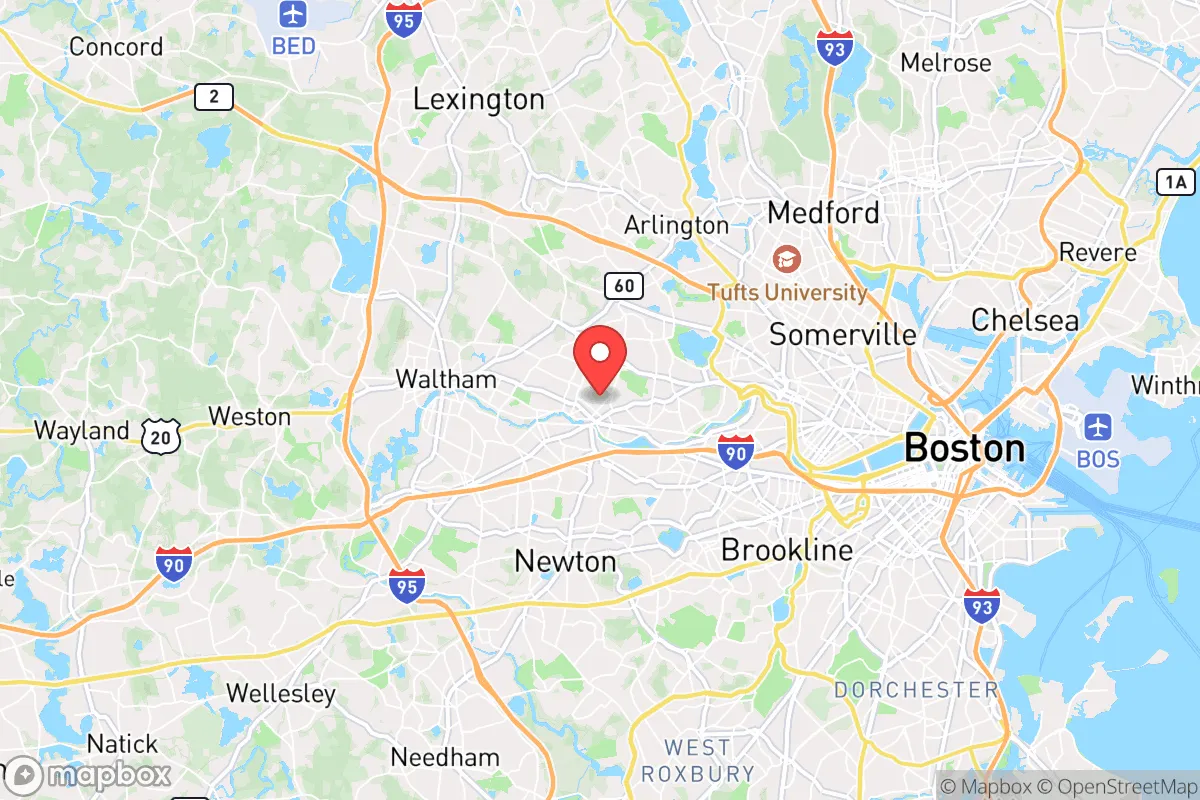
Personal Sovereignty in Watertown Town, MA
Viable for self-reliance. Generally workable, though some barriers may limit total independence.
What does Personal Sovereignty tell us?
Personal Sovereignty measures your capacity for self-reliance and independence with minimal government friction. Higher scores mean fewer barriers between you and the way you want to live... but it assumes you have the space you need and good neighbors.
What does this tell us?
Personal Sovereignty measures your capacity for self-reliance and independence with minimal government friction. Higher scores mean fewer barriers between you and the way you want to live... but it assumes you have the space you need and good neighbors.
State Policy
Energy independence: Importer (5% of energy produced in-state)
Personal Liberty
Homesteading

Personal Liberty Analysis
Watertown, Massachusetts, presents a challenging environment for those prioritizing personal sovereignty, with the state's expansive regulatory framework and tax structure significantly limiting individual autonomy. As a densely settled suburb of Boston, Watertown operates under Massachusetts' progressive governance model, which imposes high taxes, strict gun laws, and extensive state oversight over personal and property decisions. For conservative-leaning individuals and families who value self-reliance and minimal government interference, Watertown's policies on everything from firearms to homeschooling create substantial barriers to living according to one's own values.
How the tax burden and state regulations affect personal autonomy
Massachusetts imposes one of the highest combined state and local tax burdens in the nation, and Watertown residents feel this acutely. The state's income tax rate of 5% applies to nearly all earned income, while property taxes in Watertown average around $6,500 annually for a median-valued home, among the highest in Middlesex County. Sales tax at 6.25% adds to everyday costs, and the state's estate tax kicks in at just $1 million, making intergenerational wealth transfer difficult. Beyond taxes, Massachusetts' regulatory posture is dense: the state mandates strict building codes, energy efficiency standards, and environmental regulations that can delay or increase the cost of home improvements. For those seeking to reduce dependency on government services, the high tax burden leaves less disposable income for private savings, emergency supplies, or land purchases elsewhere. The state's vehicle excise tax and annual registration fees further erode financial autonomy, while the Massachusetts Health Connector requires residents to maintain health insurance or face penalties, limiting medical choice. This regulatory environment effectively forces residents to fund a large state apparatus, reducing the capacity for independent action.
Self-defense rights and the reality of gun laws in Watertown
Watertown's gun laws are among the most restrictive in the country, reflecting Massachusetts' broader approach to firearms. The state requires a License to Carry (LTC) for any handgun possession, which involves a background check, fingerprinting, a firearms safety course, and a personal interview with local police. Watertown's police chief has discretion to deny or restrict licenses, and the state's "may issue" framework means approval is not guaranteed. Magazine capacity is capped at 10 rounds, and the state's assault weapons ban prohibits many common semi-automatic rifles. For self-defense advocates, the inability to carry a firearm without government permission—and the risk of denial—represents a fundamental erosion of the right to protect oneself and family. Stand-your-ground laws do not exist in Massachusetts; instead, the state imposes a duty to retreat if safely possible, which can complicate legal defense after a self-defense incident. Ammunition purchases require a separate permit, and online sales are heavily restricted. For preppers, the inability to stockpile standard-capacity magazines or certain defensive firearms means relying on less effective tools. The state's red flag law allows for temporary seizure of firearms based on third-party reports, adding another layer of uncertainty for gun owners.
Self-reliance and homesteading viability: lot sizes, zoning, and off-grid feasibility
Watertown's urban density and strict zoning make traditional homesteading or off-grid living nearly impossible. The town's minimum lot size is typically 5,000 to 10,000 square feet, with most homes on small lots in established neighborhoods. Zoning regulations prohibit agricultural activities like keeping chickens, goats, or bees in most residential areas without special permits, and the town's health department enforces strict composting and waste disposal rules. Off-grid systems are effectively banned: Massachusetts requires connection to municipal water and sewer where available, and solar panel installations must meet state net-metering requirements that tie homeowners to the grid. Rainwater collection is limited by state water rights laws, and composting toilets are not permitted in homes with sewer access. For those seeking to grow their own food, the short growing season (Zone 6a) and small lot sizes limit production to a few raised beds. Home-based businesses face extensive licensing and zoning hurdles, making it difficult to generate income independently. The town's proximity to Boston means land prices are high—over $500 per square foot for buildable lots—making it financially impractical to acquire acreage for self-sufficient living. Preppers would find Watertown's reliance on centralized infrastructure (power, water, supply chains) a significant vulnerability in any disruption scenario.
Personal liberties: parental rights, medical autonomy, speech, and property
Massachusetts has a strong record of state intervention in areas conservatives consider personal liberties. Parental rights in education are limited: the state mandates comprehensive sex education that includes LGBTQ+ topics, and parents cannot opt children out of specific lessons without a religious exemption. Homeschooling is legal but requires annual approval from the local school district, including submission of curriculum plans and progress reports, which some families view as government oversight of private family decisions. Medical autonomy is constrained by the state's vaccine mandates for school attendance (including COVID-19 shots for certain ages) and the Massachusetts Public Health Council's authority to impose emergency orders. The state's "right to shelter" law guarantees housing for homeless families, funded by taxpayer dollars, which some residents see as an infringement on property rights. Free speech protections are generally robust, but the state's anti-SLAPP laws and hate crime statutes can be used to limit certain types of political expression. Property rights are curtailed by the state's Chapter 40B law, which allows developers to bypass local zoning for affordable housing projects, potentially altering neighborhood character without resident consent. For those who value the ability to make independent medical, educational, and property decisions, Watertown's legal environment offers little room for deviation from state-approved norms.
Overall, Watertown ranks poorly for personal sovereignty compared to other parts of the country, particularly the South, Midwest, or rural New England towns with fewer regulations. The combination of high taxes, restrictive gun laws, dense zoning, and state oversight of education and medical choices creates an environment where individual autonomy is heavily circumscribed. For conservative-leaning individuals or families who prioritize self-reliance, prepping, and minimal government interference, Watertown would require constant navigation of state mandates and a significant financial commitment to maintain even a modest degree of independence. Those seeking greater sovereignty would likely find better alignment in states with lower tax burdens, constitutional carry, and more permissive zoning—such as New Hampshire, Texas, or Idaho—where the legal framework supports rather than restricts personal freedom. Watertown works best for those who accept the trade-off of high taxes and regulation for proximity to Boston's economic opportunities, but it is not a location that fosters the survivalist or self-sufficient lifestyle many conservatives seek.

* Values derived from national, state, county, city and local statistics and may differ in a specific area. Last updated: 2026-04-23T04:55:31.000Z
Narrative content on this page is AI-generated and may contain mistakes. Verify any details that matter before acting on them.
ReloMaps may earn a commission from affiliate links at no extra cost to you.

