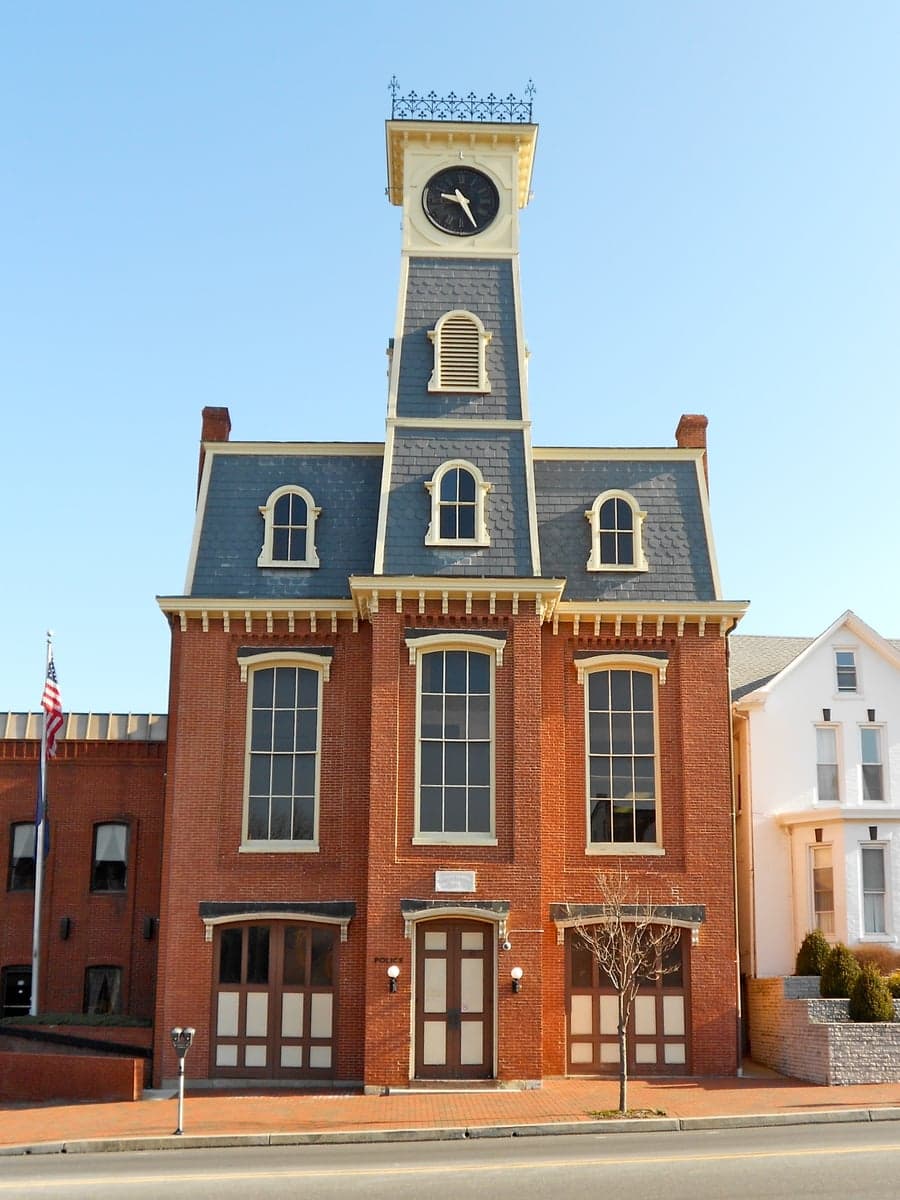
Photo: Wikipedia
Political ClimatePolitical Climate in Waynesboro, PA
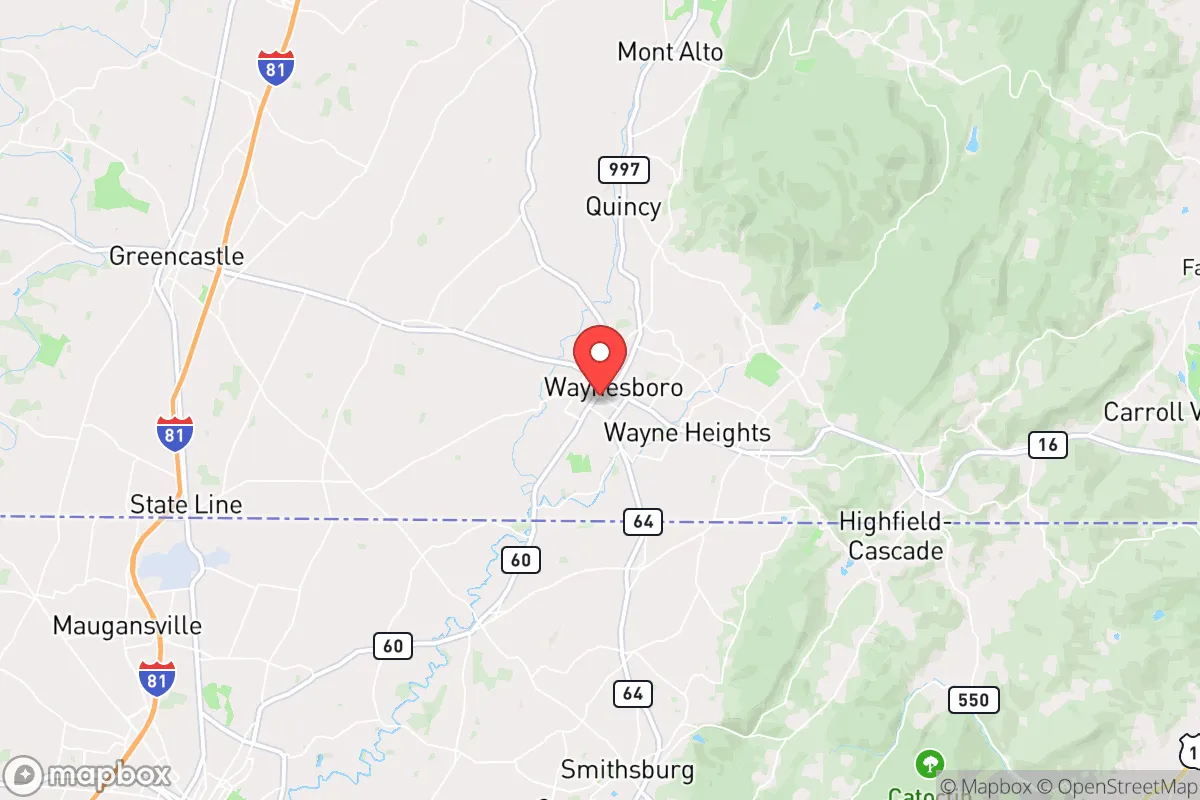
District shown is the primary district for this city’s centroid. Cities may span multiple districts.
Local Political AnalysisPolitical Analysis of Waynesboro, PA
Waynesboro is one of the most reliably Republican small towns in Pennsylvania, carrying a Cook Partisan Voting Index of R+23 — a stark contrast to the state as a whole, which sits at EVEN. In practice, that means a Republican presidential candidate typically wins Waynesboro by about 23 points more than the national average, while statewide races in Pennsylvania are toss-ups. The town has held this conservative lean for decades, and if anything, it’s hardened in the last two cycles as rural Franklin County has moved right even as the Philadelphia and Pittsburgh suburbs have shifted left. You won’t find many yard signs for Democratic candidates here, and local elections are usually decided in the GOP primary.
How it compares
To understand Waynesboro’s politics, look at the surrounding geography. Drive 15 miles north to Chambersburg, and you’ll find a similar R+20 vibe — another Franklin County stronghold. But head 20 miles east to Gettysburg (Adams County), and the picture gets more mixed: Adams County leans Republican but by a narrower margin, and the borough itself has a visible Democratic minority thanks to the college and tourism economy. The real contrast is with the state capital, Harrisburg, about 45 miles northeast. Harrisburg is a Democratic stronghold (D+15 or so), driven by a larger minority population and state government workers. So Waynesboro isn’t just conservative for Pennsylvania — it’s conservative for rural south-central PA, which is already the reddest part of the state. The R+23 PVI means that in a typical election, a Republican here gets about 61-62% of the vote, while statewide the same candidate might get 49-50%.
What this means for residents
For conservative residents, Waynesboro is comfortable. Local government, school board, and county offices are almost entirely Republican-held, so policy tends to align with small-government, pro-Second Amendment, and low-tax priorities. You’ll see “Trump 2024” signs on lawns year-round, and the local gun shop does brisk business. For liberal residents, it’s a different experience. There’s no active Democratic committee in Waynesboro itself — the nearest one is in Chambersburg — and progressive viewpoints are rarely represented in public discourse. That said, the town is not hostile; people are polite, and you won’t face open confrontation for your beliefs. But you will feel politically isolated. If you’re a Democrat, you’ll likely drive to Hagerstown, MD (20 minutes south) or Frederick, MD (35 minutes) for more like-minded social circles or events. The practical effect is that local policy leans heavily conservative: taxes are low, zoning is minimal, and there’s little appetite for public transit or affordable housing initiatives.
Culturally, Waynesboro’s politics show up in everyday life. The local paper, the Record Herald, covers national politics with a conservative slant, and the biggest community events — like the annual Waynesboro Festival — are apolitical but draw a crowd that leans right. There’s no visible progressive activism, no Pride parade, and no major environmental protests. The town’s identity is rooted in its manufacturing history (Grove Worldwide, Johnson Controls) and its rural character, which reinforces a self-reliant, don’t-tell-me-what-to-do ethos. Looking ahead, I don’t see Waynesboro flipping. The R+23 PVI might even widen as younger residents move to cities and retirees from Maryland and Virginia — many of them conservative — move in for the lower cost of living. For anyone moving here, the political reality is simple: you’ll be in a deep-red bubble, and that’s not changing anytime soon.

State Political ClimatePolitical Climate in Pennsylvania
State Political AnalysisPolitical Environment in the State
Pennsylvania is the ultimate swing state, with a Cook PVI of EVEN that perfectly captures its knife-edge balance. Over the past 20 years, the state has shifted from a reliably blue-leaning battleground (voting Democratic in every presidential election from 1992 to 2012) to a true toss-up, splitting its electoral votes between Trump in 2016, Biden in 2020, and again as a top-tier target in 2024. The dominant coalition is a three-way standoff: the heavily Democratic, union-heavy southeast (Philadelphia and its collar counties), the increasingly Republican exurbs and rural north/central regions, and the historically blue but now purple southwestern anchor of Pittsburgh. What makes Pennsylvania unique is that neither party can claim a durable majority — control flips every few cycles, and the state legislature often remains under Republican control even when Democrats win statewide races, creating a perpetual tug-of-war.
Urban vs. rural divide
The political map of Pennsylvania is a textbook case of the urban-rural chasm. Philadelphia and its immediate suburbs (Montgomery, Delaware, Chester counties) are the engine of the Democratic vote, delivering margins of 80% or more in the city proper. Pittsburgh and its Allegheny County base are also reliably blue, though with slightly softer margins (around 60-65% Democratic). The real story is the suburban ring — places like Bucks County (north of Philly) and Lancaster County (south-central) have been trending toward Democrats in presidential races, while York County and Berks County (Reading area) have swung hard toward Republicans. The rural expanse — from the Northern Tier (Tioga, Bradford counties) down through the Appalachian spine (Somerset, Bedford, Fulton) and into the south-central farm country (Franklin, Adams) — votes 65-75% Republican. The critical swing region is the Scranton/Wilkes-Barre area (Lackawanna and Luzerne counties), where working-class voters who once backed Democrats have shifted sharply right since 2016, flipping Luzerne from Obama to Trump by double digits. Erie County in the northwest is another bellwether: it voted for Obama twice, then Trump, then Biden by a razor-thin margin.
Policy environment
Pennsylvania’s policy landscape reflects its divided government. The state has a flat income tax rate of 3.07%, one of the lowest among states with a personal income tax, and a state sales tax of 6% (with no tax on clothing or groceries). Property taxes are high — among the top 10 in the nation — and vary wildly by district, a constant source of frustration for homeowners. The regulatory posture is moderate: Pennsylvania is not a right-to-work state, and unions (especially in construction, education, and public sector) remain politically powerful, particularly in the southeast. Education policy is a flashpoint: the state has a charter school law that allows for both brick-and-mortar and cyber charters, but funding formulas have been ruled unconstitutional by the state Supreme Court (2023), leading to ongoing litigation and legislative battles. Healthcare is a mixed bag: the state expanded Medicaid under the ACA, but private insurance costs are above average. Election laws are relatively accessible: no-excuse mail-in voting was enacted in 2019 (Act 77), but it remains controversial, with Republican legislators pushing for stricter ID requirements and signature verification. Gun laws are moderately permissive: no permit needed for open carry (except in Philadelphia), but a permit is required for concealed carry, and the state has a preemption law preventing local ordinances from being stricter than state law.
Recent policy direction
Over the past five years, Pennsylvania has moved in a moderately conservative direction on some fronts while holding the line on others. On gun and self-defense law, the state expanded constitutional carry in 2022 by eliminating the requirement for a license to carry a firearm openly (outside Philadelphia), though concealed carry still requires a permit. A stand-your-ground law was enacted in 2011, and there is no duty to retreat in one’s home. On parental and education rights, the state has seen fierce battles over school curriculum: in 2021-2022, multiple districts (including Central Bucks and Pennridge) adopted policies requiring parental notification of LGBTQ+ student activities, and the legislature passed a bill (vetoed by Governor Shapiro in 2023) that would have required schools to out transgender students to parents. On speech and privacy, Pennsylvania has no comprehensive privacy law like California’s, but it does have a strong Wiretap Act requiring two-party consent for recording conversations. On medical and bodily autonomy, abortion remains legal up to 24 weeks (codified by state law), and the state has become a regional safe haven for patients from Ohio and West Virginia after those states banned abortion. On property rights, the state has a robust eminent domain framework, but property taxes remain the top complaint for homeowners. On voting and ballot access, Act 77 (2019) expanded mail-in voting, but a 2024 state Supreme Court ruling upheld the requirement that mail-in ballots must be dated by hand, creating ongoing confusion. The overall direction is a stalemate: the Democratic governor (Josh Shapiro) has vetoed Republican-passed bills on election integrity, school choice expansion, and transgender athlete bans, while Republicans in the legislature block Democratic priorities like minimum wage increases and carbon pricing.
Civil unrest & political movements
Pennsylvania has seen its share of political flashpoints. The 2020 election was a major battleground: Trump’s campaign filed dozens of lawsuits challenging mail-in ballot procedures, and the state became a focal point for “Stop the Steal” rallies, particularly in Harrisburg and Gettysburg. The January 6th Capitol riot had several Pennsylvania participants, including a notable contingent from the Poconos region. On the left, Black Lives Matter protests in Philadelphia and Pittsburgh in 2020 were large and occasionally violent, leading to property damage and a lasting debate over policing. Immigration politics are less intense than in border states, but Philadelphia is a sanctuary city (since 2016), which has drawn criticism from Republican lawmakers who have introduced bills to ban such policies. Secession or nullification rhetoric is minimal — Pennsylvania is too closely divided for serious talk of leaving the Union. More visible are election integrity controversies: the state’s voter rolls have been the subject of multiple lawsuits, and in 2024, the Republican National Committee sued to remove what it claimed were thousands of non-citizen registrants. A new resident would notice the ubiquity of political yard signs in swing counties like Northampton and Monroe, and the constant presence of campaign ads on TV — Pennsylvania is the most expensive media market in the country for political advertising.
Projection
Over the next 5-10 years, Pennsylvania is likely to remain a toss-up, but the demographic trends favor a slight rightward shift in the short term. The in-migration pattern is notable: people are moving into the state from New York and New Jersey, but they are settling disproportionately in the Lehigh Valley (Allentown, Bethlehem, Easton) and the Poconos, areas that are trending purple-to-red. Meanwhile, the Philadelphia suburbs are becoming more Democratic as college-educated professionals move in, but the rural counties are depopulating and becoming even more Republican. The wild card is Pittsburgh: the city is growing slowly, but its surrounding counties (Washington, Westmoreland) are shifting right. The state legislative maps, redrawn after the 2020 census by the state Supreme Court (which has a Democratic majority), have given Democrats a chance to flip the state House (they did so in 2022 by one seat), but the state Senate remains firmly Republican. A new resident moving in now should expect continued gridlock on major issues: no income tax cut or expansion, no major gun control or gun rights expansion, no abortion ban or codification, and no major election reform. The state will remain a perpetual campaign battleground, with presidential, Senate, and gubernatorial races drawing national attention and money every two years.
For a new resident, the bottom line is this: Pennsylvania offers a genuine political balance that few states can match. If you’re conservative, you’ll find a strong rural and exurban base, low income taxes, and a legislature that blocks most progressive initiatives — but you’ll also live in a state where your vote for president is genuinely contested. If you’re liberal, you’ll find safe havens in Philadelphia and Pittsburgh, strong union protections, and a governor who vetoes conservative bills — but you’ll also face high property taxes and a legislature that won’t raise the minimum wage or pass climate legislation. The practical takeaway: your local government matters more here than in most states. School board, county commission, and municipal elections have outsized impact on your daily life — from property tax rates to school curriculum to zoning laws. Pennsylvania is not a state where you can ignore politics; it’s a state where you have to engage, because the balance is so close that every election feels like it could tip the scales.
* Values derived from national, state, county, city and local statistics and may differ in a specific area. Last updated: 2026-08-24T22:36:30.000Z
Narrative content on this page is AI-generated and may contain mistakes. Verify any details that matter before acting on them.
ReloMaps may earn a commission from affiliate links at no extra cost to you.

