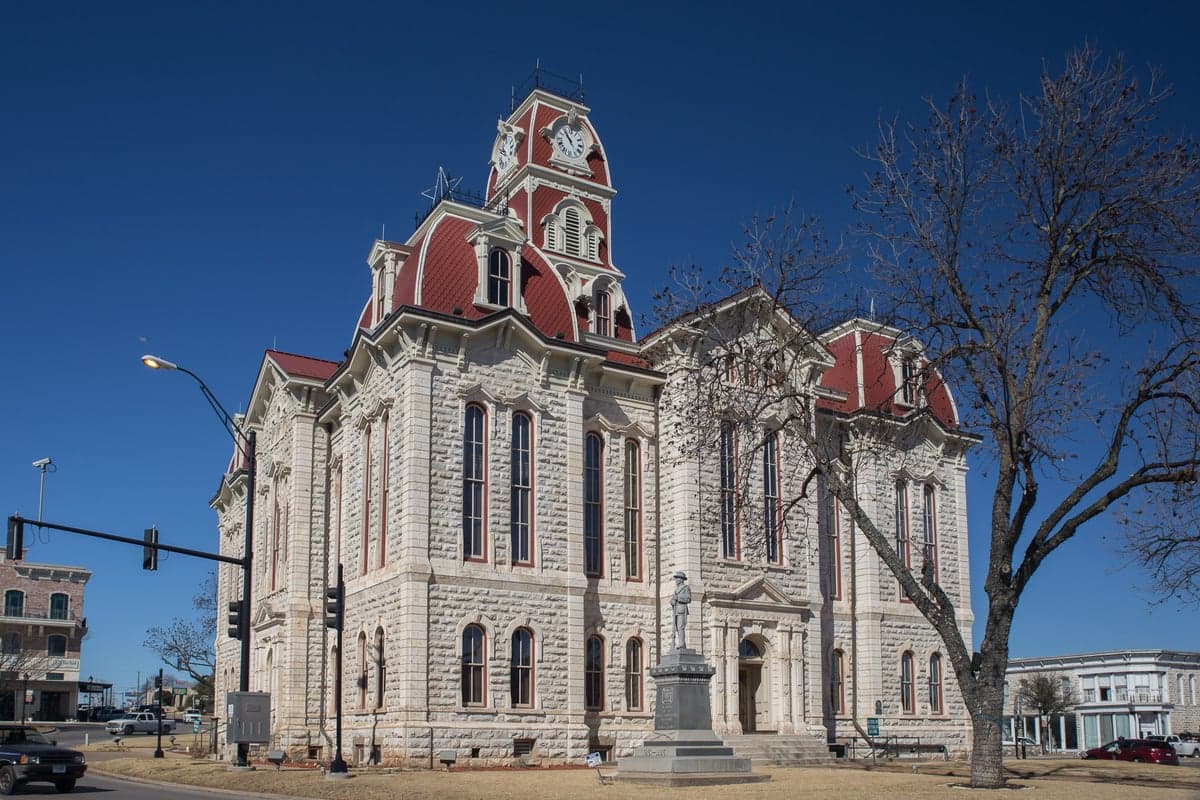
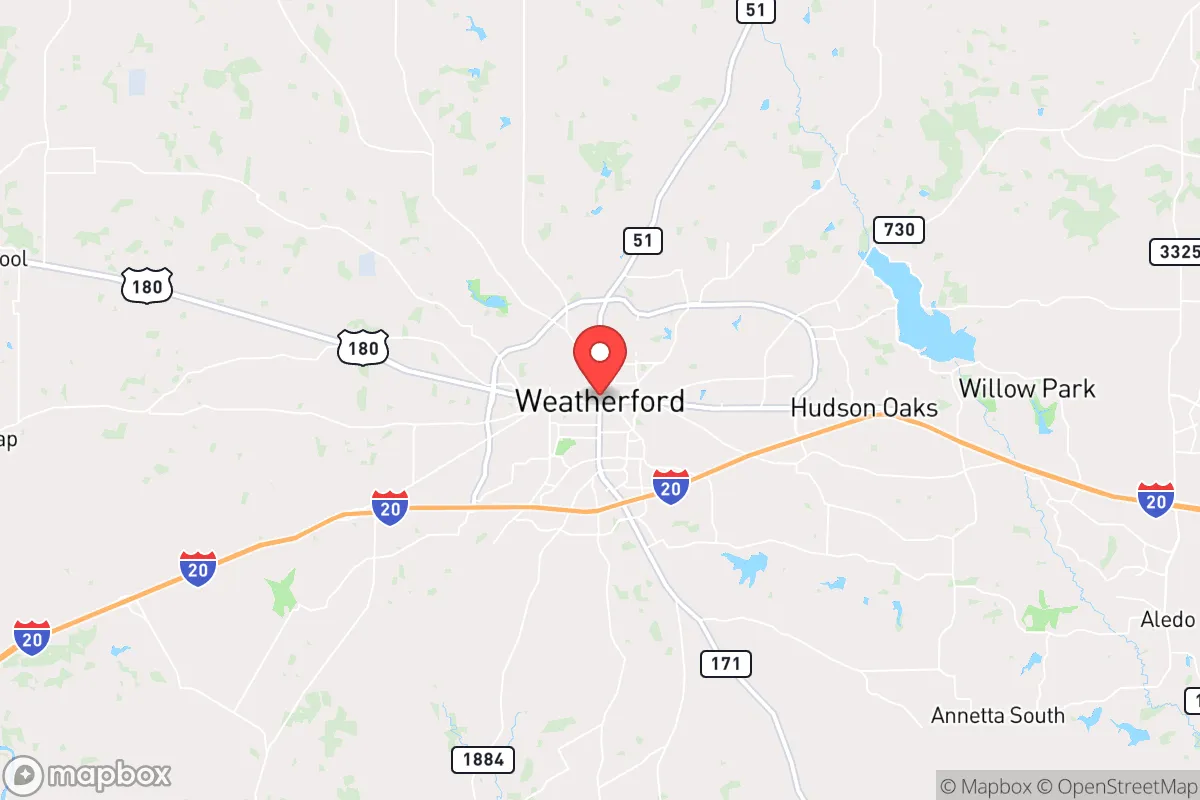
Photo: Wikipedia
Strategic Assessment of Weatherford, TX
Meaningful friction. Expect exposure to either population pressure, blast zones, or natural disaster risk. Consider buying a retreat property.
What does the Strategic Assessment tell us?
Our Strategic Assessment grades tactical survivability of an area. Major population centers, military targets, fallout zones, natural disasters, and border exposure all drive risk — lower exposure means a more defensible position in a crisis.
This is heavily inspired by Joel Skousen's Strategic Relocation book. Highly recommended you checkout the book ($)What does this tell us?
Our Strategic Assessment grades tactical survivability of an area. Major population centers, military targets, fallout zones, natural disasters, and border exposure all drive risk — lower exposure means a more defensible position in a crisis.
This is heavily inspired by Joel Skousen's Strategic Relocation book. Highly recommended you checkout the book ($)Strategic Pillars

Key Distances
Regional Safe Places
Below is our recommended "safe zones" in Texas and the surrounding area based on our strategic heuristics. For most people, it's unrealistic to live in a “safe zone” full-time due to work, family or other personal reasons. They tend to be more rural. However, many of these areas are perfect for second homes and retreat properties that double as a vacation home or even a short-term rental.

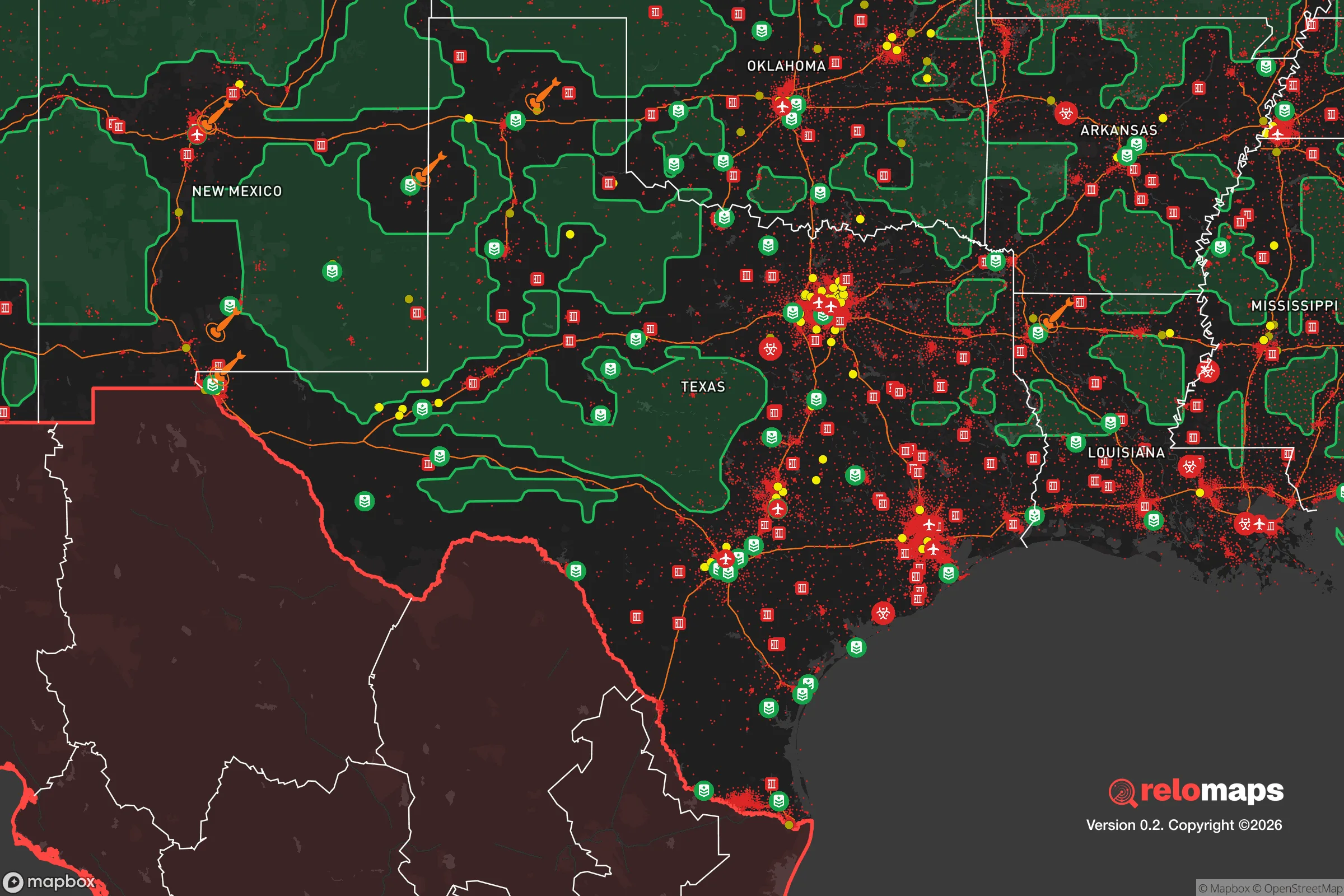


Important Note: For informational purposes only. This does not mean nothing bad ever happens in the green zones. Please use common sense. This is based on public data and modeled with AI. We tried to take a conservative approach but mistakes happen. We update this regularly as new information becomes available.
Solar Generator Recommendations
Backup power matters more here than in safer locations. We've picked three solar generators across budgets and capacity tiers — start with the budget unit if you only need a few essentials, or step up if you want to run a fridge and HVAC for days at a time.

Jackery Portable Power Station Explorer 300
Budget OptionPower on the Go: Weighing only 11 lbs, it's convenient to set up and store with book-sized foldable solar panels

BLUETTI Portable Power Station AC180
Designed for both indoor and outdoor scenarios, AC180 is highly capable as it has a robost capacity and continuous output power.

EF ECOFLOW DELTA Pro Ultra Power Station
Upgraded PickEcoFlow DELTA Pro Ultra is a whole-home energy system designed to grow with your family. Integrated with the Smart Home Panel 2, it scales to meet your evolving energy needs — keeping your home powered, intelligent, and secure through every stage of life.
We earn a commission, at no additional cost to you.
Strategic Assessment Analysis
Weatherford, Texas, sits in a strategic sweet spot that few relocators fully appreciate until they map out the concentric rings of risk around the Dallas-Fort Worth metroplex. Roughly 25 miles west of Fort Worth’s city limits and 40 miles from downtown, this Parker County seat offers enough distance from the urban core to avoid the worst of a mass-casualty event or civil unrest cascade, yet remains close enough to leverage the region’s economic and logistical infrastructure when things are stable. The area’s resilience is rooted in its position atop the Barnett Shale, its access to multiple interstate-quality highways, and a local governance structure that has historically favored limited regulation and individual preparedness over collective dependency.
Geographic position and natural buffers: why Weatherford avoids the worst of the metroplex
Weatherford’s location on the western edge of the DFW sprawl gives it a natural buffer that suburbs like Arlington or Irving simply don’t have. The city sits on the Eastern Cross Timbers ecoregion, a transition zone of oak savanna and limestone ridges that historically slowed settlement and still provides modest topographic cover. To the west, the land opens into the rolling plains of the Brazos River watershed, offering multiple egress routes toward the Hill Country or West Texas if a major event forces evacuation. The Brazos River itself runs about 10 miles south of downtown, and while it’s not a defensive moat, its floodplain creates a natural break in development that could slow the spread of unrest or contamination from the east. Weatherford’s elevation—roughly 1,050 feet above sea level—is higher than most of Tarrant County, which means slightly cooler temperatures and less flood risk from the Trinity River basin that plagues Fort Worth. For a relocator thinking in terms of fallout, the prevailing winds in North Texas blow from the south-southeast most of the year, meaning that a radiological or chemical release from the DFW core would generally push northeast, away from Weatherford. That’s not a guarantee, but it’s a meaningful probabilistic advantage over suburbs directly downwind of the metroplex’s industrial and military targets.
Risks, exposures, and proximity to fallout-relevant landmarks
No location in the lower 48 is truly safe from modern threats, and Weatherford has its own set of exposures that a serious prepper needs to weigh. The most obvious risk is proximity to the DFW metroplex, which contains multiple high-value targets: DFW International Airport, the nation’s second-busiest, is about 50 miles east; the Fort Worth Naval Air Station Joint Reserve Base (Carswell Field) is 30 miles east; and the natural gas processing hubs in the Barnett Shale are scattered throughout the region, including some within Parker County itself. A coordinated attack or major industrial accident at any of these could produce secondary effects—panic-driven refugee flows, supply chain disruption, or airborne contaminants—that would reach Weatherford within hours. The city also sits near Interstate 20, a major east-west artery that would become a choke point during any evacuation. If the metroplex empties, I-20 westbound through Weatherford would be gridlocked within 90 minutes, and the city’s own population of roughly 85,000 (2024 estimate) would be competing with evacuees for fuel, food, and medical supplies. On the natural disaster front, Parker County is in Tornado Alley, and while Weatherford hasn’t taken a direct hit from an EF4 or EF5 in modern records, the 2022 tornado outbreak that struck nearby Cisco and the 2015 storms that flooded the Brazos remind us that severe weather is a recurring hazard. The area also faces periodic drought and wildfire risk, particularly in the rural western parts of the county where brush and mesquite dominate.
Practical resilience for a relocator: food, water, energy, and defensibility
For a relocator serious about self-sufficiency, Weatherford offers a mix of advantages and gaps that require deliberate planning. Water is the first concern: the city draws from the Brazos River via the Lake Weatherford reservoir, which has a capacity of about 17,000 acre-feet. That’s adequate for normal use, but during a prolonged drought or contamination event, municipal supply could tighten. The good news is that the water table in Parker County is relatively high, and many rural properties have access to groundwater via private wells. A relocator buying land should prioritize a property with a tested well and a backup hand pump. Energy is a clear strength: Parker County sits atop the Barnett Shale, and natural gas wells dot the landscape. While that means some industrial noise and truck traffic, it also means that natural gas for heating, cooking, and backup generation is locally abundant and relatively cheap. Solar potential is good—the region averages 230 sunny days per year—and net metering policies in Texas (though deregulated) allow for grid-tied systems that can keep a home running during outages. Food production is viable but not effortless. The growing season runs about 230 days, and the clay-loam soils in the Brazos bottomlands are fertile enough for gardens, orchards, and small livestock. Parker County is known for its peach orchards and hay production, so local agriculture is already established. A relocator should plan for a 6-month pantry minimum, as the nearest major food distribution centers are in Fort Worth and could be disrupted. Defensibility is mixed. Weatherford’s suburban neighborhoods offer little in the way of natural chokepoints, but the rural areas west of town—toward Mineral Wells and the Palo Pinto Mountains—provide better terrain for a retreat property. The local law enforcement presence is solid: the Parker County Sheriff’s Office has a reputation for proactive policing, and the city’s police department is well-funded relative to its size. However, during a widespread event, response times would stretch thin, and a relocator should not rely on outside help for the first 72 hours.
The overall strategic picture for Weatherford is one of calculated trade-offs. It is not a remote bunker location—it is a semi-rural exurb with real exposure to the metroplex’s risks. But for a relocator who wants to stay within a few hours of DFW’s medical, economic, and transportation assets while maintaining a defensible, self-sufficient property, Weatherford is one of the better options in North Texas. The key is to buy land with water access, build a home with natural gas and solar backup, and establish a local network before the crisis hits. The area’s conservative political culture and strong Second Amendment community mean that like-minded neighbors are common, not outliers. If the country holds together, Weatherford is a comfortable, affordable place to raise a family. If it doesn’t, it’s a position from which you can hold, adapt, or bug out west—and that flexibility is the real strategic value.

* Values derived from national, state, county, city and local statistics and may differ in a specific area. Last updated: 2026-04-15T19:40:14.000Z
Narrative content on this page is AI-generated and may contain mistakes. Verify any details that matter before acting on them.
ReloMaps may earn a commission from affiliate links at no extra cost to you.

