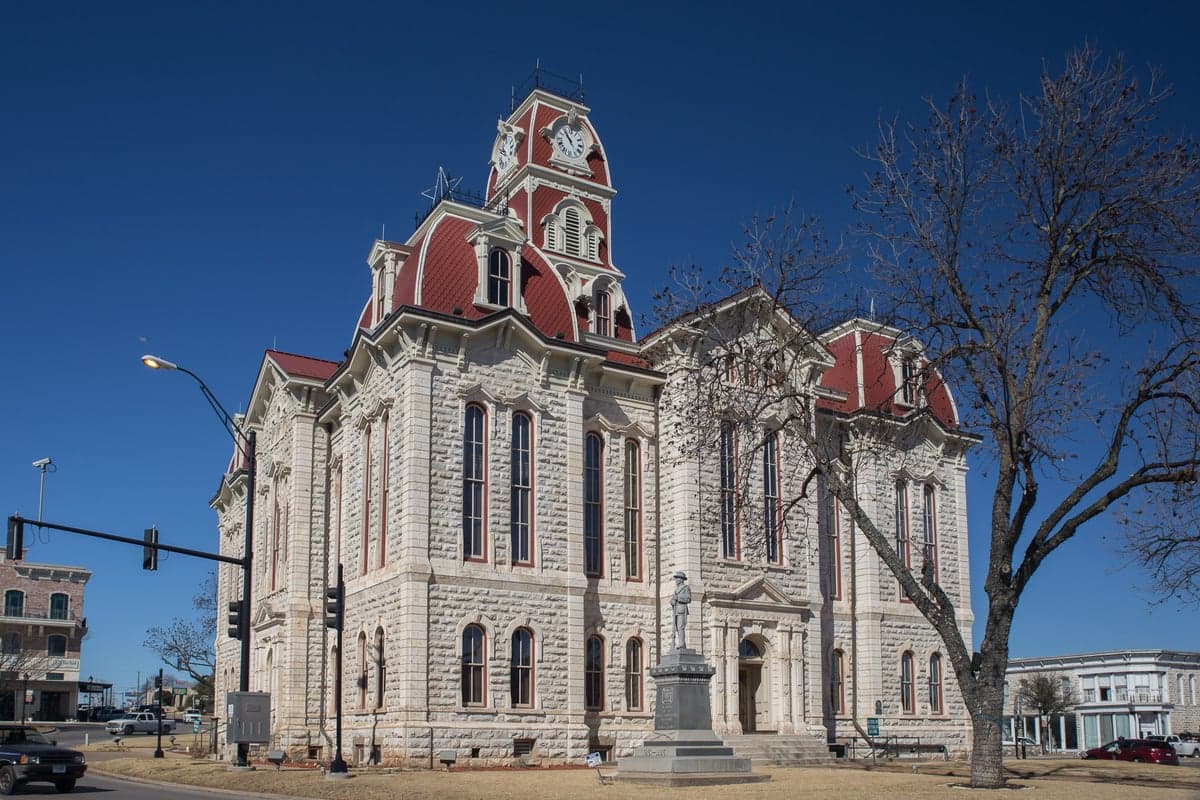
Photo: Wikipedia
Political ClimatePolitical Climate in Weatherford, TX
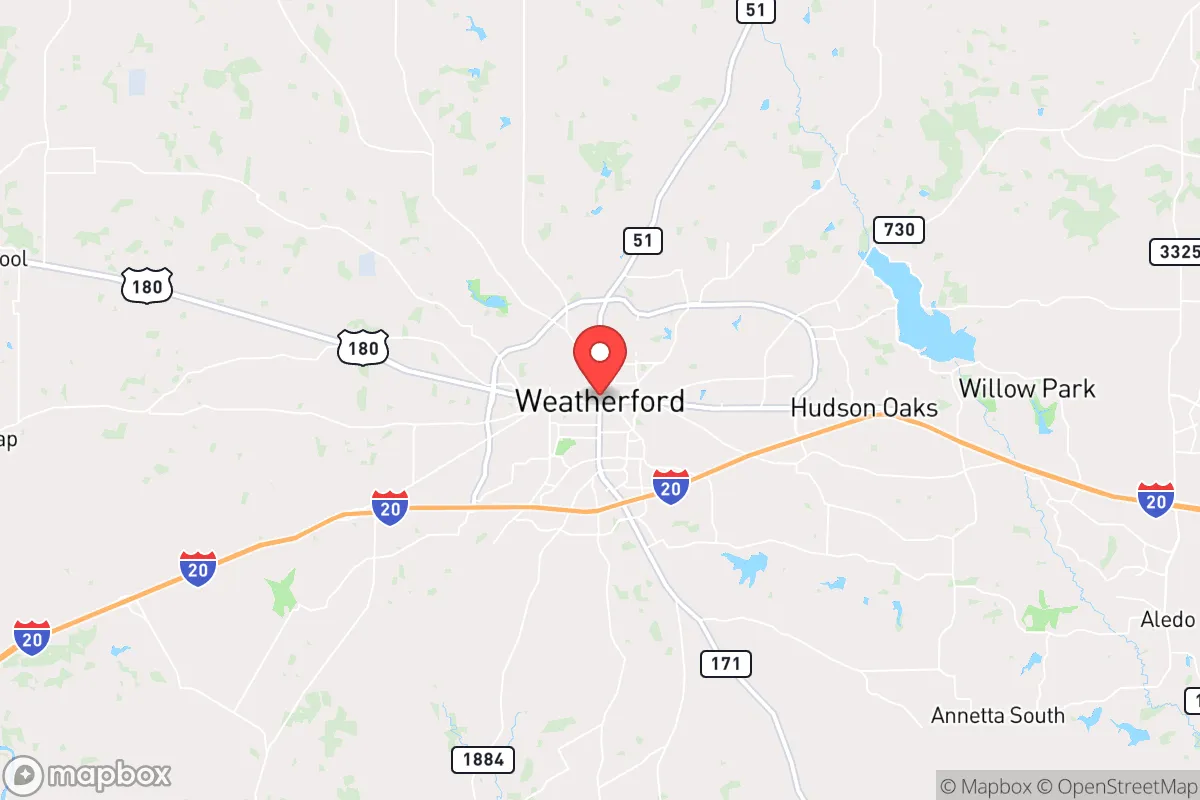
District shown is the primary district for this city’s centroid. Cities may span multiple districts.
Local Political AnalysisPolitical Analysis of Weatherford, TX
Weatherford, Texas, has long been a rock-solid conservative stronghold, and that hasn't changed. The Cook PVI rating of R+11 tells you the math, but it doesn't capture the feel of the place. This is a community where folks still believe in local control, the Second Amendment, and keeping government out of your business. While the explosive growth from the Metroplex is pushing west, Weatherford has held the line better than most, though you can see the pressure building as new subdivisions pop up and some of the old-timers start to grumble about the changing character of the county.
How it compares
Drive 20 minutes east into Fort Worth or Aledo, and you'll start to feel the shift. Fort Worth itself is still more conservative than Dallas, but it's trending purple, especially in the city core. Aledo is a bit of a mixed bag—still solidly red, but with a growing number of families from California and the Northeast who bring their voting habits with them. Head south to Granbury, and you'll find a similar conservative vibe, though it's a bit more of a retirement and lake community. The real contrast is north and west: places like Mineral Wells and Jacksboro are even more rural and deeply red, but they're also struggling economically. Weatherford sits in a sweet spot—conservative enough to feel like home, but with enough economic vitality to keep the tax base healthy and the schools decent. The surrounding Parker County is reliably Republican, and local elections rarely see serious Democratic challengers. The real political fights here are usually between establishment conservatives and the more libertarian-leaning, "leave us alone" crowd.
What this means for residents
For the most part, it means you can live your life without a lot of bureaucratic nonsense. The city council and county commissioners generally take a hands-off approach to business and property rights. You won't see the kind of zoning overreach or progressive social experiments you'd find in Austin or even parts of Dallas. The school board has been a battleground lately, with parents pushing back hard against any hint of critical race theory or gender ideology in the classroom. That fight is real, and it's not going away. The local sheriff's office is pro-Second Amendment, and you won't get sideways looks for open carrying. Property taxes are a constant headache—that's Texas for you—but the lack of a state income tax and the general resistance to new local taxes keeps things manageable. The biggest concern for long-time residents is the growth itself. As more people move in from blue states, there's a real fear that the political culture could slowly erode. It hasn't happened yet, but you can see the warning signs in places like Frisco or McKinney, which were once conservative and are now trending purple.
Culturally, Weatherford still feels like a place where the rodeo and the county fair matter more than any city council resolution. The Parker County Peach Festival is a bigger deal than any political rally. That said, the biggest policy distinction is the city's consistent support for property rights and limited government. There's no city-wide mask mandate or vaccine passport nonsense on the books, and the local leadership has been vocal about opposing federal overreach. The long-term trajectory depends on whether the new arrivals assimilate into the local culture or try to change it. For now, the old guard is still in charge, but the next decade will tell the real story. If you value personal freedom and a community that doesn't try to manage your life, Weatherford is still one of the best bets in North Texas. Just keep an eye on the city council meetings and the school board elections—that's where the future is being decided.

State Political ClimatePolitical Climate in Texas
State Political AnalysisPolitical Environment in the State
Texas remains a solidly Republican state, but the margin has tightened noticeably over the past decade. In 2024, Donald Trump carried the state by roughly 9 points, down from 11 points in 2020 and 16 points in 2016. The dominant coalition is still a mix of rural conservatives, suburban families, and business-oriented professionals, but rapid in-migration from blue states and explosive growth in the urban core are slowly reshaping the landscape. If you’re looking at Texas as a relocation destination, you need to understand that the state’s political identity is being tested by demographic change, even as its policy framework remains one of the most freedom-oriented in the country.
Urban vs. rural divide
The political map of Texas is a study in contrasts. The major metros—Houston, Dallas-Fort Worth, San Antonio, and Austin—are the engines of Democratic growth. Harris County (Houston) and Dallas County have been reliably blue for years, but the real shocker is the suburban ring. In 2020, Collin County (north of Dallas) and Tarrant County (Fort Worth) both flipped to Biden after decades of Republican dominance. Collin County has since swung back slightly in 2024, but the trend is clear: the suburbs are no longer safe GOP territory. Meanwhile, El Paso and the Rio Grande Valley have shifted rightward, with Starr County flipping to Trump in 2024 after generations of Democratic loyalty. The rural expanse—places like Lubbock, Midland-Odessa, and the Panhandle—remains deeply conservative, often voting 80-90% Republican. The divide isn’t just urban vs. rural; it’s also about growth corridors. The I-35 corridor from San Antonio to Dallas is the front line of political change, where new arrivals from California and New York are bringing different voting habits.
Policy environment
Texas’s policy environment is defined by a low-tax, low-regulation posture that has made it a magnet for business and families. There is no state income tax, and property taxes are high but capped by a 2023 law (Proposition 4) that increased the homestead exemption to $100,000 and compressed school tax rates. The regulatory climate is business-friendly, with no state-level minimum wage above the federal $7.25 and right-to-work laws that keep unions weak. On education, the state has expanded school choice through the 2023 creation of education savings accounts (HB 3), though the program is limited to special needs students for now. Healthcare is a mixed bag: Texas did not expand Medicaid under the ACA, and the state has some of the strictest abortion laws in the nation (SB 8, the Heartbeat Act, and the 2021 trigger law). Election laws were tightened in 2021 with SB 1, which banned 24-hour and drive-through voting, added ID requirements for mail ballots, and empowered poll watchers. For a conservative, the policy environment is largely aligned with limited government principles, though property taxes remain a persistent complaint.
Trajectory & freedom
On balance, Texas has been moving toward more personal freedom in several key areas, but there are warning signs. The 2021 permitless carry law (HB 1927) allows most adults to carry a handgun without a license, a major expansion of Second Amendment rights. Parental rights were strengthened with the 2023 passage of the READER Act, which restricts sexually explicit content in school libraries and gives parents more control over curriculum. Medical freedom took a hit during COVID, with Governor Abbott’s mask and vaccine mandates, but the backlash led to a 2023 law banning vaccine passports and employer mandates for COVID-19. On property rights, the 2023 ban on foreign ownership of agricultural land (SB 147) was popular, but eminent domain abuse by private pipeline companies remains a concern. The biggest threat to freedom is the growing influence of local governments. Cities like Austin and Dallas have passed their own paid sick leave ordinances, plastic bag bans, and sanctuary city policies, creating a patchwork of regulations that erode the state’s uniform legal framework. The state legislature has pushed back with preemption laws, but the trend of local overreach is accelerating.
Civil unrest & political movements
Texas has seen its share of political flashpoints. The 2020 Black Lives Matter protests in Austin and Houston were large and occasionally violent, leading to property damage and a lasting rift between progressive city councils and state leadership. The border crisis has been a constant source of tension, with Governor Abbott’s Operation Lone Star deploying state troopers and National Guard to the border, busing migrants to sanctuary cities, and installing razor wire and buoys in the Rio Grande. This has sparked legal battles with the Biden administration and created a visible, ongoing confrontation that residents in border towns like El Paso and Brownsville deal with daily. On the right, the Texas Nationalist Movement (Texit) has gained some traction, though it remains a fringe idea. Election integrity remains a hot-button issue: the 2020 and 2022 cycles saw widespread allegations of irregularities in Harris County, leading to the 2023 law (SB 1070) that abolished the county’s elections administrator position. For a new resident, the most visible sign of political tension is the constant presence of border security checkpoints and the polarized media environment in major cities.
Projection
Over the next 5-10 years, Texas will likely remain Republican at the state level, but the margin will continue to shrink. The key demographic driver is the influx of 1,000+ people per day, many from California, New York, and Illinois. These newcomers tend to be more moderate than the native population, but they are also more likely to vote for Democrats in suburban races. The 2030 redistricting cycle will be critical: if Democrats win control of the state House or the governorship, the political map could shift dramatically. The most likely scenario is a slow, grinding realignment where Texas becomes a true swing state by 2032, similar to Georgia or Arizona today. For conservatives, the best-case scenario is that the state’s low-tax, pro-business environment moderates the political lean of newcomers over time. The worst-case is that the urban growth overwhelms the rural vote, leading to a blue Texas. The next few legislative sessions will be telling: if the GOP can pass a school choice expansion, a property tax overhaul, and a constitutional carry reciprocity law, they can solidify their base. If they fail, the cracks will widen.
For a new resident, the bottom line is this: Texas still offers a high degree of personal freedom, low taxes, and a business-friendly climate, but the political landscape is shifting. If you’re moving here for conservative values, you’ll find the state government largely on your side, but you’ll also encounter growing progressive influence in the cities and suburbs. The key is to choose your location wisely—Collin County and Montgomery County are still solidly red, while Austin and Dallas are increasingly blue. The state’s trajectory is not set in stone, and your vote and voice will matter more here than in a deep-blue state. Texas is still a place where you can live your life with minimal government interference, but you’ll need to stay engaged to keep it that way.
* Values derived from national, state, county, city and local statistics and may differ in a specific area. Last updated: 2026-04-15T19:40:14.000Z
Narrative content on this page is AI-generated and may contain mistakes. Verify any details that matter before acting on them.
ReloMaps may earn a commission from affiliate links at no extra cost to you.

