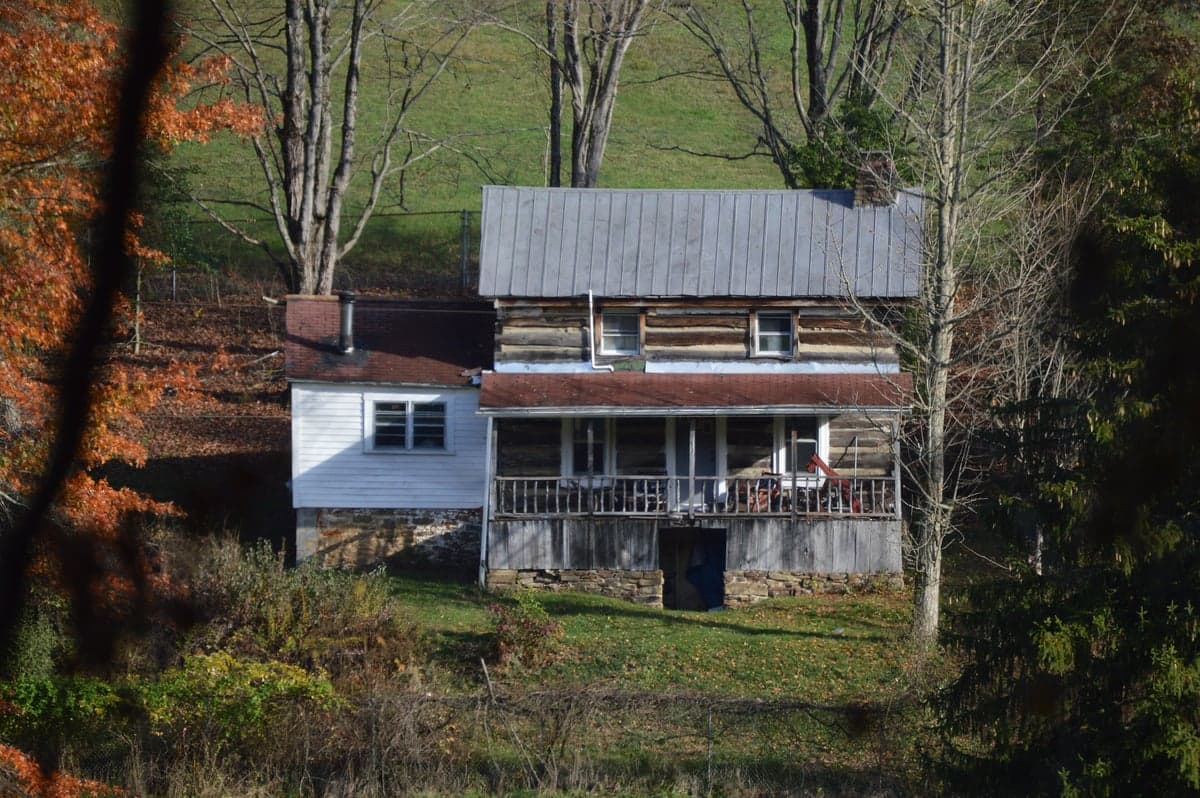
Photo: Wikipedia
Political ClimatePolitical Climate in Taylor County
Showing district-level results — no local-only data available.
Local Political AnalysisPolitical Analysis of Taylor County
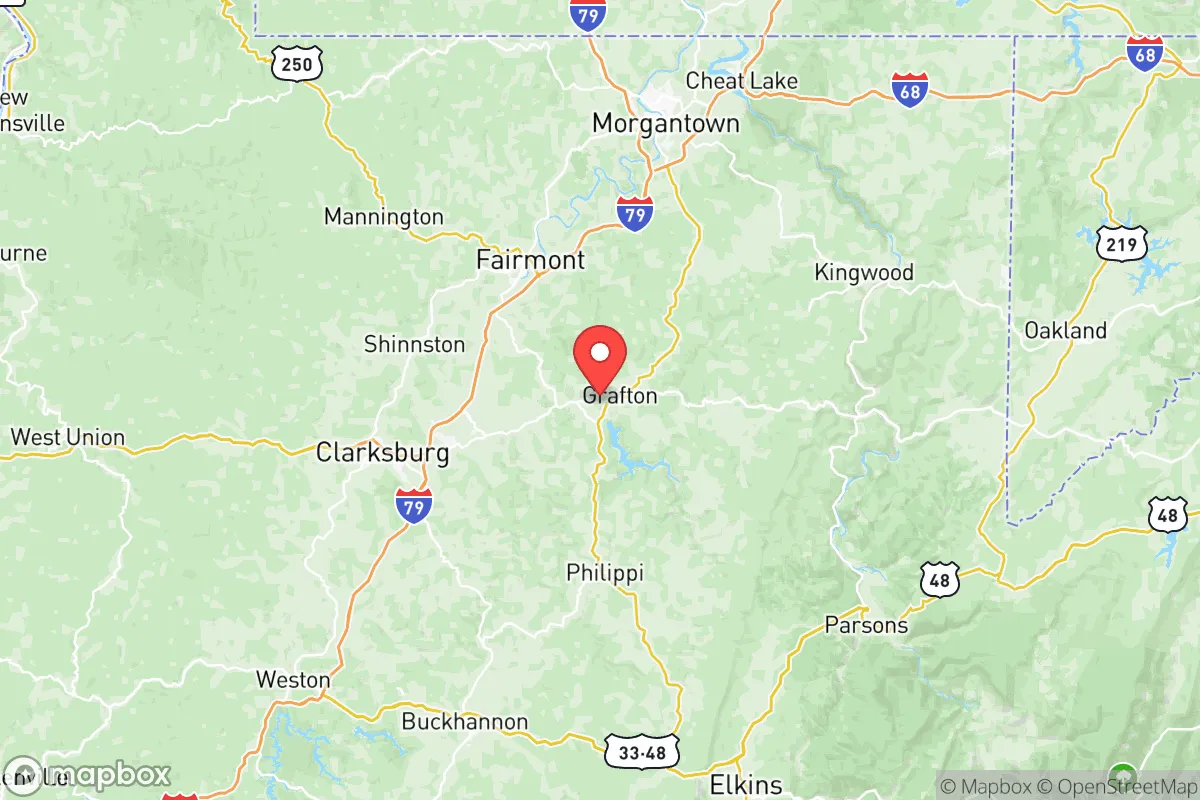
Taylor County, West Virginia, is a deeply conservative stronghold with a Cook Partisan Voting Index of R+20, meaning it votes about 20 points more Republican than the national average. This isn't a recent shift; the county has been reliably red for decades, though the margins have widened noticeably since the early 2000s. The county seat, Grafton, shows the most political variation — it's the only place where you'll find a meaningful number of Democratic-leaning precincts, largely concentrated in the older, working-class neighborhoods near the Tygart Valley River. Drive just a few miles out to Flemington or Thornton, and you're in solidly red territory where Republican candidates routinely win by 30 points or more. The swing precincts are mostly in the unincorporated areas around Pruntytown and the central part of the county, where independent voters can tip a local race by a few hundred votes.
How it compares
Compared to West Virginia as a whole, Taylor County is actually a bit more conservative than the state average. While the state's Cook PVI isn't publicly calculated the same way for every cycle, West Virginia as a whole is typically rated around R+19 to R+22, so Taylor County sits right in that ballpark. The big difference is internal: Taylor County doesn't have the kind of deep-blue college towns (like Morgantown) or the historically union-heavy coal counties (like Mingo or McDowell) that still produce Democratic votes in state elections. Instead, Taylor County's economy is more mixed — healthcare, small manufacturing, and state government jobs in Grafton — which means the political conversation here is less about coal versus environmentalism and more about taxes, local school funding, and Second Amendment issues. You'll hear more talk about the cost of living and property taxes in Grafton than you will about energy policy.
What this means for residents
For conservative residents, Taylor County feels like a place where their values are reflected in local governance. The county commission, school board, and most municipal councils are Republican-majority, and issues like gun rights, lower taxes, and limited regulation are mainstream positions. For liberal residents, the reality is more isolating. There's no organized progressive infrastructure outside of a few small groups in Grafton, and Democratic candidates rarely bother to campaign here outside of the primary. That said, the political climate is generally civil — people know their neighbors, and local elections tend to be decided on personality and local issues rather than national party labels. The biggest practical effect is on policy: the county has resisted state-level pushes for more centralized school control, and local officials tend to favor volunteer fire departments and road maintenance over new social programs.
Culturally, Taylor County stands apart from the rest of West Virginia in a few subtle ways. There's less of the "us versus the federal government" rhetoric you hear in the southern coalfields, partly because the county's economy isn't tied to extractive industries. Instead, the political identity here is more rooted in small-town independence and a wariness of outside influence — whether that's from Charleston, Washington, or even Morgantown. The annual Taylor County Fair and the Grafton High School football games are the real civic gatherings, not party rallies. Looking ahead, the county's political trajectory seems locked in: as long as the national Democratic Party continues to lose ground with rural, non-college voters, Taylor County will stay deep red. But don't expect the kind of performative culture-war politics you see in some other parts of the state — here, it's more about keeping the roads paved and the schools funded than about making national headlines.

State Political ClimatePolitical Climate in West Virginia
State Political AnalysisPolitical Environment in the State
West Virginia has become one of the most reliably Republican states in the nation, a dramatic shift from its 20th-century identity as a Democratic stronghold. The state voted for Donald Trump by nearly 39 points in 2020 and again by a similar margin in 2024, a complete inversion from 1996 when it went for Bill Clinton. This transformation is driven by a collapse of the old coal-and-union Democratic base, a cultural realignment toward social conservatism, and a deep distrust of federal environmental policy that has reshaped the state's entire political identity.
Urban vs. rural divide
The political map of West Virginia is less about urban-rural splits and more about degrees of rural conservatism. The only real population center, Charleston (Kanawha County), is a moderate Republican-leaning area that voted for Trump by about 20 points in 2024 — still red, but notably less so than the rest of the state. Morgantown, home to West Virginia University, is the state's most liberal pocket, with Monongalia County voting for Trump by only single digits and occasionally electing Democrats to local office. Huntington (Cabell County) and Wheeling (Ohio County) are solidly Republican but with a pragmatic, union-influenced streak that sometimes produces moderate candidates. The real engine of the state's conservatism is the southern coalfields — places like Logan, Mingo, and McDowell counties, where Trump won by 70-80 point margins. These areas were once the most reliably Democratic in the country, voting for FDR and then for decades of pro-union Democrats, but they flipped hard starting around 2008 over coal policy and cultural issues. The eastern panhandle, including Martinsburg and Charles Town, is a newer and more mixed region, absorbing commuters from the D.C. metro area and showing slightly more competitive numbers, though still Republican-leaning overall.
Policy environment
West Virginia's policy environment is aggressively conservative by national standards, though it retains some populist economic instincts. The state has no personal income tax on most wages after a 2023 phase-out began, with the rate dropping to 3.99% in 2025 and scheduled to be eliminated entirely by 2026 if revenue targets are met. Sales tax is a relatively low 6%, with no local add-ons. Property taxes are among the lowest in the country, capped by the state constitution at a low effective rate. The regulatory posture is business-friendly, with a right-to-work law (2016) and a tort reform system that capped non-economic damages. Education policy has been a flashpoint: the state passed a broad school choice law in 2021 creating education savings accounts usable for private school or homeschooling, and the 2023 "Parental Bill of Rights" (HB 2553) requires schools to notify parents about instructional materials and medical services. On healthcare, the state did not expand Medicaid under the Affordable Care Act until 2014 under a Democratic governor, but has since maintained the expansion. Election laws have tightened: voter ID is required, early voting is limited to 10 days, and absentee voting requires an excuse. The state has also passed a law banning ranked-choice voting and ballot harvesting.
Recent policy direction
The last five years have seen West Virginia move decisively on a broad set of liberty-related issues that relocators weigh carefully. On gun rights, the state became permitless carry in 2016 and in 2023 passed a law prohibiting local governments from restricting firearms during declared states of emergency — a direct response to COVID-era closures. Parental and education rights saw the 2023 "Don't Say Gay" style law (SB 451) banning classroom discussion of sexual orientation and gender identity in K-12, plus the 2021 school choice expansion. Medical and bodily autonomy is sharply restricted: a near-total abortion ban passed in 2022 with no exceptions for rape or incest, only for medical emergencies. Property rights were strengthened by a 2024 law limiting the use of eminent domain for carbon pipeline projects, a populist measure that pitted landowners against energy companies. Voting and ballot access tightened with the 2023 voter ID law and restrictions on drop boxes. On privacy and surveillance, the state has been relatively quiet, with no broad data privacy law but also no aggressive surveillance expansion. The overall direction is toward maximizing individual choice in education and firearms while restricting it on medical decisions and voting procedures.
Civil unrest & political movements
West Virginia has a long tradition of labor militancy that has evolved into a different kind of political activism. The 2018 statewide teachers' strike shut down every school in the state for nine days and won a 5% pay raise, demonstrating that organized labor still has real power here even in a right-to-work state. That strike was a genuinely cross-partisan movement, with conservative and liberal teachers united against the statehouse. More recently, the anti-pipeline movement has been the most visible form of civil disobedience, with activists — often rural landowners and environmentalists working together — blocking construction of the Mountain Valley Pipeline through nonviolent protest and legal challenges. On the right, the Second Amendment sanctuary movement saw dozens of counties pass resolutions in 2020 vowing not to enforce certain gun laws. Immigration politics are less heated than in border states, but Charles Town and Martinsburg in the eastern panhandle have seen local controversies over immigrant populations, with some residents pushing for stronger enforcement. There is no serious secession or nullification movement, though "state sovereignty" rhetoric is common in legislative debates. Election integrity controversies have been minimal compared to other states; West Virginia's voting systems are seen as relatively secure, and there has been little organized fraud allegation activity.
Projection
Over the next 5-10 years, West Virginia is likely to become even more Republican, but with a shifting internal character. The eastern panhandle will continue to grow as D.C. commuters and remote workers move in, bringing slightly more moderate and professional-class Republicanism rather than the populist style of the coalfields. The Morgantown area will remain a liberal island, possibly growing as the university expands and attracts out-of-state students who stay. The southern coalfields will continue to lose population, reducing their political weight but not their intensity. The income tax elimination, if completed, will accelerate in-migration of retirees and remote workers from higher-tax states, likely reinforcing the conservative tilt. The biggest wild card is the energy transition: if coal continues its long decline without a replacement industry, the state's economic base will shrink further, potentially fueling more populist anger or, alternatively, forcing a pragmatic pivot toward diversification. A new resident moving in now should expect a state that is deeply conservative on social issues, increasingly libertarian on economics, and politically stable in the sense that one party dominates — but with real internal tensions between the old coal populism and the new suburban conservatism.
For someone choosing West Virginia, the practical takeaway is straightforward: if you are conservative on social issues and value low taxes, gun rights, and school choice, you will find the state's political climate deeply comfortable and aligned with your priorities. If you are liberal, you will find yourself in a clear minority, but with a few welcoming pockets in Morgantown, parts of Charleston, and the college towns — and the trade-off is some of the lowest living costs and most beautiful natural scenery in the eastern U.S. The state's politics are not subtle or conflicted; they are what they are, and they are unlikely to change direction anytime soon.
* Values derived from national, state, county, city and local statistics and may differ in a specific area. Last updated: 2026-08-08T15:02:26.000Z
Narrative content on this page is AI-generated and may contain mistakes. Verify any details that matter before acting on them.
ReloMaps may earn a commission from affiliate links at no extra cost to you.

