Photo: Wikipedia
Demographics of Wilkes Barre, PA
Affluence Level in Wilkes Barre, PA
A low-income area with significant economic hardship. Household wealth and educational attainment are well below national averages.
People of Wilkes Barre, PA
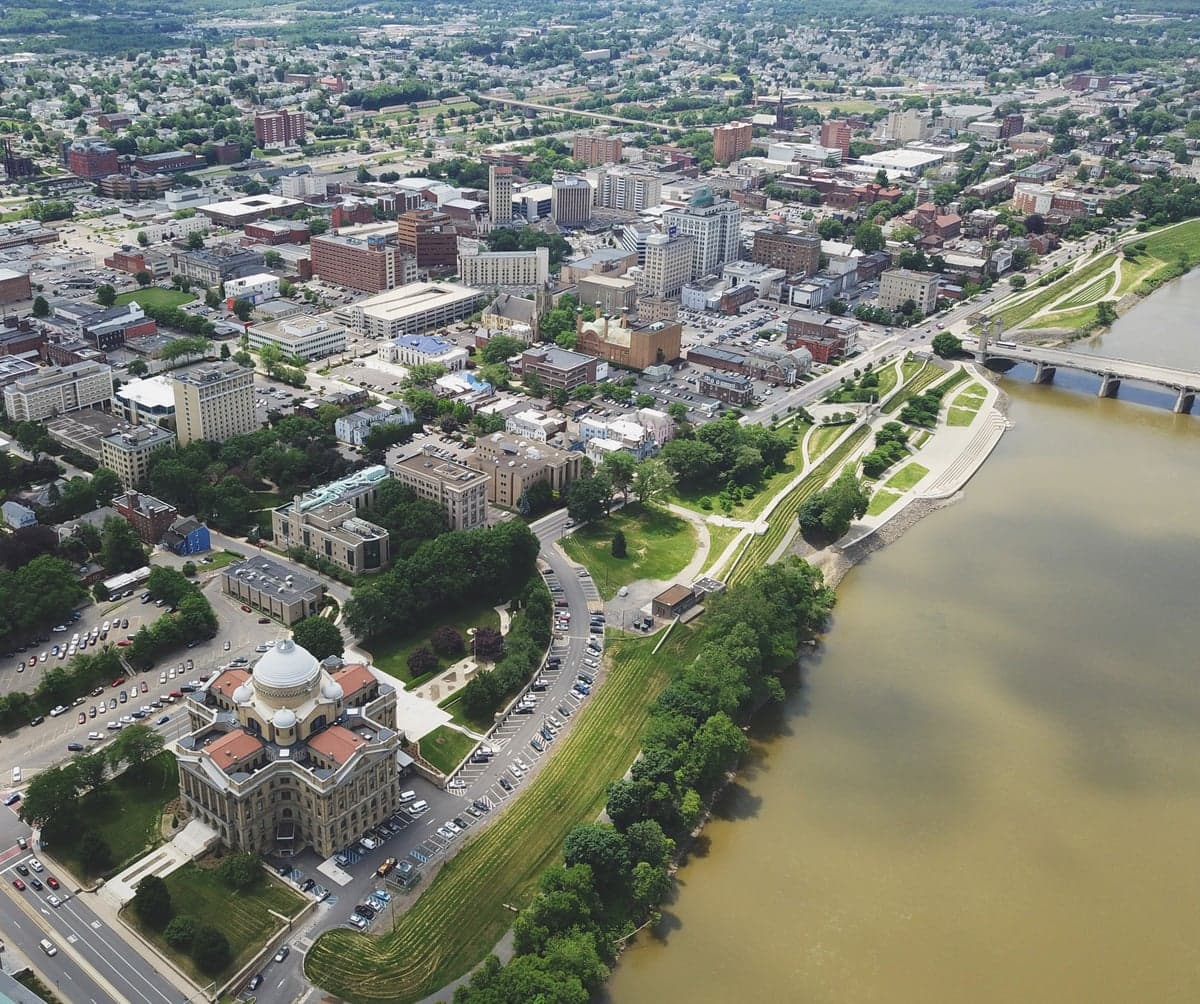
The people of Wilkes-Barre, Pennsylvania today form a dense, historically rooted urban population of 44,217 that is notably more diverse than the surrounding Wyoming Valley. The city is characterized by a majority-minority population where Hispanic residents (30.6%) and Black residents (11.7%) live alongside a white population that has fallen to 51.9%, creating a demographic profile distinct from the more homogeneous suburbs. A modest foreign-born share of 8.7% and a low college attainment rate of 19.4% reflect a working-class city still shaped by its industrial past and recent immigrant arrivals.
How the city was settled and grew
Wilkes-Barre was founded in 1769 by Connecticut settlers under the Susquehanna Company, who arrived via the Wyoming Valley to claim land grants. The original population was overwhelmingly English and Welsh, with the latter group establishing a strong presence in the Miners Mills neighborhood, where Welsh miners built the first churches and social halls. The anthracite coal boom of the 19th century drew massive waves of Irish immigrants fleeing the Great Famine, who settled in Parsons and Plains Township (then part of the city's orbit), working the deep mines and building St. Mary's and St. Patrick's parishes. Eastern Europeans followed in the 1880s–1910s: Poles, Slovaks, and Lithuanians clustered in South Wilkes-Barre and the Heights neighborhood, where they established fraternal societies and Catholic churches like St. Stanislaus. Italian immigrants arrived in the same period, concentrating in North End and East End, where they worked in the mines and later in the silk mills and cigar factories. By 1930, the city's population peaked at over 86,000, a dense, ethnic-white, Catholic-majority industrial city.
Modern era (post-1965)
The collapse of anthracite mining after World War II triggered a long population decline, but the city's ethnic composition remained largely white through the 1970s. The Hart-Cellar Act of 1965 had a delayed effect here: the first significant non-white arrivals were Black families moving from the rural South and from Philadelphia during the 1970s and 1980s, settling in the Public Square area and the River Street corridor. The Hispanic population began growing rapidly in the 1990s and 2000s, driven by Puerto Rican migration (U.S. citizens, not foreign-born) and later by Dominican and Mexican immigrants. These communities concentrated in South Wilkes-Barre and the Heights, where they opened bodegas, Pentecostal churches, and Spanish-language businesses along Carey Avenue. The East/Southeast Asian population (1.9%) is small but visible, with a Vietnamese community centered around Market Street and a Korean presence near Northampton Street. The Indian-subcontinent population (0.2%) is negligible, limited to a handful of professionals and students at nearby Wilkes University. The white population, once over 95%, has dropped to 51.9% as younger families left for suburbs like Dallas and Back Mountain, while older ethnic whites remain in Miners Mills and Parsons.
The future
Wilkes-Barre's population is trending toward a Hispanic-plurality future. The white population is aging and declining, with a median age over 40 in white-majority neighborhoods, while the Hispanic population is younger (median age under 30) and has a higher birth rate. The foreign-born share (8.7%) is growing slowly, primarily through family reunification from the Dominican Republic and Mexico, but the city's low college attainment and limited job growth in professional sectors constrain new immigration. The Black population is stable but not growing, and the East/Southeast Asian community is plateauing. The city is not tribalizing into stark enclaves—most neighborhoods are mixed, though South Wilkes-Barre is now majority-Hispanic and Miners Mills remains predominantly white. Over the next 10–20 years, the city will likely become a Hispanic-majority city with a significant white minority and smaller Black and Asian communities, resembling other post-industrial Pennsylvania cities like Hazleton and Reading.
For someone moving in now, Wilkes-Barre is a city in demographic transition—still affordable, still dense, but with a population that is younger and more diverse than its reputation suggests. The working-class character remains strong, but the ethnic anchors have shifted from Polish and Italian parishes to Puerto Rican and Dominican churches. The city offers lower housing costs than the suburbs but also lower educational attainment and fewer professional jobs, making it a practical choice for those who value urban density and diversity over suburban homogeneity.

* Values derived from national, state, county, city and local statistics and may differ in a specific area. Last updated: 2026-05-01T03:08:12.000Z
Narrative content on this page is AI-generated and may contain mistakes. Verify any details that matter before acting on them.
ReloMaps may earn a commission from affiliate links at no extra cost to you.

