Photo: Wikipedia
Demographics of Williams, AZ
Affluence Level in Williams, AZ
A middle-class area roughly in line with national averages across income, home values, education, and employment.
People of Williams, AZ
The people of Williams, Arizona, today number 3,322, forming a tight-knit, predominantly White and Hispanic community with a distinct Western character rooted in railroad and Route 66 history. The city’s population is notably less diverse than the national average, with a foreign-born share of just 5.4% and a college attainment rate of 22.4%, reflecting a working-class, family-oriented demographic. Residents identify strongly with the city’s identity as the “Gateway to the Grand Canyon,” and the population is characterized by a mix of multi-generational locals and newer arrivals drawn to tourism, outdoor recreation, and a slower pace of life.
How the city was settled and grew
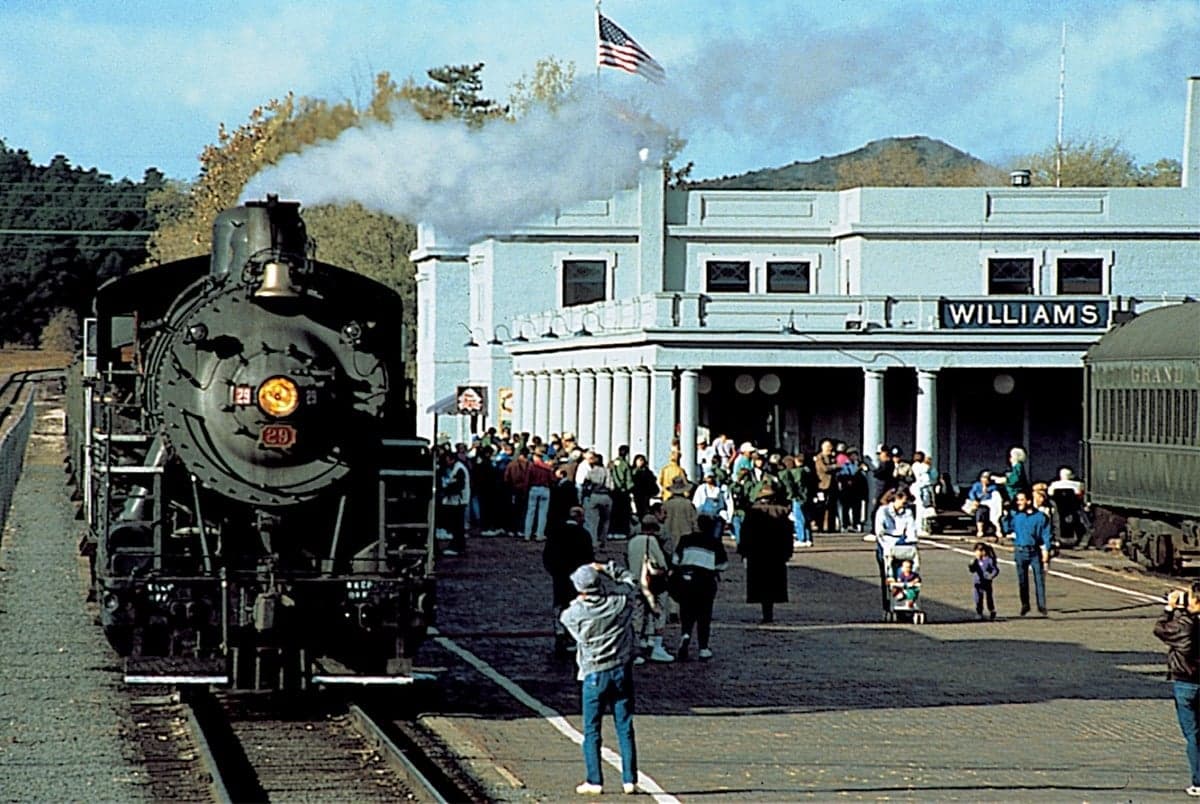
Williams was founded in 1881 as a railroad town on the Atlantic and Pacific Railroad line, which brought the first major wave of settlers—primarily Anglo-American railroad workers, merchants, and ranchers. The original population clustered around the railroad depot in what is now Downtown Williams, where the historic train station and Route 66 corridor remain the commercial heart. A second wave arrived in the early 1900s with the expansion of the timber industry, drawing workers to the Railroad Addition neighborhood, a working-class area east of the tracks built for sawmill and railroad employees. Mexican laborers began arriving in significant numbers during the 1910s and 1920s, recruited for railroad maintenance and agricultural work; they settled in the South Side district, south of the tracks, which remains a historically Hispanic enclave. By the 1930s, Route 66 brought a tourism boom, and the Mountain View neighborhood, west of downtown, grew with motels and service-industry housing. The population peaked at around 3,800 in the 1950s before declining as the railroad and timber sectors contracted.
Modern era (post-1965)
After the 1965 Immigration and Nationality Act, Williams saw modest Hispanic growth through family reunification, with the Hispanic share rising from roughly 15% in 1970 to 33.6% today. This growth concentrated in the South Side and the newer Ponderosa Estates subdivision, a middle-class area developed in the 1990s south of the railroad tracks. The White population, now 59.3%, has aged in place, with many younger White families moving to Flagstaff or Prescott for jobs, leaving an older demographic in established neighborhoods like Railroad Addition and Mountain View. The Black population remains minimal at 1.3%, concentrated in scattered households rather than a distinct neighborhood. East and Southeast Asian residents (1.1%) are mostly business owners in the tourism sector, living in Downtown Williams or Ponderosa Estates. The Indian subcontinent population is effectively zero. The foreign-born share (5.4%) is overwhelmingly Hispanic, with most immigrants arriving from Mexico in the 1980s and 1990s; new immigration has slowed since 2010. The college-educated share (22.4%) is low, reflecting the dominance of tourism, retail, and service jobs, with few professional or tech-sector employers.
The future
Williams is likely to remain a predominantly White and Hispanic community, with gradual homogenization as younger White residents leave and Hispanic families age into the middle class. The Hispanic population is plateauing, as immigration has slowed and second- and third-generation families increasingly identify as White or mixed-race. No new immigrant communities are emerging; the East/Southeast Asian and Black populations are stable and small. The city is not tribalizing into distinct enclaves—neighborhoods like South Side and Ponderosa Estates are becoming more integrated as housing turnover increases. The next 10-20 years will likely see slow population growth, driven by retirees and remote workers seeking affordable housing near the Grand Canyon, but the city’s limited job base and lack of higher education will constrain significant demographic change. The college-educated share may rise slightly as telecommuters arrive, but Williams will remain a working-class, family-oriented town.
For someone moving in now, Williams is a stable, culturally conservative community where Hispanic and White residents coexist with little friction, and where the population is aging slowly rather than diversifying rapidly. The city’s future is one of modest, incremental change—not a transformation—making it a predictable choice for those seeking a small-town, Western lifestyle with strong ties to tourism and the outdoors.

* Values derived from national, state, county, city and local statistics and may differ in a specific area. Last updated: 2026-05-02T04:17:15.000Z
Narrative content on this page is AI-generated and may contain mistakes. Verify any details that matter before acting on them.
ReloMaps may earn a commission from affiliate links at no extra cost to you.

