
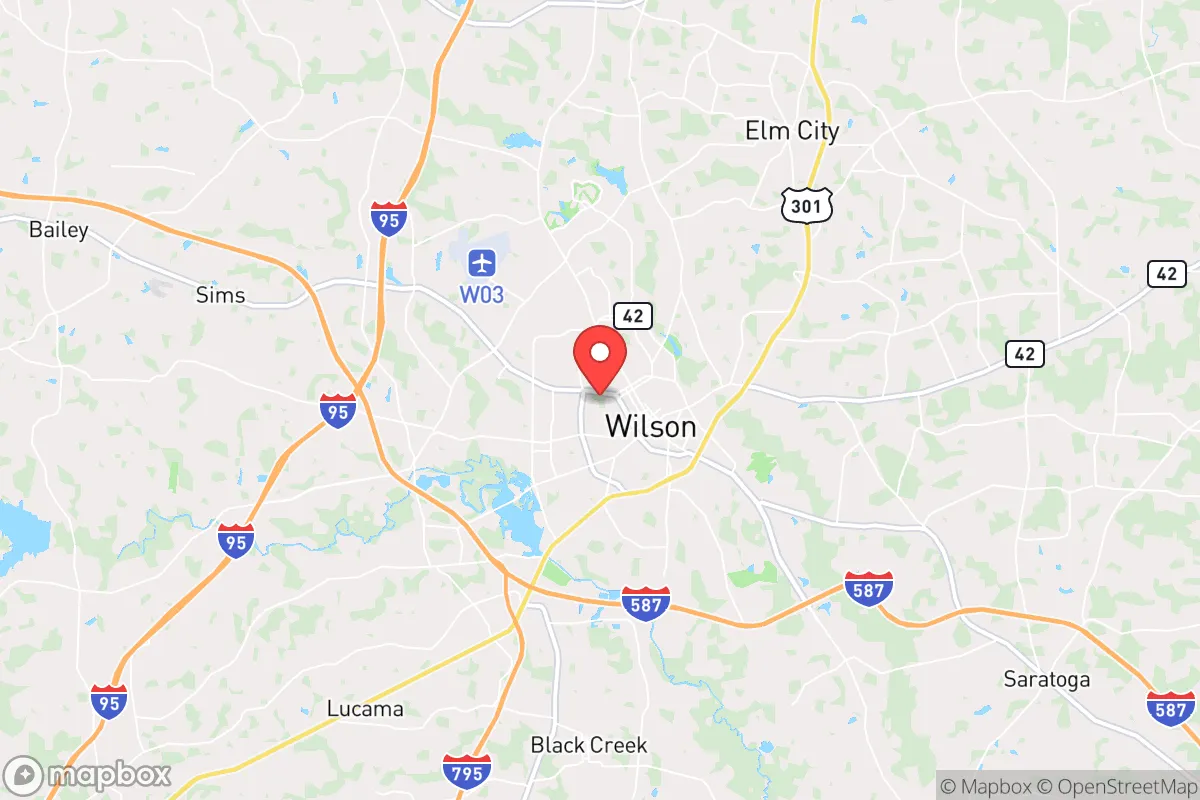
Photo: Wikipedia
Personal Sovereignty in Wilson, NC
Viable for self-reliance. Generally workable, though some barriers may limit total independence.
What does Personal Sovereignty tell us?
Personal Sovereignty measures your capacity for self-reliance and independence with minimal government friction. Higher scores mean fewer barriers between you and the way you want to live... but it assumes you have the space you need and good neighbors.
What does this tell us?
Personal Sovereignty measures your capacity for self-reliance and independence with minimal government friction. Higher scores mean fewer barriers between you and the way you want to live... but it assumes you have the space you need and good neighbors.
State Policy
Energy independence: Importer (15% of energy produced in-state)
Personal Liberty
Homesteading

Personal Liberty Analysis
Wilson, North Carolina offers a notably high degree of personal sovereignty relative to many other parts of the country, particularly for those who prioritize minimal government interference in daily life. The city sits in a state that has consistently pushed back against federal overreach on issues ranging from gun rights to pandemic mandates, and the local culture in Wilson reinforces a live-and-let-live ethos that appeals to survivalists, preppers, and anyone wary of creeping government control. While no location is a libertarian utopia, Wilson’s combination of state-level protections, a relatively low regulatory burden, and a community that values self-reliance makes it a strong contender for those seeking to maximize their autonomy in a volatile world.
Tax burden and regulatory posture: How Wilson compares to high-tax states
North Carolina’s tax structure is a major draw for those looking to escape the fiscal grip of high-tax states like New York, California, or Illinois. The state levies a flat income tax rate of 4.75% as of 2025, with scheduled reductions moving toward 3.99% by 2027, meaning Wilson residents keep more of what they earn. Property taxes in Wilson County are moderate, with an effective rate around 0.78% of assessed home value, well below the national average. There is no state-level property tax, and local governments are restrained in their ability to hike rates without voter approval. Sales tax in Wilson sits at 7% (6.75% state plus 0.25% local), which is competitive. More importantly, North Carolina is a right-to-work state with no state income tax on Social Security benefits, and it offers a standard deduction that shields a significant portion of retirement income. For preppers and homesteaders, the regulatory posture is equally favorable: there are no state-level building codes in unincorporated areas of Wilson County, and the city itself has relatively lenient zoning compared to urban centers. This means fewer permits and inspections for those building workshops, root cellars, or off-grid structures on their property, though you’ll still need to comply with basic septic and well regulations. The state’s overall business climate ranks in the top 10 nationally, which translates to fewer bureaucratic hurdles for anyone starting a small farm, repair shop, or home-based enterprise.
Self-defense and gun law specifics: What Wilson offers for armed preparedness
North Carolina is a shall-issue state for concealed carry permits, meaning Wilson residents face no subjective “good cause” requirement—if you meet the basic criteria, you get the permit. The state also has constitutional carry for law-abiding citizens 18 and older, allowing open carry of handguns without a permit, though a permit is still needed for concealed carry unless you qualify under the 2023 permitless carry law. Wilson County’s sheriff’s office is known for being pro-Second Amendment, and there are no local ordinances that restrict magazine capacity, firearm types, or ammunition sales beyond state law. Stand-your-ground laws are in full effect, with no duty to retreat in any place you have a legal right to be. Castle doctrine protections extend to vehicles and occupied structures. For preppers, this means you can legally maintain a substantial armory for defense against both criminal threats and potential civil unrest. The state also prohibits local governments from maintaining “red flag” laws, so there is no risk of temporary firearm seizure without due process. Wilson has several gun shops and ranges within a 30-minute drive, and the rural surroundings make private land shooting practical. The only notable restriction is a 48-hour waiting period for handgun purchases from dealers, but private sales between individuals remain unregulated. For those concerned about federal overreach, North Carolina has passed a Second Amendment Sanctuary resolution, and Wilson County’s commissioners have signaled support for resisting any future federal gun bans.
Self-reliance and homesteading viability: Lot sizes, zoning, and off-grid feasibility
Wilson offers a sweet spot for homesteading: it’s not so rural that you’re isolated from supplies and healthcare, but not so suburban that HOAs and zoning boards dictate your every move. Within the city limits, standard residential lots range from 0.25 to 0.5 acres, but you can find larger parcels—1 to 5 acres—in the county’s extraterritorial jurisdiction (ETJ) just outside town. Zoning in unincorporated Wilson County is minimal: there are no county-wide building codes, and agricultural uses like raising chickens, goats, or even a few head of cattle are generally permitted on parcels of 1 acre or more. The city itself allows backyard chickens (hens only, no roosters) on lots under 1 acre, and larger livestock with a simple permit. For off-grid living, the feasibility is high: North Carolina has no state law prohibiting rainwater collection, and Wilson County does not restrict it. Solar panels are allowed without special permits in most areas, though grid-tied systems require utility approval. Wells and septic systems are regulated by the county health department, but the process is straightforward for standard setups. The climate supports year-round gardening (USDA zone 8a), with a growing season of about 220 days. The biggest practical limitation is water: Wilson gets about 48 inches of rain annually, but droughts do occur, so a well with a backup cistern is wise for serious preppers. There are no county-level restrictions on composting toilets or greywater systems, though you’ll need a septic permit for any blackwater system. Overall, Wilson County is one of the more permissive areas in the state for self-sufficient living, especially compared to the coastal counties with stricter environmental regulations.
Personal liberties: Parental rights, medical autonomy, speech, and property
North Carolina has been a battleground for personal liberties, and the current legal landscape leans heavily toward individual freedom. Parental rights are strongly protected: the state has a Parents’ Bill of Rights that requires schools to notify parents of any medical or mental health services offered to minors, and it prohibits schools from hiding a child’s gender identity or sexual orientation from parents. Wilson County Schools have generally complied with these laws, and the local school board has resisted federal overreach on curriculum mandates. Medical autonomy is mixed: North Carolina did not impose broad vaccine mandates during the pandemic, and the state legislature has since passed laws prohibiting vaccine passports and limiting emergency powers of governors. However, the state does require vaccines for school attendance (with religious and medical exemptions), and there is no state-level protection for ivermectin or hydroxychloroquine prescriptions. For those seeking alternative medicine, Wilson has a handful of functional medicine practitioners and a growing interest in holistic health. Free speech protections are robust: North Carolina has no hate speech laws that criminalize political or religious expression, and the state’s courts have consistently upheld First Amendment rights. Property rights are strong, with no state-level rent control and limited eminent domain abuse. Wilson County does not have a county-wide planning department that can arbitrarily restrict land use, and the city’s zoning board is generally deferential to property owners. The biggest threat to property rights in the area is the potential for future federal environmental regulations on wetlands or endangered species, but currently, Wilson’s inland location avoids the coastal development restrictions that plague eastern NC. For those concerned about government surveillance, Wilson is not a “smart city” with ubiquitous cameras or license plate readers, and the local police department is small and community-oriented rather than militarized.
In the broader context of personal sovereignty, Wilson, NC stands out as a place where the state and local governments largely stay out of your way. Compared to the Pacific Northwest or the Northeast, where zoning, gun laws, and tax policies can crush individual autonomy, Wilson offers a breathing room that is increasingly rare. The trade-offs are real: you’re in a conservative, religiously traditional community where social conformity is expected, and the local economy is not booming enough to offer high-paying jobs for everyone. But for the strategic relocator who values self-reliance, minimal government interference, and the ability to prepare for uncertain times, Wilson provides a solid foundation. The state’s trajectory is toward more freedom, not less, and the local culture reinforces the idea that your life, your property, and your family are yours to manage. If you’re looking to escape the overreach of blue-state governance without moving to a remote wilderness, Wilson deserves a serious look.

* Values derived from national, state, county, city and local statistics and may differ in a specific area. Last updated: 2026-04-21T16:55:12.000Z
Narrative content on this page is AI-generated and may contain mistakes. Verify any details that matter before acting on them.
ReloMaps may earn a commission from affiliate links at no extra cost to you.

