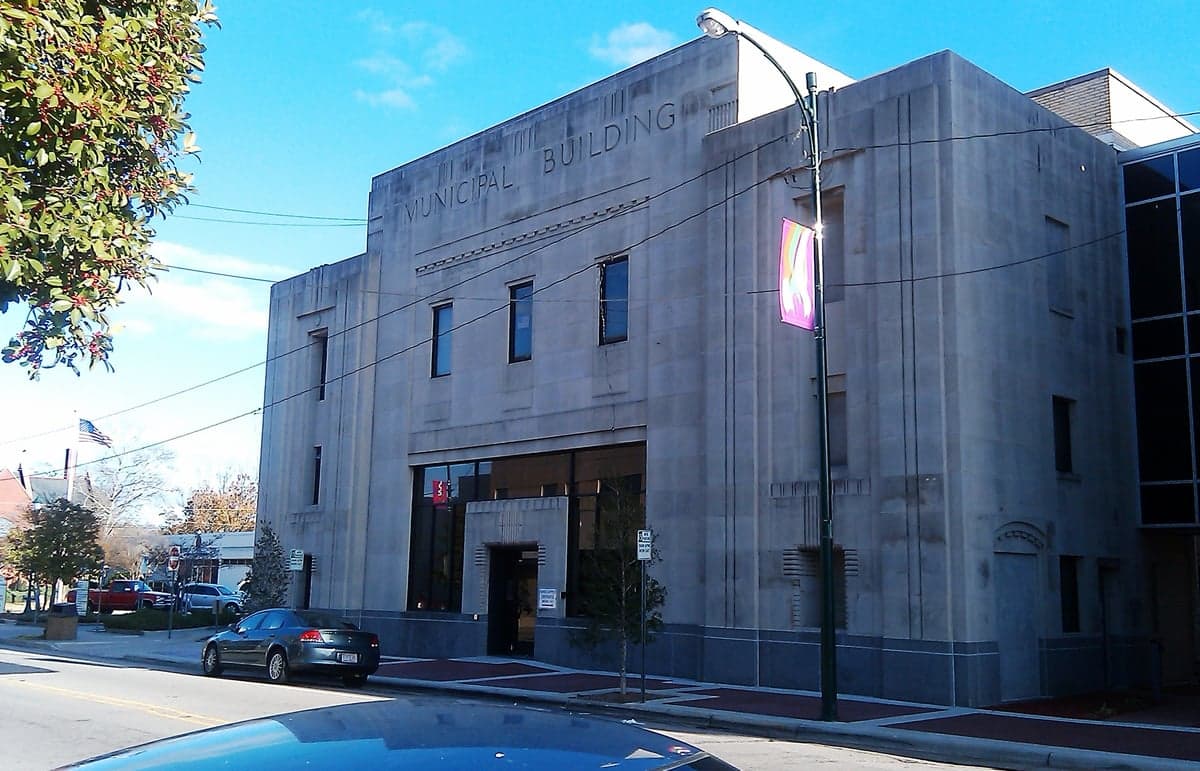
Photo: Wikipedia
Demographics of Wilson, NC
Affluence Level in Wilson, NC
A low-income area with significant economic hardship. Household wealth and educational attainment are well below national averages.
People of Wilson, NC
The people of Wilson, NC today form a majority-Black city of 47,740 residents, where nearly half the population (48.9%) identifies as Black or African American, over a third (35.2%) as White, and 11.3% as Hispanic. The city is notably less diverse than the national average in foreign-born residents—just 3.3%—and has a college attainment rate of 22.8%, below the state average. Wilson retains a distinct small-city Southern character, with a strong sense of local identity rooted in tobacco history and a growing emphasis on revitalizing its historic downtown and surrounding neighborhoods.
How the city was settled and grew
Wilson was founded in 1849 as a railroad stop on the Wilmington and Weldon Railroad, drawing its earliest population from English and Scots-Irish farmers who established plantations in the surrounding agricultural area. The city's growth accelerated after the Civil War, when the tobacco industry took hold. The arrival of the Bright Leaf tobacco auction market in the 1880s transformed Wilson into a major processing and shipping hub, attracting both White and Black laborers. Black families, many formerly enslaved, settled in neighborhoods such as East Wilson (the historic Black business district along Nash Street) and Rountree, building churches, schools, and a thriving middle class. White workers and merchants concentrated in West Wilson and the Downtown area, where the tobacco warehouses and rail lines dominated the landscape. By 1900, Wilson's population had grown to roughly 4,000, and it continued to expand steadily through the early 20th century as tobacco remained the economic engine.
Modern era (post-1965)
The post-1965 era brought significant demographic shifts to Wilson, driven by the decline of tobacco and the broader patterns of suburbanization and racial change in the South. The Civil Rights movement and the end of legal segregation opened housing options for Black families, who began moving into previously White-only neighborhoods like Forest Hills and Lake Wilson, though de facto residential segregation persisted. The city's Black population share rose from roughly 40% in 1970 to nearly 49% today, while the White share fell from over 55% to 35.2%. The Hispanic population, virtually nonexistent in 1970, grew to 11.3% by 2020, driven largely by immigration from Mexico and Central America for work in agriculture, construction, and poultry processing. These newer Hispanic residents concentrated in the South Wilson area and along the US 301 corridor, where affordable housing and proximity to farm jobs were available. The East/Southeast Asian population remains very small at 0.9%, and the Indian-subcontinent population at 0.5%, with no single concentrated ethnic enclave. The city's foreign-born share of 3.3% is well below the national average of 13.7%, reflecting Wilson's limited draw for international immigration compared to larger North Carolina cities like Raleigh or Charlotte.
The future
Wilson's population is projected to remain relatively stable, with modest growth driven by domestic in-migration from other parts of North Carolina and the broader Southeast. The city is not homogenizing into a single identity; instead, it is likely to continue its pattern of distinct residential enclaves. The Black population is expected to remain the largest group, while the Hispanic share may grow slowly as families settle and birth rates remain above the local average. The White population, which has declined in absolute numbers since 2000, may stabilize as retirees and remote workers are drawn to the city's lower cost of living and historic downtown revitalization. The East/Southeast Asian and Indian communities are too small to drive significant change, and the foreign-born share is unlikely to rise above 5% in the next decade. Wilson is not becoming a major immigrant gateway; its future demographic story is one of gradual, organic change within a predominantly Black and White Southern framework.
For someone moving to Wilson now, the city offers a stable, affordable, and culturally rooted community where the population is neither rapidly diversifying nor shrinking. The key neighborhoods—East Wilson, West Wilson, Forest Hills, South Wilson, and the Downtown district—each retain distinct identities, and newcomers will find a place where the past (tobacco, segregation, and resilience) and the present (revitalization, modest growth, and a strong sense of place) coexist. The city is becoming a quieter, more stable version of its former self, not a boomtown or a melting pot, but a solid choice for those seeking a manageable, family-oriented Southern city.

* Values derived from national, state, county, city and local statistics and may differ in a specific area. Last updated: 2026-04-21T16:55:12.000Z
Narrative content on this page is AI-generated and may contain mistakes. Verify any details that matter before acting on them.
ReloMaps may earn a commission from affiliate links at no extra cost to you.

