 Popular
Photo: Wikipedia
Demographics of Winston Salem, NC
Affluence Level in Winston Salem, NC
A middle-class area roughly in line with national averages across income, home values, education, and employment.
People of Winston Salem, NC
Winston-Salem’s 250,887 residents form a majority-minority city where no single racial group holds a numerical majority: 44.0% White, 31.8% Black, 17.9% Hispanic, 1.5% East/Southeast Asian, and 0.8% Indian. The city is denser and more urban than most of the Piedmont Triad, with a distinctive identity shaped by tobacco wealth, Moravian communal planning, and successive waves of Black and Hispanic in-migration. Foreign-born residents make up 7.1% of the population, and 37.2% of adults hold a college degree, reflecting a bifurcated economy of healthcare/education jobs and legacy manufacturing.
How the city was settled and grew
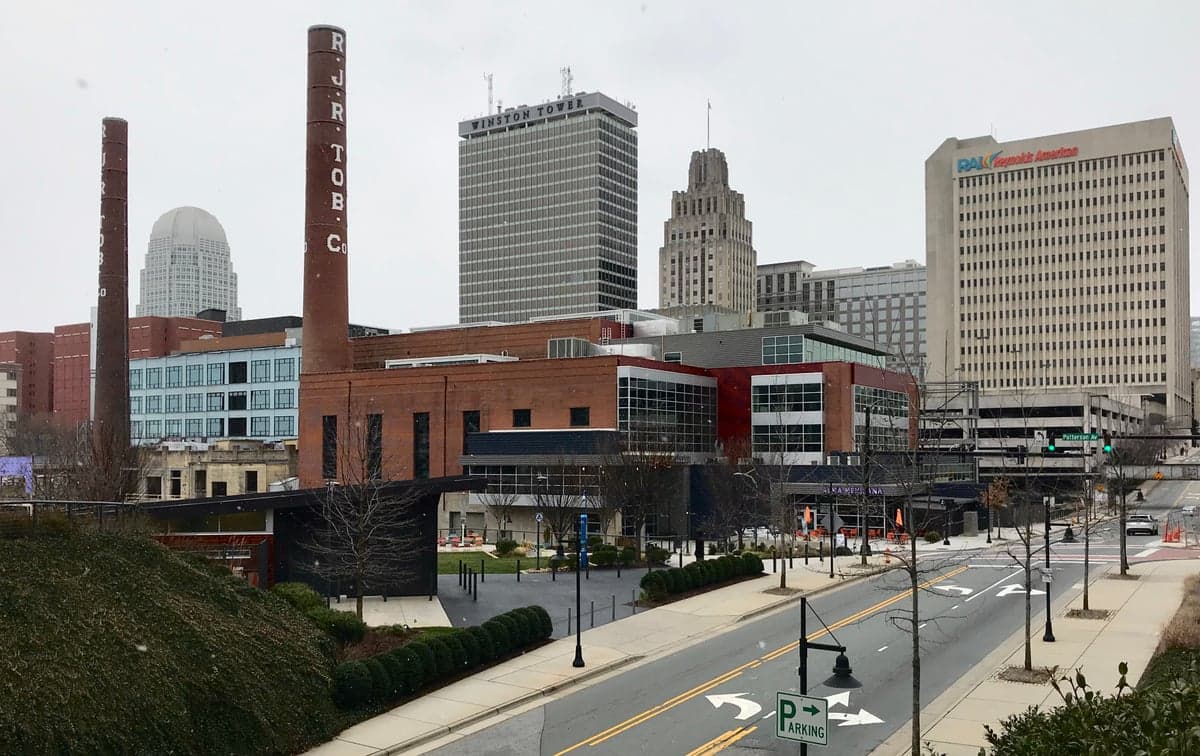
Winston-Salem began as two separate towns. Salem was founded in 1766 by Moravian missionaries from Pennsylvania and Germany, who purchased nearly 100,000 acres from Lord Granville. The Moravians built a planned religious community centered on what is now Old Salem, a historic district where German-speaking craftsmen, farmers, and clergy lived in communal ownership. Winston was established in 1849 as the county seat of Forsyth County, named after a local Revolutionary War hero. The two towns merged in 1913, but the population remained overwhelmingly White and native-born through the early 1900s.
The city’s explosive growth came from tobacco. R.J. Reynolds moved his cigarette company to Winston in 1875, drawing thousands of White and Black workers from rural North Carolina and Virginia. Black migrants settled in East Winston, a historically Black corridor along Liberty Street and Patterson Avenue that became the commercial and social heart of the city’s African American community. By 1930, Winston-Salem was the largest city in North Carolina, with a Black population of roughly 30% concentrated in East Winston and Happy Hill, one of the South’s first public housing projects for Black families. White working-class families clustered in West Salem and Ardmore, neighborhoods built around the Reynolds factories and textile mills.
Modern era (post-1965)
The 1965 Hart-Cellar Act and the collapse of tobacco manufacturing reshaped Winston-Salem’s demographics. The city’s Black population grew from 31% in 1970 to 38% by 2000, driven by domestic migration from rural counties and the decline of East Winston’s industrial base. White families suburbanized heavily into Clemmons, Lewisville, and western Forsyth County, leaving the city core with a higher proportion of Black and low-income residents. East Winston lost population and retail, while Washington Park, a historically White middle-class neighborhood near downtown, underwent racial transition and then reinvestment in the 2010s.
Hispanic growth is the most significant post-1965 shift. The Hispanic share rose from under 2% in 1990 to 17.9% today, driven by Mexican and Central American immigrants working in construction, poultry processing, and landscaping. The primary settlement corridor is South Main Street and the Waughtown area, where Hispanic-owned tiendas, churches, and restaurants now anchor a dense, walkable commercial strip. East/Southeast Asian communities (1.5%) are smaller and more dispersed, with Vietnamese and Korean families concentrated in the Stratford Road corridor near Hanes Mall. The Indian population (0.8%) is professional and highly educated, clustered in the Buena Vista and Sherwood Forest neighborhoods near Wake Forest University and the medical center.
The future
Winston-Salem is not homogenizing; it is tribalizing into distinct enclaves. The White share continues to decline (down from 55% in 2000), while the Hispanic share is projected to reach 22-25% by 2040, driven by both immigration and higher birth rates. East Winston remains overwhelmingly Black and economically distressed, while downtown and the West End are rapidly gentrifying with White and Asian professionals. The Indian and East/Southeast Asian populations are growing slowly from a small base, primarily through university and medical recruitment, and are unlikely to reach double-digit shares in the next decade. The foreign-born share (7.1%) is below the national average and is plateauing, as most Hispanic growth now comes from U.S.-born children rather than new arrivals.
For a conservative-leaning mover, the key trend is spatial sorting: the city is becoming more politically and culturally fragmented by neighborhood. East Winston votes overwhelmingly Democratic; the western suburbs vote Republican; downtown and the university area lean left but are demographically mixed. The city’s overall growth rate is modest (roughly 0.5% annually), and population gains are concentrated in the Hispanic and professional White cohorts.
Winston-Salem is becoming a smaller, more diverse, and more economically stratified city than its tobacco-era peak. The practical takeaway for a new resident is that neighborhood choice matters more than citywide averages: the experience of living in Waughtown, East Winston, Buena Vista, or Ardmore will differ dramatically in terms of schools, safety, political culture, and daily life. The city is not trending toward a single identity but toward a collection of distinct communities under one municipal umbrella.

* Values derived from national, state, county, city and local statistics and may differ in a specific area. Last updated: 2026-05-03T04:51:02.000Z
Narrative content on this page is AI-generated and may contain mistakes. Verify any details that matter before acting on them.
ReloMaps may earn a commission from affiliate links at no extra cost to you.

