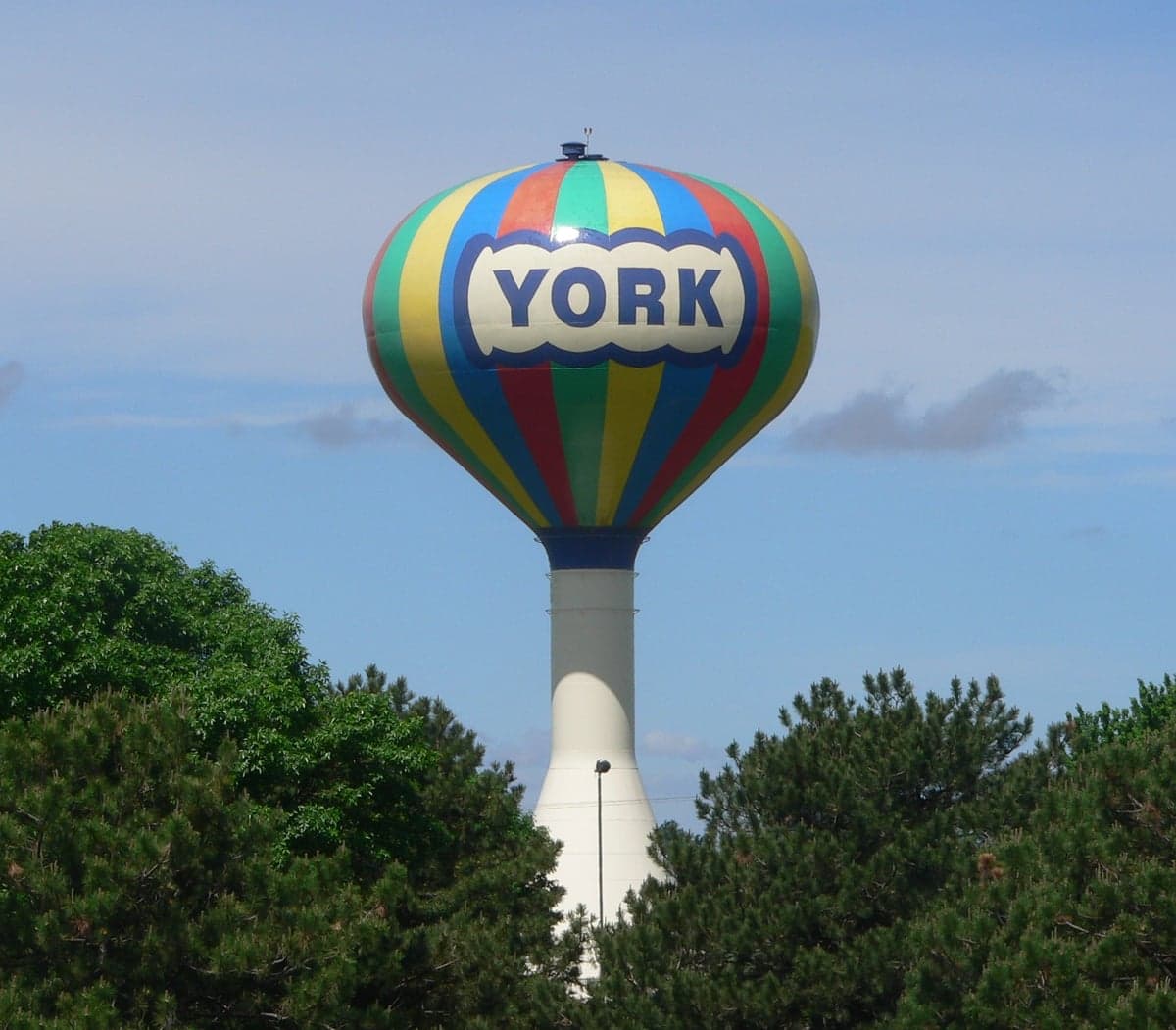
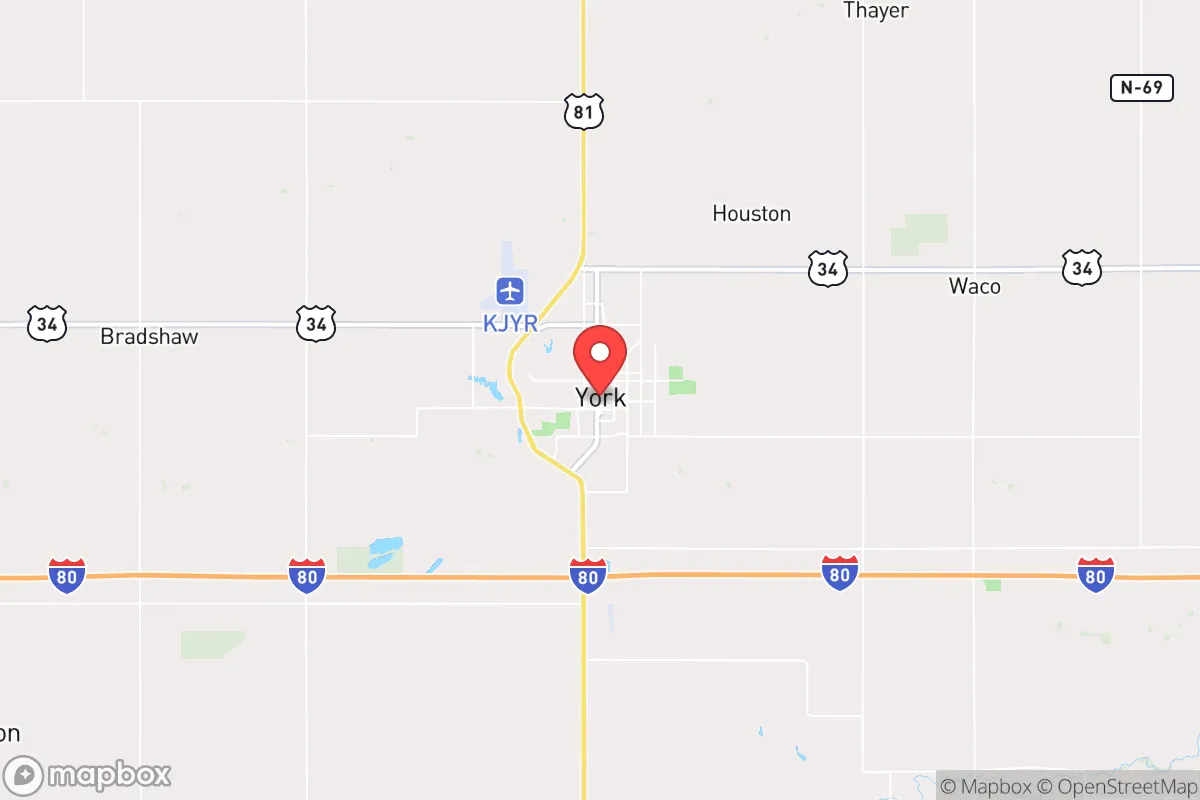
Photo: Wikipedia
Demographics of York, NE
Affluence Level in York, NE
A below-average socioeconomic profile. Incomes, home values, and educational attainment trail the U.S., with higher poverty and unemployment.
People of York, NE
The people of York, Nebraska, today form a predominantly white, family-oriented community of 8,114 residents, characterized by a strong sense of civic pride and a slower pace of life. With a 91.3% white population and a foreign-born share of just 1.8%, the city remains one of the most ethnically homogeneous in the state, though a small but growing Hispanic community (4.3%) is beginning to reshape parts of its social fabric. The city’s identity is rooted in its agricultural and manufacturing heritage, with a median age of 40.2 and a college attainment rate of 25.4% reflecting a workforce that values practical skills and local employment over academic migration. Residents often describe York as a place where “everyone knows your name,” and the city’s low crime rate and strong public schools reinforce its appeal to conservative-leaning families seeking stability.
How the city was settled and grew
York was founded in 1869 as a railroad town on the Burlington and Missouri River Railroad line, with the first wave of settlers being Yankee and German immigrants drawn by the promise of cheap land under the Homestead Act. The original plat centered on the downtown square, and the South Central neighborhood—bounded by Lincoln Avenue and 9th Street—became the heart of the German Lutheran community, who built St. John’s Lutheran Church (1874) and established the York College (1890) as a training ground for teachers and ministers. A second wave of Danish and Swedish immigrants arrived in the 1880s, settling in the North Side district around 14th Street, where they founded the Swedish Evangelical Free Church and operated dairy farms that supplied the city’s creameries. By 1900, the population had reached 3,000, and the East Hill neighborhood—east of the railroad tracks—emerged as a working-class enclave for Czech and Polish laborers who worked at the York Grain Elevator and the Nebraska Furniture Mart (founded 1913). The city’s growth plateaued during the Dust Bowl and Great Depression, as many farm families moved west, but a post-World War II boom brought returning veterans and their families to the West Park addition, a planned subdivision of ranch-style homes built between 1950 and 1965.
Modern era (post-1965)
The post-1965 period saw York’s population stabilize around 7,000–8,000, with domestic in-migration from rural Nebraska counties rather than international immigration. The Southwest Hills subdivision, developed in the 1970s and 1980s, attracted middle-class families employed at the York General Hospital and the expanding Kawasaki Motors Manufacturing plant (opened 1974), which brought a small number of Japanese engineers and managers—accounting for the 0.8% East/Southeast Asian population today. The Hispanic community, which grew from less than 1% in 1990 to 4.3% by 2020, concentrated in the South Side area around 5th Street, where a handful of Mexican restaurants and a Spanish-language church (Iglesia Bautista Nueva Vida) have taken root. Unlike many Midwestern towns, York did not experience significant suburbanization or white flight; instead, the downtown core has seen reinvestment, with the 2016 renovation of the historic York Opera House drawing young professionals and empty-nesters back to lofts above storefronts. The Black population remains negligible at 0.6%, and the Indian-subcontinent community is virtually nonexistent at 0.1%, reflecting the city’s limited draw for high-skilled immigration.
The future
York’s population is projected to remain flat or decline slightly over the next decade, as out-migration of young adults to Lincoln (45 miles west) and Omaha (60 miles east) offsets modest in-migration of retirees and remote workers. The Hispanic share is likely to grow to 6–8% by 2035, driven by natural increase and labor demand at the York County Meat Processing plant, but the city shows no signs of becoming a diverse enclave—the white population will remain above 85%. The East Hill and South Side neighborhoods are slowly becoming more mixed, while the West Park and Southwest Hills subdivisions remain overwhelmingly white and middle-class. The city’s biggest demographic challenge is aging: 22% of residents are over 65, and the school district has seen a 10% enrollment decline since 2010. New housing construction is limited to a few infill lots and a 40-unit senior living complex near the hospital, reinforcing a trend toward homogenization rather than tribalization.
For a conservative-leaning individual or family moving to York today, the city offers a stable, safe, and culturally familiar environment where the population is aging but not declining sharply. The lack of ethnic diversity and limited economic growth mean that newcomers will find a community that values continuity over change, with strong churches, active 4-H programs, and a downtown that still hosts a weekly farmers’ market. York is not becoming a melting pot or a boomtown—it is a place where the people are slowly becoming older, slightly more Hispanic, and deeply rooted in the same agricultural and manufacturing traditions that defined the original settlers.

* Values derived from national, state, county, city and local statistics and may differ in a specific area. Last updated: 2026-04-19T08:31:08.000Z
Narrative content on this page is AI-generated and may contain mistakes. Verify any details that matter before acting on them.
ReloMaps may earn a commission from affiliate links at no extra cost to you.

