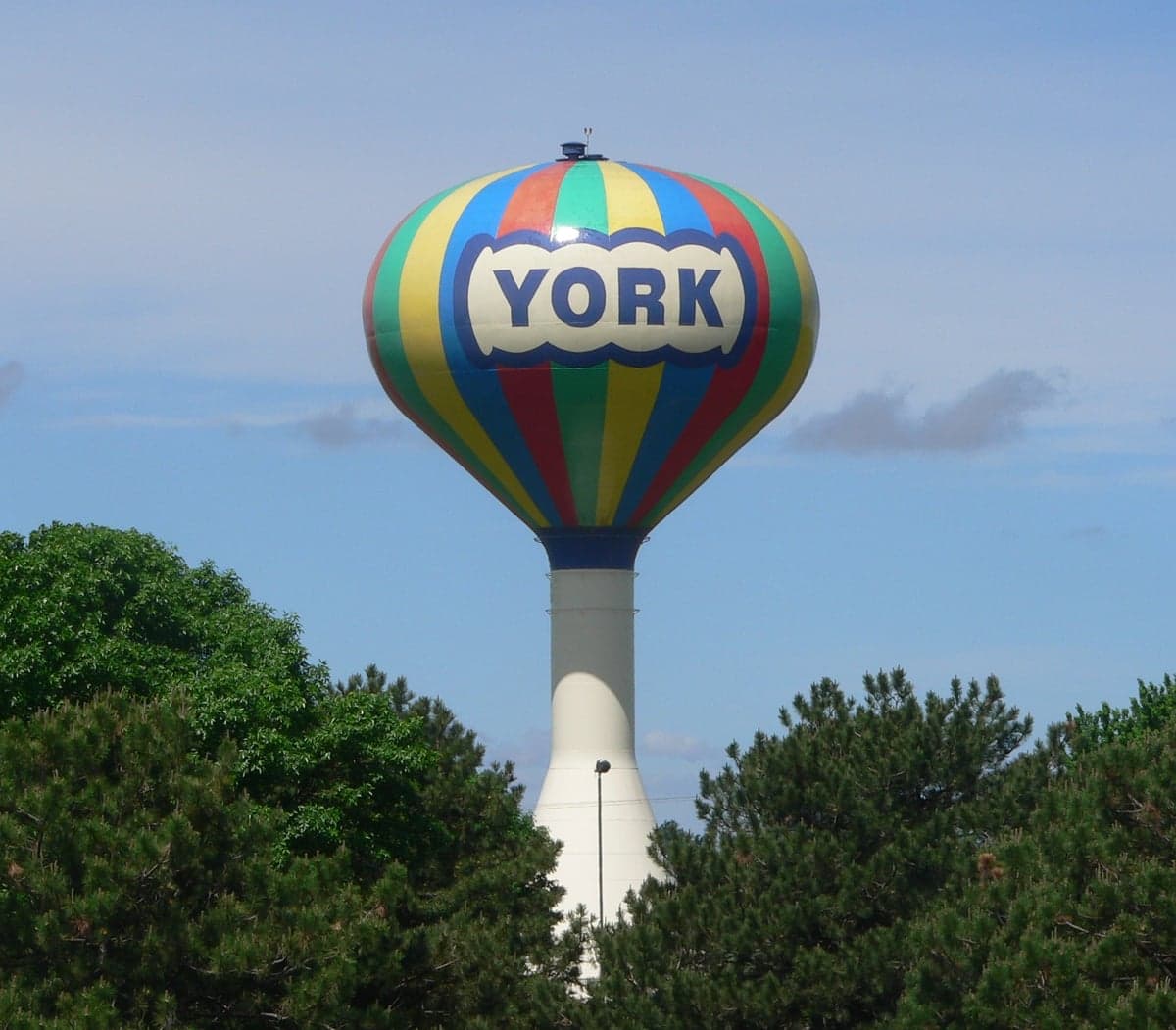
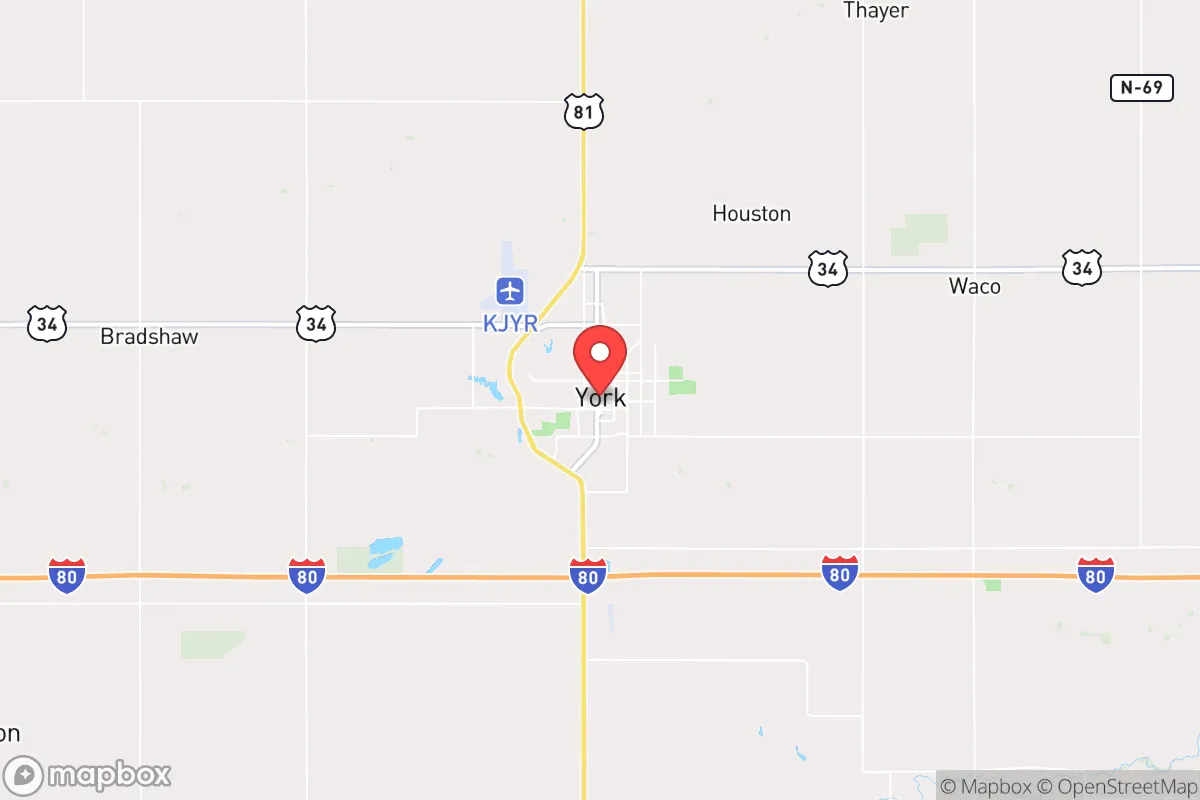
Photo: Wikipedia
Political ClimatePolitical Climate in York, NE
District shown is the primary district for this city’s centroid. Cities may span multiple districts.
Local Political AnalysisPolitical Analysis of York, NE
York, Nebraska, is about as solidly conservative as it gets in the state, with a Cook PVI of R+27 that puts it deep in the red. That number isn't just a statistic; it reflects a community that has, for generations, valued personal responsibility, limited government, and a way of life that doesn't need a bureaucrat's permission. While the surrounding areas like Lincoln (a blue island 45 minutes east) and even Grand Island (more purple, trending left) have seen their politics shift, York has held the line. The trajectory here is one of cautious vigilance—folks are proud of their independence, and they're watching closely to make sure that doesn't get chipped away.
How it compares
Drive 20 minutes north to Stromsburg or south to McCool Junction, and you'll find the same conservative values—it's a regional thing. But the real contrast is with Lincoln. In York, you don't see the same push for progressive zoning, the same kind of school board battles over curriculum, or the same pressure to adopt state-level mandates that feel like they come from D.C. or the state capitol. Compared to Omaha or even Kearney (which has a younger, more transient population from the university), York feels like a place where the old-school Nebraska ethos of "live and let live" still holds, as long as you're not asking for a handout or a new regulation. The R+27 rating isn't just a number; it's a firewall against the kind of government overreach that's creeping into other parts of the state.
What this means for residents
For someone living here, the political climate means you can generally trust that your local government isn't going to get too creative with your tax dollars or your freedoms. The city council and county board meetings aren't usually about redefining rights or imposing new fees; they're about fixing the water main and keeping the streets plowed. That's a big deal. It means less noise about mask mandates, less hand-wringing over critical race theory in the classroom, and a lot less of the "we know what's best for you" attitude that's taken hold in bigger cities. The downside? If you're hoping for a rapid shift toward more progressive policies—like expanded public transit or more social programs—you'll be waiting a long time. The community is stable, but it's also resistant to change for change's sake.
One cultural distinction worth noting: York has a strong agricultural base, and that ties directly to its politics. Landowners here are fiercely protective of property rights, and there's a deep skepticism of any federal or state program that looks like it might tie up land use or dictate how a farm or ranch should be run. You see it in the local opposition to things like the proposed carbon pipeline routes—folks don't want eminent domain used for private profit, and they don't want the government stepping in to "help" manage their land. That's the kind of issue that gets people to the polls, and it's a reminder that the R+27 isn't just about national politics; it's about a local, practical resistance to overreach. Looking ahead, the biggest concern I hear from neighbors is whether the next generation will hold the line, or if the pull of Lincoln's culture and the national media's narrative will start to erode what makes this place work. For now, York remains a place where you can still breathe easy, but you keep one eye on the horizon.

State Political ClimatePolitical Climate in Nebraska
State Political AnalysisPolitical Environment in the State
Nebraska is a reliably conservative state, but it’s not the monolith outsiders often assume. The state’s overall partisan lean is solidly Republican — Donald Trump carried it by 19 points in 2024 — but that number masks a deep and growing urban-rural split. Over the last 10-20 years, the dominant coalition has been a mix of rural conservatives and suburban moderates, but the real story is the slow, steady leftward drift of the state’s two major metro areas, Lincoln and Omaha, while the rest of the state has only gotten redder. This isn’t a purple state yet, but the fault lines are getting sharper.
Urban vs. rural divide
The political map of Nebraska is a tale of two worlds. Douglas County (Omaha) and Lancaster County (Lincoln) together hold nearly half the state’s population, and they are the only reliably blue or purple areas. Omaha’s 2nd Congressional District has become a national bellwether — it flipped to Biden in 2020 and has sent a Democrat to the House in recent cycles. Lincoln, home to the University of Nebraska, is increasingly liberal, driven by younger voters and a growing professional class. Drive 20 minutes outside either city, though, and you hit deep red territory. Sarpy County, just south of Omaha, is a classic suburban swing area that has trended right in recent cycles, voting +12 R in 2024. Out west, Scottsbluff and North Platte are rock-ribbed conservative, with Trump winning Scotts Bluff County by 40 points. The rural counties along the Platte River — Hall County (Grand Island) and Buffalo County (Kearney) — are reliably Republican but have a strong independent streak, often favoring candidates who emphasize local control over party orthodoxy. The divide isn’t just about population density; it’s about culture. Omaha’s tech and insurance sectors pull in a more diverse, college-educated workforce, while the rural economy — ag, manufacturing, and energy — remains deeply traditional.
Policy environment
Nebraska’s policy environment is a mixed bag for conservatives. On taxes, the state has made real progress: the top individual income tax rate was cut from 6.84% to 5.84% in 2024, with a path to 3.99% by 2027. Property taxes remain a sore spot — among the highest in the region — but the legislature passed LB 243 in 2023 to cap local levy growth and provide credits. The regulatory posture is generally light, especially for agriculture and manufacturing, but the state’s unicameral, nonpartisan legislature can produce unpredictable outcomes. On education, Nebraska has a robust school choice movement: LB 753 (2023) created a state-funded scholarship program for low-income students, though it was challenged by a referendum and upheld by the courts. Healthcare is a flashpoint: the state expanded Medicaid under the Affordable Care Act via a 2018 ballot initiative, which many conservatives opposed, but the program has been administered without major scandal. Election laws are solid — voter ID was passed in 2023 (LB 514), and Nebraska has no same-day registration, which keeps the system clean. The state also allocates its Electoral College votes by congressional district, a unique feature that gives Omaha’s 2nd District outsized national influence.
Trajectory & freedom
On the freedom front, Nebraska has been a mixed bag — some wins, some worrying trends. The good: constitutional carry became law in 2023 (LB 77), allowing permitless concealed carry for anyone 21 or older. That was a major victory for Second Amendment advocates. Parental rights got a boost with LB 1084 (2023), which requires schools to notify parents of any changes to a student’s health or well-being — a direct response to the transgender activism that has swept other states. On the concerning side, the state’s COVID-era emergency powers were used aggressively by Governor Pete Ricketts, including a 2020 order that limited church gatherings and forced business closures. That overreach sparked a backlash, leading to LB 391 (2022), which curbed the governor’s ability to issue blanket emergency orders without legislative approval. Medical freedom took a hit with the state’s strict vaccine mandate for healthcare workers, which was never fully repealed. Property rights are generally strong, but the state’s Nebraska Public Power District has eminent domain authority for transmission lines, which has caused friction with rural landowners. The trajectory is cautiously positive — the legislature has been trending more conservative on social issues, but the urban influence in Lincoln keeps the door open for future encroachments.
Civil unrest & political movements
Nebraska is not a hotbed of civil unrest, but there have been flashpoints. The 2020 George Floyd protests in Omaha turned violent, with looting and fires in the Old Market district, leading to a heavy National Guard presence. That event galvanized a strong law-and-order response in the suburbs — Papillion and La Vista saw a surge in conservative activism. On the right, the Nebraska Republican Party has been split between establishment and populist factions, with the latter gaining ground after the 2022 primary. Immigration politics are relatively quiet — Nebraska is not a border state, but there have been localized tensions in Grand Island and South Sioux City, where meatpacking plants have drawn a significant Hispanic workforce. There is no sanctuary city policy anywhere in the state; in fact, LB 403 (2023) banned local governments from adopting such policies. Election integrity has been a minor issue — the 2020 election in Nebraska was smooth, but the state’s unique electoral college system has drawn national scrutiny, with Democrats pushing to eliminate it. No serious secession or nullification rhetoric exists, but there is a strong strain of local control sentiment, especially in rural counties that feel ignored by Lincoln and Omaha.
Projection
Over the next 5-10 years, Nebraska is likely to remain a Republican-leaning state, but the margin will narrow. The key demographic shift is the continued growth of Omaha’s 2nd District, which is attracting young professionals from blue states who are drawn to lower taxes but bring more liberal social views. Lincoln will keep trending left as the university expands. Meanwhile, the rural counties are aging and losing population, which will slowly erode the Republican base. The wild card is in-migration from California and Colorado — places like Kearney and Fremont are seeing an influx of remote workers and retirees who want a lower cost of living but may not share the local cultural values. The legislature will likely stay Republican, but the margin could shrink to a single seat or two, making the nonpartisan structure even more unpredictable. Expect continued fights over property tax relief, school funding, and the scope of emergency powers. The state’s conservative trajectory on guns and parental rights is likely to hold, but the urban centers will keep pushing for progressive policies on climate, diversity, and social issues.
For a new resident, the bottom line is this: Nebraska offers a high degree of personal freedom on most fronts — low taxes, strong gun rights, and a government that mostly stays out of your life — but you need to be strategic about where you land. If you want a reliably conservative environment, stick to the suburbs of Omaha like Elkhorn or the smaller cities like Columbus and Norfolk. If you move to Lincoln or downtown Omaha, expect to be in a blue bubble where your values will be increasingly out of step with your neighbors. The state is still a good bet for freedom-minded people, but the urban-rural divide means you have to choose your community carefully. The next decade will test whether Nebraska can hold the line or slowly drift toward the progressive model of its coastal neighbors.
* Values derived from national, state, county, city and local statistics and may differ in a specific area. Last updated: 2026-04-19T08:31:08.000Z
Narrative content on this page is AI-generated and may contain mistakes. Verify any details that matter before acting on them.
ReloMaps may earn a commission from affiliate links at no extra cost to you.

