
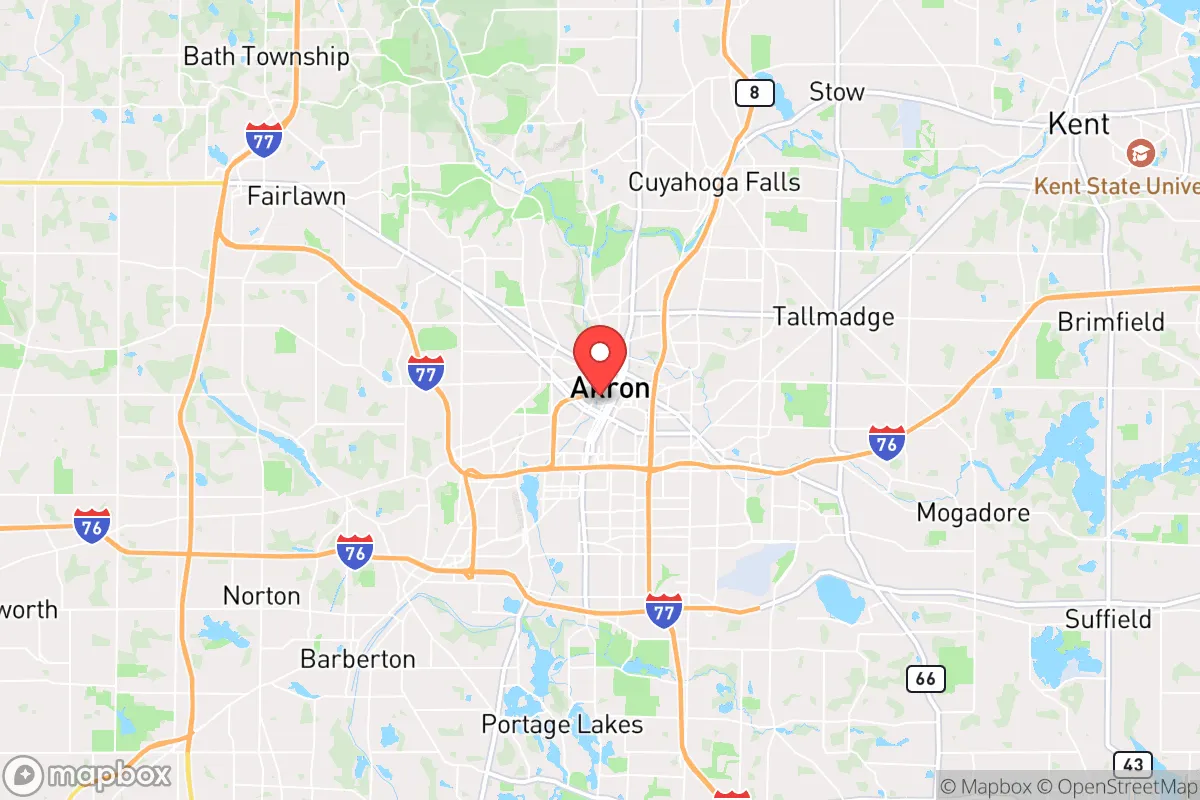
Photo: Wikipedia
Political ClimatePolitical Climate in Akron, OH
District shown is the primary district for this city’s centroid. Cities may span multiple districts.
Local Political AnalysisPolitical Analysis of Akron, OH
Akron’s political climate has shifted noticeably over the past decade, and if you’ve lived here as long as I have, you’ve felt it. The city itself leans left, but the Cook PVI rating of EVEN tells you it’s a true battleground—a place where the old-school, blue-collar, union Democrat roots are clashing hard with the newer, more progressive wave. The surrounding Summit County has been trending bluer, but drive just 15 minutes south to Green or Uniontown, and you’re in solidly red territory. The real story isn’t just the voting numbers; it’s the growing sense that local government is getting too comfortable telling people how to live their lives, and that’s something a lot of us here are watching closely.
How it compares
Akron sits in a political no-man’s-land compared to its neighbors. Head north to Cleveland or east to Youngstown, and you’re in deep blue counties where progressive policies are the norm. But go west to Medina or south to Stark County (Canton), and you’ll find communities that still value limited government and personal responsibility. The contrast is stark: in Akron, you’ve got city council pushing things like “equity” ordinances and zoning changes that feel more about social engineering than practical governance. Meanwhile, just a few miles away in Bath or Fairlawn, the local debates are still about property taxes and road repairs. That EVEN rating means Akron is a political prize, but it also means the folks in charge here are constantly trying to pull the city further left, often at the expense of the common-sense values that built this town.
What this means for residents
For the average person living in Akron, the political drift has real consequences. You’re seeing more city mandates on everything from business licensing to housing regulations—rules that sound good on paper but end up making it harder for small shops and landlords to operate without a lawyer on speed dial. The push for “inclusive” policies often comes with a heavier tax burden and more red tape, and that’s a red flag for anyone who values the freedom to run their own life. Property taxes have crept up, and there’s a growing sense that the city’s priorities are shifting away from basic services—like keeping the streets plowed and the cops funded—toward social programs that don’t always deliver results. If you’re a conservative here, you feel like you’re constantly fighting a rear-guard action against a city hall that thinks it knows better than you do.
One thing that still sets Akron apart is its stubborn, working-class identity. For all the progressive noise, there’s a deep streak of “leave me alone” independence here, especially among the older generation and the folks who still work in the rubber and manufacturing plants. You don’t see the same level of aggressive government overreach as in places like Columbus or Cincinnati. The local school board and city council still have to answer to voters who remember when Akron was a place where you could buy a house on a single income. That’s fading, but it’s not gone. The long-term worry is that if the progressive tide keeps rising, we’ll lose that character entirely—and with it, the personal freedoms that make living here worth it. For now, it’s a fight worth having, but you’ve got to keep your eyes open.

State Political ClimatePolitical Climate in Ohio
State Political AnalysisPolitical Environment in the State
Ohio has long been the quintessential swing state, but over the past decade it has shifted decisively to the right, voting for Donald Trump by 8 points in both 2016 and 2020 and by a similar margin in 2024. The state’s political center of gravity is now solidly Republican at the state level, with a GOP supermajority in the legislature and a Republican governor, but the coalition is fracturing along urban-rural lines and a growing populist vs. establishment divide. For a conservative considering relocation, Ohio offers a mixed bag: low taxes and strong gun rights, but also a recent history of ballot-box activism on issues like marijuana and abortion that can feel like whiplash.
Urban vs. rural divide
The political map of Ohio is a textbook case of the urban-rural chasm. The three C’s — Cleveland, Columbus, and Cincinnati — are deep blue islands in a sea of red. Cuyahoga County (Cleveland) delivered 66% for Biden in 2020, while Franklin County (Columbus) hit 62%. Hamilton County (Cincinnati) is more competitive, flipping to Biden by 5 points after going for Trump in 2016, but the suburbs like West Chester and Mason are trending redder. Meanwhile, the rural and exurban counties are blood red: Mercer County in the west gave Trump 80%, and Holmes County (home to the Amish) hit 82%. The real story is the Mahoning Valley (Youngstown area) and Belmont County (eastern Ohio), which were reliably blue for decades thanks to union steelworkers and coal miners, but flipped hard to Trump in 2016 and stayed there. The I-71 corridor from Cincinnati to Cleveland is the political fault line: the suburbs of Delaware County (north of Columbus) are now reliably red, while Licking County (east of Columbus) is trending that way too. If you’re a conservative looking for like-minded neighbors, the exurbs of Columbus, the Cincinnati suburbs, and most of the state outside the urban cores are your sweet spot.
Policy environment
Ohio’s policy environment is a conservative’s dream in many respects, but with some notable exceptions. The state income tax was cut from a top rate of nearly 5% to a flat 3.5% under Governor Mike DeWine, and property taxes are moderate (average effective rate around 1.5%). There is no estate tax. The regulatory posture is business-friendly, with right-to-work laws not on the books (unions remain strong in manufacturing) but tort reform has capped lawsuit damages. On education, Ohio has a robust school choice program: the EdChoice voucher system allows families in underperforming districts to use state funds for private or parochial schools, and there are no income caps for eligibility. Parents can also homeschool with minimal oversight. Healthcare is a mixed bag: Medicaid expansion was accepted under Kasich, but the state has not imposed a state-level individual mandate. Election laws are moderately restrictive: voter ID is required (a photo ID or a utility bill), and early voting runs 28 days, but no-excuse absentee voting is allowed. The legislature passed a law in 2023 limiting ballot drop boxes to one per county, which conservatives see as a security measure. The biggest red flag for a liberty-minded conservative is the state’s handling of the 2023 Issue 1 and Issue 2: voters approved a constitutional amendment for abortion rights (Issue 1) and legalized recreational marijuana (Issue 2) via ballot initiative, overriding the GOP legislature. This shows that direct democracy can override conservative policy, which is a concern for those who value legislative control.
Trajectory & freedom
On the freedom front, Ohio is a tale of two trends. On the positive side for conservatives, the state passed constitutional carry in 2022 (HB 227), allowing permitless concealed carry for adults 21 and older. The Stand Your Ground law was already in place. Parental rights were strengthened with the Parents’ Bill of Rights (HB 8) in 2023, requiring schools to notify parents of any medical or mental health services offered to their child and banning instruction on sexual orientation in grades K-3. The state also passed a law banning transgender athletes from female sports (HB 151) in 2023. On the negative side, the state imposed a six-week abortion ban (SB 23) in 2019, which was in effect for a few months before being blocked by a court challenge, and then voters overturned it via Issue 1 in 2023. The marijuana legalization via Issue 2 also went against the legislature’s wishes. Property rights are generally strong, but the state has seen some eminent domain battles in the Utica Shale oil and gas region. The biggest concern for freedom-minded folks is the ballot initiative process itself: it’s too easy for out-of-state money to fund campaigns that override the legislature. A 2024 proposal to raise the threshold for constitutional amendments to 60% (Issue 1) was defeated by voters, meaning the current simple-majority standard remains. This makes Ohio’s constitution a bit of a moving target.
Civil unrest & political movements
Ohio has seen its share of political flashpoints. The 2020 protests in Columbus and Cleveland over George Floyd’s death were large but mostly peaceful, though there were some instances of looting and property damage. The 2023 train derailment in East Palestine (Columbiana County) became a national political flashpoint, with residents furious at both the railroad company and the federal response, fueling populist anger on both sides. The immigration debate is less intense than in border states, but the Springfield area (Clark County) has seen a surge of Haitian immigrants in recent years, leading to local tensions and a 2024 city council resolution declaring the city a “non-sanctuary” jurisdiction. Election integrity has been a hot topic: the 2020 election in Ohio was widely seen as secure (no major fraud allegations), but the legislature passed a law in 2023 requiring all ballots to be counted by hand in some counties, a move that has been controversial. The Ohio Republican Party itself is split between the establishment wing (DeWine, Senate President Matt Huffman) and the populist wing (Secretary of State Frank LaRose, some county parties). You’ll see this play out in primary elections, especially in the Butler County area (Cincinnati exurbs), where the populist faction is strongest. For a new resident, the most visible sign of political activism is the proliferation of yard signs and billboards for local candidates, especially in the spring primary season.
Projection
Over the next 5-10 years, Ohio is likely to become more Republican at the state level, but with a growing populist vs. establishment tension. The in-migration pattern is favorable: people are moving from blue states like California and Illinois to the Columbus and Cincinnati suburbs, and they tend to be moderate to conservative. The Columbus metro is growing fast (Delaware County is one of the fastest-growing in the Midwest), and these new arrivals are often families looking for lower taxes and better schools. The rural areas will continue to bleed population, but the exurbs will absorb it. The biggest wildcard is the ballot initiative process: if progressives continue to use it to pass abortion rights and marijuana legalization, conservatives may push for a higher threshold again, leading to a constitutional battle. The 2026 gubernatorial race will be a key test: if a populist Republican wins the primary, expect more aggressive action on school choice, gun rights, and election security. If a moderate like DeWine’s lieutenant governor wins, the status quo continues. For a conservative moving in now, expect the state to remain a red-leaning purple state for the next decade, but with the possibility of a more solidly red legislature if the ballot initiative issue is resolved.
Bottom line for a new resident: Ohio is a solid choice for a conservative family or individual who values low taxes, strong gun rights, and school choice, but be prepared for the occasional progressive ballot initiative that can override the legislature. The best places to land are the exurbs of Columbus (Delaware, Licking, Union counties) or the Cincinnati suburbs (Butler, Warren counties), where the political culture is reliably red and the schools are good. Avoid the urban cores of Cleveland, Columbus, and Cincinnati if you want to avoid the blue bubble. The state is trending in the right direction on most fronts, but keep an eye on the ballot box — it’s the one place where the left can still win in Ohio.
* Values derived from national, state, county, city and local statistics and may differ in a specific area. Last updated: 2026-04-21T19:21:18.000Z
Narrative content on this page is AI-generated and may contain mistakes. Verify any details that matter before acting on them.
ReloMaps may earn a commission from affiliate links at no extra cost to you.

