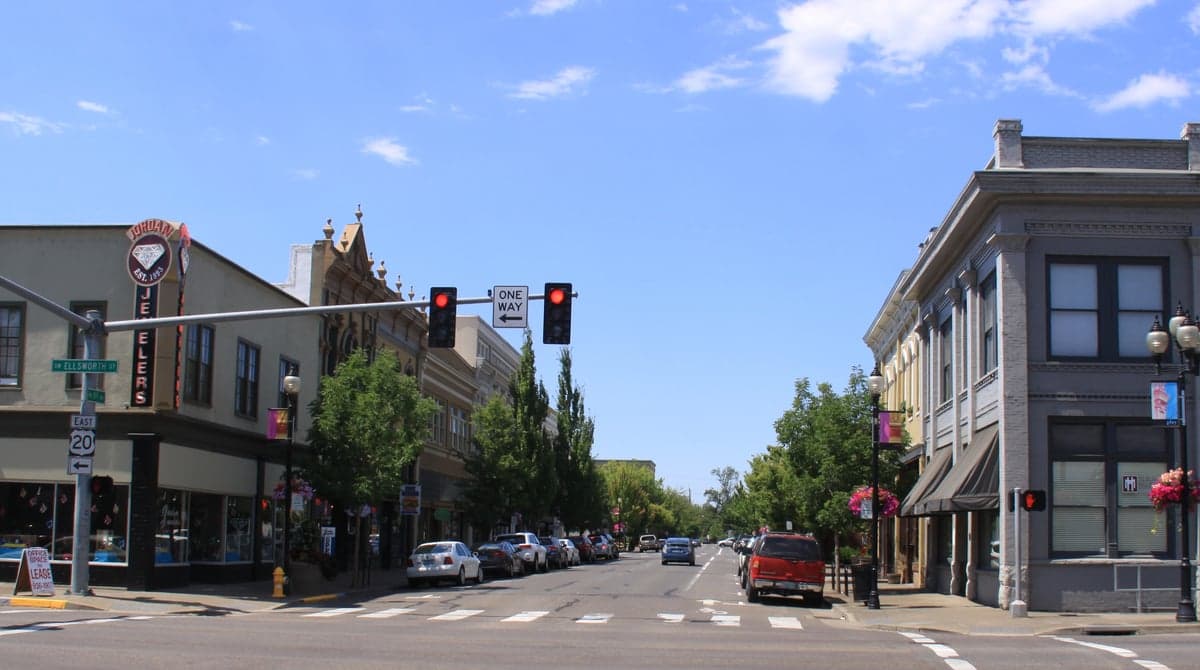
Photo: Wikipedia
Personal Sovereignty in Albany, OR
Viable for self-reliance. Generally workable, though some barriers may limit total independence.
What does Personal Sovereignty tell us?
Personal Sovereignty measures your capacity for self-reliance and independence with minimal government friction. Higher scores mean fewer barriers between you and the way you want to live... but it assumes you have the space you need and good neighbors.
What does this tell us?
Personal Sovereignty measures your capacity for self-reliance and independence with minimal government friction. Higher scores mean fewer barriers between you and the way you want to live... but it assumes you have the space you need and good neighbors.
State Policy
Energy independence: Importer (35% of energy produced in-state)
Personal Liberty
Homesteading

Personal Liberty Analysis
Albany, Oregon, offers a mixed bag for those prioritizing personal sovereignty, sitting in a state that increasingly tests the limits of individual autonomy. While the city itself is more politically moderate than Portland or Eugene, it remains subject to Oregon’s statewide regulatory environment, which can feel restrictive to those with a survivalist or prepper mindset. For single individuals and parents seeking to maximize self-reliance, Albany provides a relatively affordable base with access to land and resources, but the legal framework requires careful navigation to avoid government overreach into daily life.
Tax burden and regulatory posture in Albany and Linn County
Oregon’s tax structure is a significant consideration for anyone valuing financial sovereignty. The state imposes a progressive income tax with rates reaching 9.9% on high earners, and there is no sales tax, which can be a double-edged sword. For a single individual or family, this means every dollar earned is subject to state oversight, and property taxes in Linn County average around 1.1% of assessed value, which is moderate compared to the national average but still a recurring burden. Albany itself has not adopted local income taxes, keeping the city’s bite limited to property and utility fees. However, Oregon’s land use laws, particularly Senate Bill 100, heavily restrict what you can do on your own land, especially in unincorporated areas. This regulatory posture limits the ability to build additional structures, run a home business, or alter property without county approval—a direct constraint on personal autonomy that preppers and homesteaders must factor into their plans.
Self-defense and gun law specifics in Albany and Oregon
For those concerned with self-defense and the right to bear arms, Oregon presents a challenging landscape. While Albany itself is not a sanctuary city for gun rights, the state has enacted Measure 114, which requires a permit to purchase any firearm, a background check for every transfer, and bans magazines over ten rounds. As of 2026, the law is partially in effect after legal challenges, but the trend is clear: the state government is actively restricting access to firearms. Open carry is legal without a permit, but concealed carry requires a license issued by the county sheriff, and Linn County is generally more permissive than urban counties. For parents, this means teaching firearm safety and self-reliance is possible, but the legal hurdles to acquiring and storing weapons are higher than in states like Idaho or Texas. The Castle Doctrine in Oregon is not a true stand-your-ground law; you have a duty to retreat if possible before using deadly force, even in your home, which undermines the principle of personal sovereignty in defending your family.
Self-reliance and homesteading viability in Albany’s zoning and land use
Albany’s zoning and lot sizes offer some opportunities for self-reliance, but with significant caveats. Within city limits, standard residential lots range from 6,000 to 10,000 square feet, which allows for substantial vegetable gardens, small orchards, and even backyard chickens (up to six hens, no roosters, per city code). However, keeping larger livestock like goats or pigs is prohibited within city limits, pushing homesteaders to unincorporated Linn County. There, minimum lot sizes for agricultural zoning are typically 5 to 10 acres, and the county is more lenient with outbuildings and accessory dwelling units. Off-grid feasibility is limited by Oregon’s building codes; you cannot legally live in a tiny home or RV on your land without a permitted dwelling, and rainwater collection is restricted to 5,000 gallons of storage without a permit. Solar panels are allowed but must comply with local utility interconnection rules, which can be bureaucratic. For a prepper, the best bet is to buy land outside Albany’s urban growth boundary, but even then, state land use laws prevent the kind of unrestricted self-sufficiency found in less regulated states.
Personal liberties in Albany: parental rights, medical autonomy, speech, and property
Parental rights in Oregon are under increasing pressure, which is a major concern for conservative families. The state has mandated comprehensive sex education in public schools starting in kindergarten, and parents cannot opt their children out of all lessons—only specific portions. Medical autonomy is similarly constrained; Oregon has no parental consent requirement for minors to receive reproductive health services, including contraception and abortion, without notifying parents. This directly undermines a parent’s authority over their child’s healthcare decisions. Free speech is protected under the First Amendment, but Oregon’s public accommodation laws have been used to compel speech in commercial contexts, such as requiring bakers to create cakes for same-sex weddings, which some view as a violation of religious liberty. Property rights are the most eroded area; Oregon’s land use system treats property as a privilege, not a right, and the state can restrict development, logging, or even landscaping on your own land without compensation. For a survivalist, this means your ability to fortify your home, store supplies, or build a bunker is subject to permit approval and neighbor complaints.
Overall, Albany offers a relatively moderate environment within a state that is actively centralizing control over personal decisions. Compared to Portland, you have more breathing room for self-reliance, but compared to Idaho or Montana, you face significant legal barriers to true sovereignty. For single individuals and parents who value autonomy, Albany can work if you are willing to navigate the regulatory maze and accept that some freedoms—like unrestricted gun ownership, off-grid living, and parental control over education—are compromised. The city’s affordability and access to natural resources make it a viable base for those who prioritize community and preparedness, but it is not a haven for those seeking to live entirely outside government oversight. If the trend toward state overreach continues, Albany may become a place to pass through rather than dig in.

* Values derived from national, state, county, city and local statistics and may differ in a specific area. Last updated: 2026-05-01T03:30:14.000Z
Narrative content on this page is AI-generated and may contain mistakes. Verify any details that matter before acting on them.
ReloMaps may earn a commission from affiliate links at no extra cost to you.

