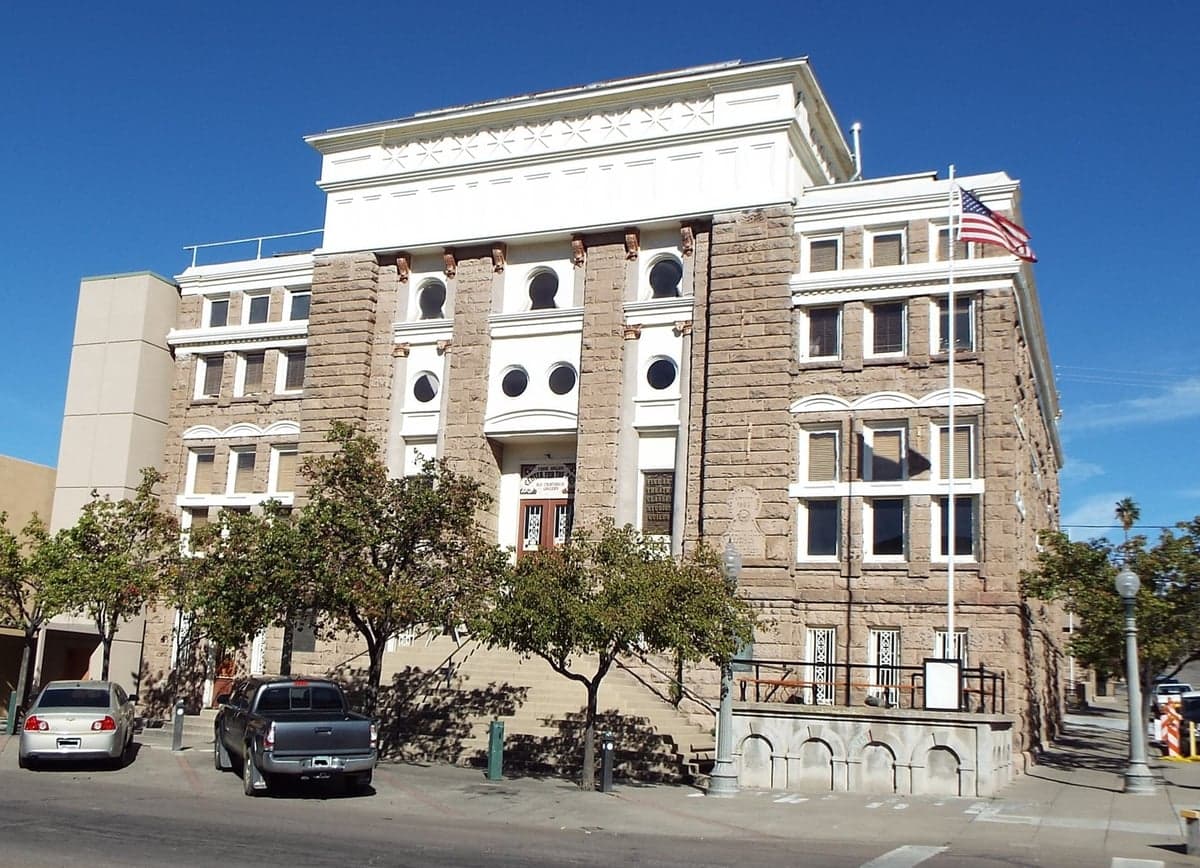
Photo: Wikipedia
Personal Sovereignty in Gila County
Strong independent fundamentals that actively favor personal liberty and low regulation.
What does Personal Sovereignty tell us?
Personal Sovereignty measures your capacity for self-reliance and independence with minimal government friction. Higher scores mean fewer barriers between you and the way you want to live... but it assumes you have the space you need and good neighbors.
What does this tell us?
Personal Sovereignty measures your capacity for self-reliance and independence with minimal government friction. Higher scores mean fewer barriers between you and the way you want to live... but it assumes you have the space you need and good neighbors.
State Policy
Energy independence: Importer (20% of energy produced in-state)
Personal Liberty
Homesteading

Personal Liberty Analysis
Gila County, Arizona, offers one of the strongest environments for personal sovereignty in the Southwest, largely because its rugged geography and low population density have historically kept government overreach at arm’s length. Unlike the increasingly regulated urban corridors of Phoenix or Tucson, this county operates with a live-and-let-live ethos that appeals to those who value self-reliance, gun rights, and minimal interference in daily life. For single individuals and parents alike, the key trade-off is clear: you gain substantial freedom from state and county bureaucracy, but you also accept that basic services—law enforcement, emergency response, and infrastructure—are thinner on the ground. This is not a place for those who expect government to solve problems; it is a place for those who want to solve their own.
Tax burden and regulatory posture in Gila County compared to metro Arizona
Arizona’s state-level tax climate is already favorable—flat income tax at 2.5% and no tax on Social Security benefits—but Gila County takes the regulatory posture a step further. The county’s sales tax rate sits at 8.35% in unincorporated areas, slightly lower than the 8.6% in Globe or 8.7% in Payson, but the real advantage is the absence of the kind of overlay zoning and permitting delays that plague Maricopa County. Property taxes are among the lowest in the state, with an effective rate around 0.6% of assessed value, meaning a $250,000 home carries an annual tax bill of roughly $1,500. More importantly, the county’s planning and zoning department is known for a hands-off approach: building permits for owner-built structures are straightforward, and there is no county-wide building code enforcement outside incorporated towns. For a prepper or survivalist, this means you can erect a workshop, install a rainwater catchment system, or build a detached garage without months of red tape. The towns of Young and Pleasant Valley are particularly known for minimal county interference, while Payson has slightly more municipal oversight but still far less than any Phoenix suburb.
Self-defense and gun law specifics in Gila County’s rural culture
Arizona is a constitutional carry state, meaning no permit is required to carry a concealed firearm for anyone 21 or older who can legally possess a gun. Gila County’s sheriff’s office, led by Sheriff J. Adam Shepherd as of 2026, has a well-documented pro-Second Amendment stance and has publicly stated that deputies will not enforce federal firearm regulations they deem unconstitutional. This is not theoretical—the county was an early adopter of Second Amendment Sanctuary status in 2021, and the local culture reflects that. In Globe and Miami, open carry is common, and gun stores like Globe Gun & Pawn report steady business from locals who view firearms as everyday tools, not political statements. For parents, the practical implication is that firearm safety education is normalized; many rural families teach children gun handling from a young age, and there is no stigma around having a rifle rack in a pickup truck. Stand-your-ground laws apply statewide, but in Gila County, the legal and social environment means you are unlikely to face prosecution for a defensive shooting that is clearly justified. The nearest major gun ranges are the Tonto National Forest public lands, where target shooting is legal on most BLM and Forest Service land, provided you follow basic fire safety rules.
Self-reliance and homesteading viability: lot sizes, zoning, and off-grid feasibility
Gila County is one of the best places in Arizona for off-grid living, largely because the county does not require a minimum square footage for dwellings and has no county-wide ban on alternative energy systems. Lot sizes vary dramatically: in unincorporated areas near Pine and Strawberry, you can find parcels as small as one acre zoned for single-family use, while deeper into the Sierra Ancha region, 40-acre tracts are common and often sold without any utility hookups. The county allows composting toilets, greywater systems, and solar panels without special permits, as long as they meet basic health department standards for septic. Rainwater harvesting is legal and encouraged, with no permit required for systems under 10,000 gallons. The biggest practical challenge is water access—many rural properties rely on wells that can cost $15,000–$30,000 to drill, and groundwater rights are not guaranteed in all areas. Young and Pleasant Valley have the loosest zoning, with no building permits required for structures under 200 square feet, making them ideal for a phased homestead build. Payson has stricter rules—minimum lot sizes of 6,000 square feet in town and a requirement for engineered septic systems—but even there, you can keep chickens, goats, and up to two horses on a standard residential lot. For those serious about food independence, the growing season at 5,000 feet elevation runs from May to October, suitable for cold-hardy crops like potatoes, kale, and apples.
Personal liberties: parental rights, medical autonomy, speech, and property
Gila County’s political culture leans heavily toward individual liberty, and this manifests in several specific areas. Parental rights are strongly protected: the county’s school boards, particularly in Payson Unified School District and Globe Unified School District, have resisted curriculum mandates from the state level, and parents have broad latitude to opt children out of any instruction they find objectionable. Medical autonomy is another area where the county stands apart—there is no county-level mask or vaccine mandate on the books, and the local health department has a reputation for issuing guidance rather than orders. During the 2020–2021 period, Gila County had one of the lowest compliance rates with state health directives in Arizona, and that sentiment has solidified into policy. Property rights are similarly robust: the county has no rent control, no short-term rental bans (though Payson has a 90-day minimum for vacation rentals in residential zones), and no county-wide noise ordinances that would restrict shooting on private land. Free speech is protected by the same First Amendment that applies everywhere, but the social environment in places like Miami and Globe means you can voice opinions on government overreach, immigration, or economic collapse without fear of social ostracism—these are common topics of conversation at local diners and hardware stores.
Overall, Gila County ranks among the top 10% of U.S. counties for personal sovereignty, according to metrics from the Property Rights Alliance and the Cato Institute’s Freedom in the 50 States index. It offers a rare combination of low taxes, minimal zoning, strong gun culture, and a population that values self-reliance over government dependency. The trade-offs are real—limited healthcare access, long drives to major shopping, and a wildfire risk that demands personal preparedness—but for those who view those as acceptable costs of freedom, Gila County is a strategic relocation destination that outperforms most of the Mountain West. If you are comparing it to neighboring counties like Navajo or Coconino, Gila’s advantage is its consistent, county-wide commitment to letting people live as they see fit, without the patchwork of municipal restrictions that fragment freedom elsewhere.

* Values derived from national, state, county, city and local statistics and may differ in a specific area. Last updated: 2026-05-27T20:49:15.000Z
Narrative content on this page is AI-generated and may contain mistakes. Verify any details that matter before acting on them.
ReloMaps may earn a commission from affiliate links at no extra cost to you.

