
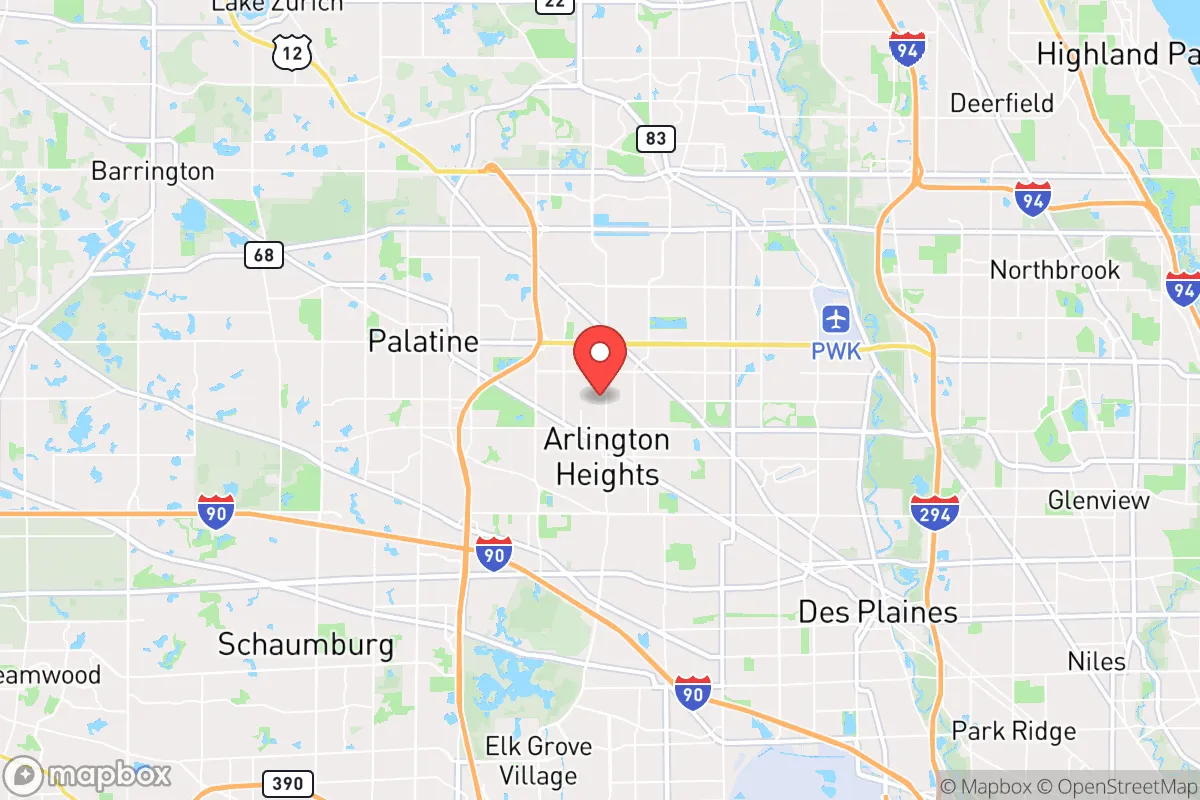
Photo: Wikipedia
Personal Sovereignty in Arlington Heights, IL
Viable for self-reliance. Generally workable, though some barriers may limit total independence.
What does Personal Sovereignty tell us?
Personal Sovereignty measures your capacity for self-reliance and independence with minimal government friction. Higher scores mean fewer barriers between you and the way you want to live... but it assumes you have the space you need and good neighbors.
What does this tell us?
Personal Sovereignty measures your capacity for self-reliance and independence with minimal government friction. Higher scores mean fewer barriers between you and the way you want to live... but it assumes you have the space you need and good neighbors.
State Policy
Energy independence: Importer (45% of energy produced in-state)
Personal Liberty
Homesteading

Personal Liberty Analysis
For a conservative-leaning individual or family prioritizing personal sovereignty, Arlington Heights, Illinois, presents a complex and often contradictory environment. While the village itself maintains a relatively orderly, low-crime atmosphere with strong property rights enforcement, it operates entirely under the thumb of Cook County and the State of Illinois—two jurisdictions that consistently rank among the most restrictive in the nation on gun rights, tax burdens, and parental autonomy. The net effect is a place where day-to-day life feels safe and stable, but where your legal latitude to prepare, defend, and provide for your own is significantly narrower than in a red state or even a downstate Illinois county. You are trading a high degree of local convenience and community stability for a substantial loss of personal sovereignty at the state and county level.
Tax burden and regulatory posture: how much of your income and property stays yours
Arlington Heights sits in Cook County, which imposes some of the highest property tax rates in the entire United States. The effective property tax rate in the village typically ranges from 2.0% to 2.5% of assessed value, meaning a $400,000 home carries an annual tax bill of $8,000 to $10,000. This is not a one-time shock; it is a permanent, escalating lien on your equity, driven by generous public-sector pensions and overlapping layers of government—village, township, school district, park district, and library district. The state income tax is a flat 4.95%, and while not progressive, it adds to the overall burden. Regulatory posture is similarly heavy: building permits, zoning variances, and business licenses require multiple approvals and fees. For a prepper or self-reliant individual, this means every modification to your property—from a shed to a solar array to a chicken coop—must pass through a bureaucratic sieve. The state's regulatory climate is generally hostile to small-scale independence; for example, Illinois has strict cottage food laws that limit what you can sell from home without a commercial kitchen. The bottom line: you will keep less of what you earn, and you will need permission for more of what you build.
Self-defense and gun law specifics: what you can own, carry, and where
This is the single biggest sovereignty trade-off in Arlington Heights. Illinois is a "may-issue" state for concealed carry, but in practice, Cook County is far more restrictive than the rest of Illinois. While the state now has a concealed carry law (Firearm Concealed Carry Act), the process is expensive, time-consuming, and requires a 16-hour training course plus a $150 application fee. More critically, Arlington Heights itself bans the possession of assault weapons and large-capacity magazines under a local ordinance passed in 2018, and Cook County has its own AWB. This means you cannot legally own an AR-15 or similar rifle in your own home within village limits. The state also has a universal background check law and a 72-hour waiting period for handgun purchases. Magazine capacity is capped at 10 rounds for long guns and 15 for handguns under state law. For a survivalist mindset, this is a severe limitation: your defensive capabilities are legally restricted to handguns and shotguns with limited capacity. Furthermore, Illinois does not recognize any other state's concealed carry permit, so if you travel, you must comply with Illinois law at all times while in state. The regulatory environment is actively hostile to the idea that you are the first line of your own defense.
Self-reliance and homesteading viability: lot sizes, zoning, and off-grid feasibility
Arlington Heights is a dense, established suburb with typical lot sizes ranging from 0.15 to 0.25 acres in older neighborhoods, though some larger lots exist near the golf courses and in the northern sections. Zoning is strictly residential, with most lots zoned R-1 or R-2, which prohibits agricultural uses. You cannot legally keep chickens, goats, or bees on a standard residential lot without a special permit, and even then, the village has strict noise and nuisance ordinances. Off-grid living is effectively impossible within village limits. The village requires connection to municipal water and sewer; solar panels are allowed but must be installed by licensed contractors and meet building code requirements, and you cannot disconnect from the grid. Rainwater collection is not explicitly banned but is heavily regulated under state water rights law. For a prepper looking to establish a self-sufficient homestead, Arlington Heights is the wrong environment. You would need to look to unincorporated Cook County or, better yet, a county like McHenry or DeKalb to find the acreage and zoning flexibility for serious self-reliance. The village's density and regulatory structure are designed for a commuter lifestyle, not for independence.
Personal liberties: parental rights, medical autonomy, speech, and property
Illinois has some of the strongest state-level protections for parental rights in the context of education, but the reality is more nuanced. The state's Parental Notice of Abortion Act requires parental notification for minors, but Illinois also has a "shield law" that protects providers and patients from out-of-state legal actions, which some conservatives view as federal overreach. On medical autonomy, Illinois mandates that health insurance cover contraception and abortion, and it has a state-run health insurance exchange that operates independently of federal changes. For a parent concerned about medical mandates, Illinois did have a COVID-19 vaccine mandate for healthcare workers and school staff, though it has since been lifted. On speech, Illinois has an anti-SLAPP law that protects citizens from frivolous lawsuits intended to silence criticism, but it also has a strict hate crimes statute that some argue chills certain types of political speech. Property rights are the strongest area: Illinois has a robust eminent domain law that requires just compensation, and Cook County's property tax appeal process, while cumbersome, is functional. However, the state's rent control preemption prevents local governments from imposing rent control, which protects landlords but not tenants. For a conservative parent, the biggest concern is likely the state's education policy: Illinois has a comprehensive sex education mandate that includes LGBTQ+ content, and parents cannot opt their children out of specific lessons, only the entire curriculum. This is a direct infringement on parental sovereignty that many find unacceptable.
In the final analysis, Arlington Heights offers a high baseline of safety, community order, and property value stability, but it does so at the cost of significant personal sovereignty. Compared to a place like Texas or Florida, you will have less control over your tax burden, your defensive capabilities, your ability to live off-grid, and your children's education. Compared to other Cook County suburbs, it is about average—not the worst, but far from the best. For a survivalist or prepper, the village is a place to live well within the system, not to build a life outside of it. If your priority is maximum personal autonomy, you would be better served by a rural county in a red state. If your priority is a stable, well-run community with good schools and low crime, and you are willing to accept the trade-offs, Arlington Heights can work—but only if you are prepared to navigate a regulatory environment that views your independence as something to be managed, not encouraged.

* Values derived from national, state, county, city and local statistics and may differ in a specific area. Last updated: 2026-04-24T16:44:11.000Z
Narrative content on this page is AI-generated and may contain mistakes. Verify any details that matter before acting on them.
ReloMaps may earn a commission from affiliate links at no extra cost to you.

