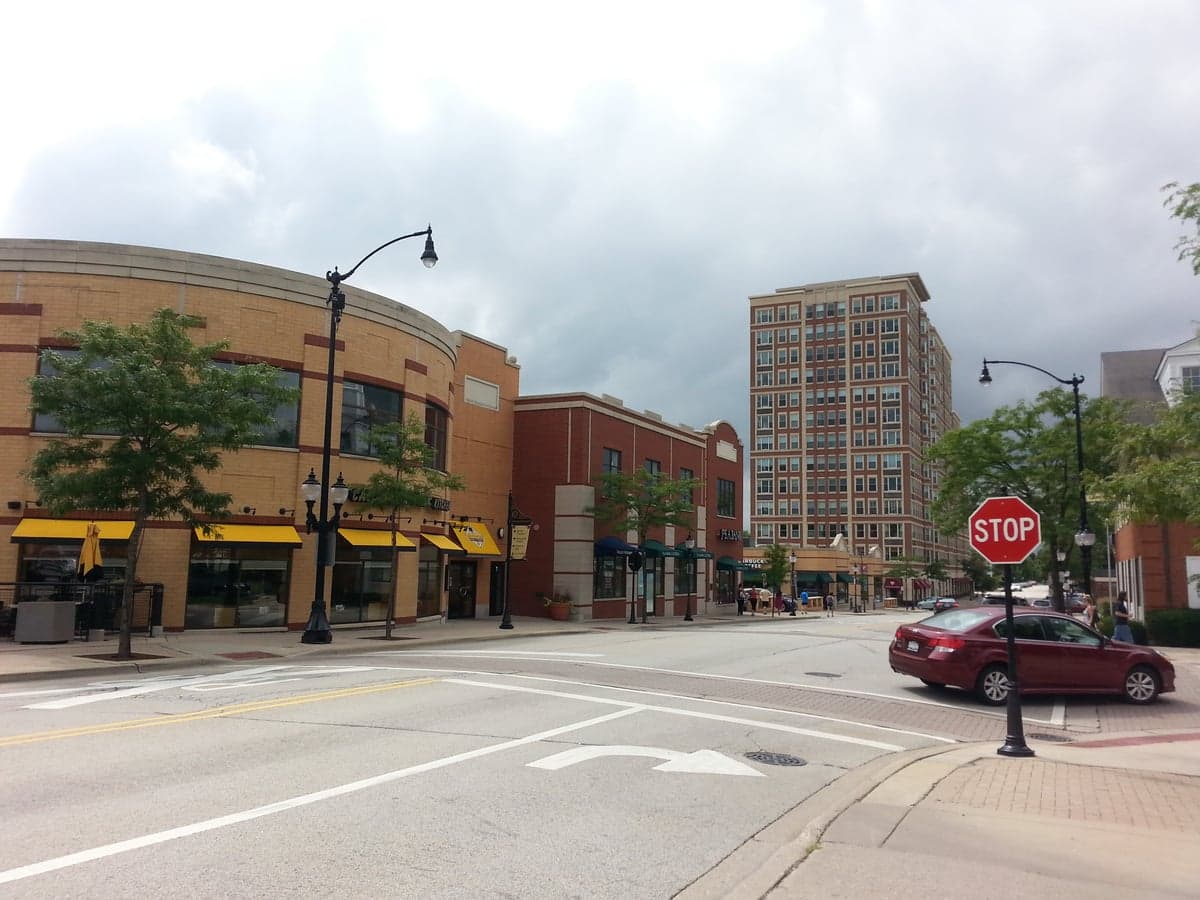
Photo: Wikipedia
Demographics of Arlington Heights, IL
Affluence Level in Arlington Heights, IL
An upper-middle-class area. Household wealth, education levels, and homeownership run ahead of national benchmarks.
People of Arlington Heights, IL
Arlington Heights, Illinois, is a predominantly white, highly educated suburb of 76,220 residents where 60.2% of adults hold a bachelor’s degree or higher, a figure well above the national average. The city is characterized by a stable, family-oriented population with a growing diversity driven by distinct East/Southeast Asian and Indian communities, each forming nearly 5% of the total. Its foreign-born population stands at 8.5%, reflecting a measured but steady influx of immigrants who have settled into specific neighborhoods rather than dispersing evenly. The city’s identity is rooted in its historic role as a railroad town and its evolution into a prosperous, middle-to-upper-middle-class suburb with a strong sense of local tradition.
How the city was settled and grew
Arlington Heights was originally settled in the 1830s by Yankee and German farmers drawn to the fertile prairie land of northern Cook County. The arrival of the Chicago & North Western Railway in 1854 transformed the small farming hamlet into a commuter suburb, attracting a wave of German and Irish immigrants who built the railroad and worked in the new brickyards and creameries. These early European settlers concentrated in the downtown historic district around Vail Avenue and the Arlington Heights Road corridor, where many of the original frame houses and brick storefronts still stand. By the early 1900s, Swedish and Polish families joined the mix, establishing St. Peter Lutheran Church and St. James Catholic Church as community anchors. The population grew steadily through the 1920s, reaching about 5,000, and remained overwhelmingly white and European-heritage through the mid-20th century.
Modern era (post-1965)
The post-1965 immigration reforms and the expansion of the Chicago-area economy reshaped Arlington Heights’ population in subtle but significant ways. The city’s white population, which was over 98% in 1970, has gradually declined to 74.6% today, while Hispanic residents now make up 9.6% and Black residents 2.9%. The most notable modern shift has been the arrival of East/Southeast Asian and Indian families, each accounting for roughly 4.9% and 4.7% of the population, respectively. These groups have clustered in distinct areas: East/Southeast Asian households, many of Chinese and Korean origin, are concentrated in the Northwest Arlington Heights neighborhoods near Palatine Road and the Greenbrier subdivision, drawn by top-rated schools like Thomas Middle School and John Hersey High School. Indian families, many working in technology and healthcare, have settled heavily in the South Arlington Heights area around Central Road and the Windsor Park neighborhood, where newer single-family homes and proximity to the Arlington Park Metra station are key draws. Hispanic residents, primarily of Mexican heritage, are more dispersed but have a visible presence in the East Arlington Heights area near the Chicago border, where older, more affordable housing stock exists. These enclaves are not isolated but reflect the city’s pattern of attracting professionals who prioritize school quality and commute times.
The future
Arlington Heights’ population is likely to continue its gradual diversification, though the pace will remain moderate compared to closer-in suburbs. The white share is projected to decline further, possibly to around 68-70% by 2040, as older residents age in place and younger, more diverse families move in. The East/Southeast Asian and Indian communities are expected to grow, driven by the city’s reputation for excellent schools and safe neighborhoods, but they are unlikely to become majority in any single census tract. The Hispanic population is growing slowly, primarily through natural increase rather than new immigration, and is assimilating into the broader suburban fabric. The city is not tribalizing into sharply divided enclaves; rather, it is experiencing a gentle homogenization of lifestyle across groups, with all major ethnicities participating in the same schools, parks, and civic events. The planned redevelopment of the former Arlington Park racetrack site into a mixed-use district could attract a younger, more transient population, but the core demographic will remain family-oriented and property-tax-conscious.
For a conservative-leaning individual or parent considering a move, Arlington Heights offers a stable, high-opportunity environment where demographic change is gradual and community cohesion remains strong. The city is becoming more diverse without losing its essential character as a safe, well-run suburb with excellent schools and a low crime rate. New residents will find a place where traditional values of homeownership, education, and civic engagement are shared across an increasingly varied population.

* Values derived from national, state, county, city and local statistics and may differ in a specific area. Last updated: 2026-04-24T16:44:11.000Z
Narrative content on this page is AI-generated and may contain mistakes. Verify any details that matter before acting on them.
ReloMaps may earn a commission from affiliate links at no extra cost to you.

